FUE Eyebrow Hair Transplant: The Micrografting Skill Gap
Introduction: The Hidden Skill Gap in Eyebrow Hair Transplantation
Most clinic websites present eyebrow FUE as a smaller version of scalp FUE. They use the same language, the same before-and-after galleries, and the same promises of “natural, undetectable results.” The procedure is framed as fewer grafts in a smaller area.
That framing leaves out what matters most. Eyebrow restoration is a separate surgical discipline. It is closer to ultra-refined micrografting than to true follicular unit transplantation, and it requires a different set of skills.
This article covers five technical proof points that show the difference:
- Stereo-microscopic single-hair dissection
- Shallow angulation (10 to 15 degrees versus 30 to 45 degrees for scalp hair)
- Herringbone placement mapping
- Curl and caliber donor matching
- A documented case in which mismatched curl produced an unnatural result
The stakes are high. Eyebrows are among the most closely observed features of the face. They frame the eyes, convey expression, and shape how others read emotion. A poor result is hard to hide and hard to reverse. For that reason, patients researching this procedure need a technical way to evaluate surgeons, not only a set of photos or a list of clinics.
Why Eyebrow Restoration Isn’t “Mini Scalp FUE”
The difference starts with biology. Scalp hair grows in natural groupings called follicular units, each containing 1 to 4 hairs. Follicular Unit Transplantation, whether harvested by strip (FUT) or by individual extraction (FUE), is designed to keep those natural groupings intact and move them to a new location.
Eyebrow hair grows differently. Eyebrow hairs grow as single-hair units. A multi-hair graft taken from the scalp therefore cannot be placed in the brow as it is. It must first be divided under magnification into individual follicles. For this reason, an eyebrow transplant is technically not true Follicular Unit Transplantation. It is an ultra-refined form of micrografting.
The field also has its own history. Eyebrow and eyelash reconstruction has been recognized as a distinct surgical subfield for close to a century:
- 1917: Knapp transplanted free graft strips from the eyebrow to the eyelid border.
- 1929: Sasagawa used a specially designed needle to implant human hair into the subcutaneous tissue of the eyebrow.
- 1953: Fujita developed punctiform insertions using an injection needle.
This distinction has practical consequences. A surgeon trained mainly in high-volume scalp FUE has learned to work efficiently with multi-hair units at scalp angles across large areas. Eyebrow work requires different dissection technique, different angulation, and a stronger sense of facial design. Strong scalp results do not guarantee strong brow results.
Five Technical Proof Points That Separate Eyebrow Restoration From Scalp FUE
The following clinical details separate skilled eyebrow micrografting from generic FUE technique. Each one is specific and can be verified, which makes each one useful to ask about during a consultation.
Stereo-Microscopic Single-Hair Dissection
Natural brow hairs are single units, so each graft must be divided under a stereo-microscope into individual follicles before implantation. This step is easy to overlook, and it is one of the most delicate parts of the procedure.
Standard scalp graft preparation aims to preserve the follicular unit with its surrounding tissue. Eyebrow preparation aims to divide that unit without injuring any of the follicles in it. The hair bulb and the surrounding structures that support growth are small and easily damaged. A careless cut can transect a follicle or damage the bulb, and the result is a graft that does not grow, which directly affects the clinic’s overall graft survival rate.
Precision at this stage affects more than appearance. It decides whether the hairs grow at all. A brow procedure involves relatively few grafts, so each damaged follicle is a noticeable loss in the final result.
Angulation Precision: 10-15° vs. 30-45°
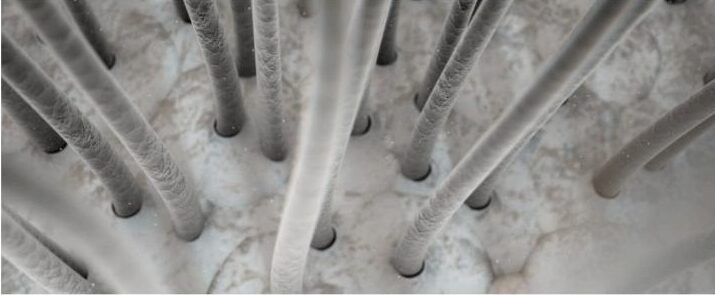
Natural eyebrow hairs leave the skin at about 10 to 15 degrees. Scalp hair grows at roughly 30 to 45 degrees. That difference has a large effect on surgical technique.
Recipient sites for the brow must be made at a much flatter angle, almost parallel to the skin. Creating one shallow site is not difficult. Creating hundreds of them consistently, while the angle also changes gradually across the brow, takes real control and experience.
Incorrect angulation is one of the most common reasons eyebrow transplants look transplanted. When grafts are placed too steeply, the hairs stand up or stick out instead of lying flat. Even with good density and shape, hairs that point outward will look wrong in conversation, in photos, and in a mirror.
Herringbone Placement Mapping and Brow Architecture
Eyebrow hair does not all grow in one direction. Its pattern changes along the length of the brow:
- Medial brow (the head, near the nose): hairs grow upward and slightly outward.
- Central body: hairs grow more horizontally.
- Lateral tail: hairs grow downward.
To reproduce this, skilled surgeons place grafts in a herringbone-like pattern, with upper and lower rows angled toward each other so the hairs meet and overlap the way natural brow hair does. Each graft’s direction is chosen individually.
This is a design and mapping skill as much as a technical one. It requires an understanding of facial symmetry, brow position relative to the eyes and bone structure, and gender-specific shape. Male brows are usually thicker and more horizontal. Female brows are usually more arched and taper toward the tail. A brow that suits one face may look out of place on another.
The two skills must also work together. Correct angles placed in the wrong design will still look artificial, and a good design placed at the wrong angles will look the same. Few providers explain architecture and angulation as one connected skill set, yet natural results depend on both.
Curl and Caliber Donor Matching
Eyebrow hair is finer than most scalp hair. Eyebrow transplantation therefore calls for thinner-caliber donor hair, which surgeons often take from specific scalp areas. Within the occipital donor region, hair is usually narrower at both temporal sides and in the lower occipital area than elsewhere.
This choice has lasting effects because of a principle called recipient dominance, which in practice means the transplanted hair keeps the traits of its origin. Scalp follicles moved to the eyebrows tend to keep the diameter of the donor area. Coarse scalp hair stays coarse in the brow, and curly scalp hair stays curly.
Surgeons must plan for this from the start. Harvesting from a standard FUE zone or strip without checking caliber and curl can produce hairs that will never match the patient’s native brow, however well they are angled and placed.
Case Study: When Curl Mismatch Creates an Unnatural Result
Clinical literature documents a clear example. A 30-year-old man with very thick, curly donor hair (at or above 90 micrometers in diameter) had eyebrow transplant surgery at another clinic using standard FUE methods. The result looked unnatural because the curl of the transplanted hairs did not match natural brow hair.
The hairs grew. The problem was that they grew as curly scalp hair, in a place where fine, straight hair would normally be.
This case is the article’s central warning. It shows that a promise of “natural results” means little without a donor selection protocol that accounts for curl and caliber. It is also the kind of result that generic scalp-FUE training does not prepare a surgeon to prevent, because in scalp work the donor hair’s character usually matches its new location.
Who Actually Needs Eyebrow Restoration
Eyebrow loss, known medically as madarosis, has many causes beyond over-plucking or regret over microblading. Clinical reviews describe causes in several categories:
- Autoimmune (such as alopecia areata)
- Endocrinologic (including thyroid disorders)
- Genetic
- Infectious
- Neoplastic
- Nutritional
- Traumatic (including trichotillomania and injury)
A careful medical evaluation matters because some of these causes need treatment before transplantation is considered, and some make a patient a poor candidate.
Scar-related eyebrow loss from burns, trauma, or earlier surgery is an especially complex group. Hair direction often has to change around scar tissue, and the surgeon must assess scar quality and weigh the desired density against the blood supply available at the recipient sites. Scar tissue cannot always support the graft density that healthy skin can.
Demand is rising. According to the ISHRS 2025 Practice Census, eyebrows are now the leading non-scalp recipient area for women, making up 12% of female transplant procedures after the scalp, a trend reflected in the growing interest in FUE hair transplant for women. Among men, eyebrow transplants made up 4% of non-scalp procedures in 2024, up from 2% in 2021, which is roughly a doubling.
Eyebrow patients also tend to be younger than scalp patients. Reported data show that about 52% are female, with an average age of 29, and more than 72% of female patients are between 25 and 45. Many of these patients will live with their transplanted brows for decades, which makes getting the result right especially important.
Readers who have experienced over-plucking, scarring, trichotillomania, or medically stabilized brow loss may be reasonable candidates. A qualified specialist can confirm candidacy.
Why Generic “Natural Results” Language Isn’t Enough
Most eyebrow transplant marketing follows the same pattern: many before-and-after photos, reassuring words such as “natural” and “undetectable,” and little explanation of how those results are achieved.
For a procedure this visible, that is not enough. A photo cannot show whether a surgeon dissects grafts consistently under a microscope, keeps shallow angles across every site, or has a protocol for matching curl. Lighting, angle, brow makeup, and timing can all make a photo look better than the result does in daily life, which is why learning how to evaluate before-and-after photos critically matters.
Patients get more useful information by asking about technique. Helpful consultation questions include:
- How are grafts dissected for single-hair placement? Is a stereo-microscope used, and who does the dissection?
- What angle protocol is used for eyebrow recipient sites? How does the angle change between the head, body, and tail of the brow?
- How is donor hair chosen to match the caliber and curl of the natural brow hair? Which donor areas are used, and why?
- How is the brow designed? How are facial symmetry and gender-specific shape considered?
- How many eyebrow procedures has the surgeon done? Can they show results at full maturity, not only soon after surgery?
These questions move the comparison away from marketing claims and toward documented technique and credentials.
The Credibility Standard: What to Look for in an Eyebrow FUE Surgeon
Because eyebrow restoration is its own discipline, checking credentials should go beyond general board certification in hair transplantation. Patients should look for evidence that a surgeon contributes to the field and keeps learning, a theme covered in more depth in guidance on how to choose the right surgeon.
Involvement in the International Society of Hair Restoration Surgery (ISHRS) is a meaningful sign, especially leadership roles, published research, and regular participation in international education and recognition. These activities mean a surgeon’s methods are examined by peers.
Dr. Sharon Keene of Hair Transplant Specialists in Eagan, Minnesota, is an example of this kind of documented expertise. She served as President of the ISHRS from 2014 to 2015, received the ISHRS Platinum Follicle Award for research, and has published work on FUE techniques and safe excision limits. Her record also includes international workshops in Buenos Aires, Bangkok, Prague, and Cancun, and an award for inventing a multibladed recipient site scalpel. These are records patients can check, not general claims of trust.
Hair Transplant Specialists also uses a named, defined technique: Microprecision Follicular Grafting®. The approach is built on natural follicular groupings and carefully designed transition zones meant to avoid a “pluggy” or “clumpy” appearance. That focus on precise, natural graft placement is the same principle that eyebrow micrografting depends on.
A named technique with a track record gives patients something specific to ask about. They can ask how it works, how it applies to their case, and what results it has produced. That is more useful than generic assurances.
What to Expect After Eyebrow Micrografting
Recovery follows a predictable pattern, though some stages can be worrying if patients do not expect them.
- Weeks two to six: shedding. The hair shafts of nearly all transplanted grafts fall out. It can look like the procedure failed, but it has not. The follicles stay in place below the skin and enter a resting phase.
- Around month three: regrowth begins. New hairs start to appear, often fine at first.
- Around one year: final density. The brows reach their mature thickness and appearance.
There is also a long-term requirement that surprises many patients. Because the follicles come from the scalp, transplanted brow hairs keep growing at scalp-hair speed, about a centimeter a month. They need trimming every one to two weeks for life. Most patients find this easy to manage, but it should be part of the decision.
Technique matters here as well. Precise angulation and herringbone placement decide how the brows look as they grow and after each trim. Hairs placed flat and in the right direction lie down naturally. Hairs placed at steep or inconsistent angles show the problem more clearly as they lengthen.
Conclusion: Treat Eyebrow FUE as the Specialized Procedure It Is
Eyebrow restoration requires single-hair microscopic dissection, angles of 10 to 15 degrees, herringbone directional mapping, and deliberate curl and caliber matching. Together these place it closer to micrografting artistry than to standard scalp FUE.
The documented curl-mismatch case shows what happens when this is ignored: grafts that grew, in a result that still looked unnatural. Patients can use the consultation questions and credential standards in this article to evaluate any provider before booking. The standard to expect is a surgeon with eyebrow-specific experience, published research, and a named technique protocol, such as the ISHRS-recognized background of Dr. Keene and the Microprecision Follicular Grafting® approach at Hair Transplant Specialists.
Ready to Explore Eyebrow Restoration? Start With an Expert Consultation
Patients considering eyebrow micrografting can schedule a consultation with Hair Transplant Specialists to discuss candidacy with a team that includes ISHRS leadership experience. Each consultation includes a personal review of brow architecture, an assessment of donor hair caliber and curl, and technique planning for the individual case.
Hair Transplant Specialists
2121 Cliff Dr. Suite 210, Eagan, MN 55122
Phone: (651) 393-5399 or (651) 395-5366
Website: INeedMoreHair.com
Office Hours: Monday to Thursday, 9:00 AM to 5:00 PM; Friday, 9:00 AM to 3:00 PM; Saturday and Sunday by appointment.
Eyebrows are highly visible and leave little room for error, so the decision deserves careful research. Asking the right questions and choosing a surgeon with documented expertise gives patients the best chance of a natural, lasting result.