Stem Cell Therapy for Hair Loss Exosomes: The FDA Status & Clinical Evidence Report 2026
The promise of regenerative medicine has arrived at the doorstep of hair restoration, and exosome therapy stands at the center of this transformation. Clinical studies now demonstrate hair density increases of 9.5 to 35 hairs per square centimeter, with some research showing density improvements from 96.5 to 163.5 hairs per square centimeter in just six weeks. Yet despite these compelling numbers, not a single exosome product has received FDA approval for hair loss treatment as of January 2026.
This report presents neither a sales pitch nor a dismissal of this emerging therapy. Instead, it offers an informed decision framework that examines both the compelling clinical evidence and the critical regulatory gaps that patients must understand. Legitimate research shows measurable results, while regulatory oversight remains conspicuously absent. Patients navigating this landscape deserve complete transparency about both realities.
Hair Transplant Specialists approaches this topic with a commitment to patient education over marketing hype—a necessity in a field increasingly saturated with unsubstantiated claims. The following sections examine FDA status, clinical evidence, treatment protocols, costs, safety profiles, and how exosomes compare to established treatments.
Understanding Exosome Therapy: The Science Behind the Treatment
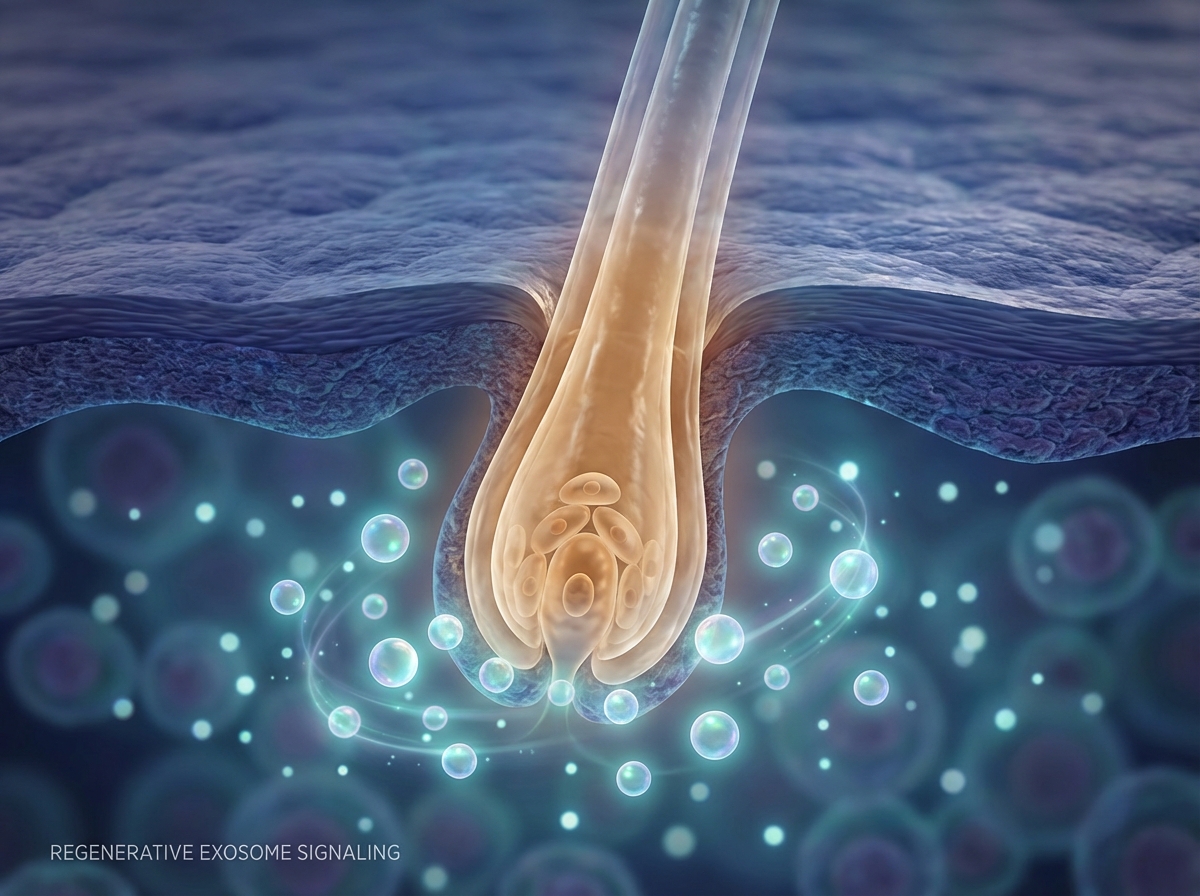
Exosomes are nano-sized extracellular vesicles measuring between 30 and 150 nanometers—roughly one thousand times smaller than a human hair’s diameter. These microscopic packages function as cellular messengers, carrying proteins, growth factors, lipids, mRNA, and microRNA between cells throughout the body.
The mechanism of action for hair regeneration involves multiple pathways. Exosomes stimulate hair follicle stem cells, activate dermal papilla cells (the command centers of hair follicles), promote angiogenesis (new blood vessel formation), and modulate key signaling pathways including Wnt/β-catenin, VEGF, and TGF-β. This biological cascade effectively moves hair follicles from their resting telogen phase into the active growth anagen phase.
Exosome sources vary considerably across the industry. Most commonly, they derive from mesenchymal stem cells harvested from adipose tissue, placenta, umbilical cord, bone marrow, foreskin, or hair follicles themselves. Some products utilize plant extracts, including rose stem cells. Research indicates different sources demonstrate varying efficacy levels, making the specific product composition a critical consideration for prospective patients.
The FDA Regulatory Status: What Patients Must Know in 2026
The regulatory landscape surrounding exosome therapy requires clear understanding: as of January 2026, no exosome products have received FDA approval for hair loss treatment or any therapeutic application. The FDA classifies exosomes as biological drugs requiring premarket approval under federal regulations.
Enforcement actions have escalated in recent years. The FDA has issued multiple warning letters throughout 2024 and 2025 to companies marketing unapproved exosome products. The agency’s public safety notification explicitly warns consumers about clinics operating outside federal regulations.
The American Hair Loss Association reinforced these concerns in April 2025, stating it does not endorse exosome use outside legitimate clinical trials. The organization characterized much of the current marketing as opportunistic, capitalizing on patient desperation without adequate scientific foundation.
For patients, this regulatory status means treatments remain available but operate in a gray zone without the safety oversight and efficacy validation that FDA approval provides. This assessment does not condemn the underlying science but establishes a transparency requirement—patients should understand they are receiving an investigational treatment.
The Clinical Evidence: What the Research Actually Shows
Despite regulatory gaps, the clinical evidence base has grown substantially. A systematic review of 11 clinical studies published in September 2025 demonstrated that MSC-derived exosomes increased hair density by 9.5 to 35 hairs per square centimeter and hair thickness by up to 13.01 micrometers.
One particularly striking study showed density increases from 96.5 to 163.5 hairs per square centimeter with statistical significance (p<0.0001) in just six weeks. Patient satisfaction data proves equally encouraging: 88.9% of male participants and 54.5% of female participants reported satisfied to extremely satisfied outcomes, with 11.1% to 24.2% increases in hair density over six months.
A prospective study of 30 male patients published in August 2024 examined foreskin-derived MSC exosomes, finding increased hair density with sustained patient satisfaction and no reported side effects. Comparative research has positioned exosomes favorably against alternatives, with one systematic review finding exosome therapy shows the most promising results versus PRP and minoxidil.
Case reports have documented successful treatment of challenging conditions including alopecia areata, with complete regrowth and natural color restoration following treatment protocols.
Research Limitations and Evidence Gaps
Transparency demands acknowledgment of significant limitations in current evidence. Studies to date involve small sample sizes—approximately 125 total patients across reviewed research. Heterogeneity in study designs, short follow-up periods, and absence of large-scale randomized controlled trials with long-term data (five or more years) limit definitive conclusions.
Standardized protocols remain elusive, with variability in exosome sources, concentrations, delivery methods, and treatment schedules across studies. While early evidence demonstrates promise, the field remains in relative infancy with uncertainties about optimal treatment approaches. These limitations inform decision-making rather than dismissing the treatment’s potential.
Safety Profile and Side Effects: The Current Evidence
The safety data for hair loss applications appears favorable within studied populations. Review of 125 patients receiving exosome treatment for hair loss showed rare side effects. Common mild effects include temporary redness, swelling, and injection site discomfort typically lasting 12 to 24 hours.
However, a critical counterpoint emerges from broader dermatology applications. A PubMed review from April 2025 noted at least 10 serious adverse events associated with exosome use across dermatological treatments. This creates a safety paradox: hair loss applications demonstrate an excellent safety profile in limited studies, while broader exosome use has raised legitimate concerns.
Without FDA oversight and long-term data, the complete safety picture remains incomplete. The importance of provider expertise, sterile technique, and proper sourcing of exosome products cannot be overstated.
Treatment Protocols and What to Expect
Standard treatment regimens involve three to four initial sessions spaced three to four weeks apart, constituting an initial phase of approximately three to four months. Maintenance treatments follow every six to twelve months to sustain results. Individual sessions typically last 30 to 60 minutes.
Application methods include microneedling, intradermal injections, or electroporation. Some protocols combine exosome delivery with ultrasound, laser therapy, or PRP for enhanced penetration and results. Northwestern Medicine dermatologists recommend one session monthly for four months as a baseline protocol.
Patients should expect early improvements—particularly reduced shedding—within two to eight weeks. Visible regrowth typically appears at three to four months, with full results developing between six and twelve months post-treatment. Maintenance treatments remain necessary to sustain improvements; this is not a one-time permanent solution.
Cost Analysis: Investment and Value Considerations
Exosome therapy costs range from $1,500 to $15,000 per session depending on location, clinic reputation, and exosome source. Most patients in the United States pay between $2,500 and $6,000 per session, with total treatment packages ranging from $3,000 to $10,000. Northwestern Medicine reports their protocol costs $600 to $800 per session.
Cost factors include geographic location, provider credentials, exosome source and quality, and number of sessions included in treatment packages. Compared to alternatives, exosome therapy costs more per session than PRP but requires fewer total sessions. It costs less than hair transplant surgery but requires ongoing maintenance.
International clinics, particularly in Turkey, offer costs 70 to 80 percent lower than United States pricing. However, patients must carefully vet quality and credentials when considering medical tourism options. Most treatments are not covered by insurance as they are considered both cosmetic and investigational.
Exosomes vs. Established Treatments: A Comparative Analysis
Positioning exosome therapy within the broader treatment landscape requires comparison across multiple options. Evidence suggests exosomes may outperform PRP, with case series showing significant improvement after a single exosome session versus five to six PRP sessions required for comparable results.
Systematic reviews find exosomes show the most promising results, followed by PRP with moderate benefits, while minoxidil remains most accessible but demonstrates limited effectiveness. Finasteride, with 85% or greater stabilization after five years, and minoxidil remain the only FDA-approved medical treatments for hair loss.
Hair transplant surgery—including techniques like the proprietary Microprecision Follicular Grafting® offered by Hair Transplant Specialists—represents the gold standard for permanent restoration. However, surgery does not prevent further loss in untreated areas, making combination approaches increasingly common.
Ideal Candidates: Who Benefits Most from Exosome Therapy
The best candidates for exosome therapy include those with early to moderate androgenetic alopecia (male or female pattern baldness) and non-scarring alopecias including alopecia areata and telogen effluvium.
Early intervention matters significantly because exosomes work by reactivating dormant follicles rather than creating new ones. Treatment proves most effective when follicles remain viable. Poor candidates include those with advanced hair loss featuring completely dormant follicles or scarring alopecia where follicles are permanently destroyed.
Studies reveal gender differences in satisfaction rates: 88.9% of males versus 54.5% of females report satisfaction, though both groups demonstrate measurable benefits. Realistic expectations remain essential—exosomes can improve density and thickness but may not restore a full juvenile hairline.
Combination Therapy Approaches: Maximizing Results
Sophisticated treatment protocols increasingly position exosomes within comprehensive strategies rather than as standalone solutions. Exosomes are often combined with PRP, minoxidil, finasteride, microneedling, or low-level laser therapy for synergistic effects.
Different treatments complement each other through distinct mechanisms: finasteride blocks DHT to prevent further loss, minoxidil stimulates growth, exosomes regenerate follicles, and PRP provides additional growth factors. Some protocols combine exosomes with ultrasound or laser for enhanced penetration.
Comprehensive treatment plans consistently show better long-term success than monotherapy approaches. Maintenance medications may remain necessary even with successful exosome treatment to preserve results over time.
Choosing a Provider: Critical Considerations for Patient Safety
Given the regulatory gap, provider selection becomes paramount. Patients should seek board-certified dermatologists or hair restoration specialists with specific training in regenerative medicine. Providers should clearly disclose FDA status, exosome source, treatment protocols, and realistic expectations.
Red flags include providers making guarantee claims, refusing to disclose exosome sources, offering prices far below market rates, or lacking proper medical credentials. Essential questions include: What is the source of the exosomes? How are they processed and stored? What are the complication rates? Can references from treated patients be provided?
Hair Transplant Specialists emphasizes these same principles in their educational content, warning patients about risks associated with unqualified practitioners—particularly in medical tourism contexts. Without FDA oversight, patient due diligence becomes even more critical.
The Future of Exosome Therapy: What’s on the Horizon
Larger randomized controlled trials are currently in development, along with long-term follow-up studies and standardization efforts. As evidence accumulates and protocols standardize, a regulatory approval pathway becomes more feasible.
Emerging technologies include improved exosome isolation techniques, targeted delivery methods, and combination formulations. Research remains in relative infancy, but the trajectory appears promising. Standardization of protocols and exosome sources will prove critical for clinical translation.
The next three to five years will likely prove pivotal in determining whether exosomes become mainstream treatment or remain a niche option.
Conclusion: Making an Informed Decision About Exosome Therapy
The evidence presents a dual reality: compelling clinical data showing 9.5 to 35 hairs per square centimeter increases and high patient satisfaction exists alongside significant regulatory gaps including no FDA approval and limited long-term data. This represents evidence-based promise with important caveats rather than simple hope versus hype.
Informed patients can make appropriate decisions when armed with complete information about both benefits and limitations. Exosomes represent a legitimate addition to the hair restoration toolkit, particularly for good candidates who understand the investigational nature of treatment. Combination approaches with FDA-approved treatments may offer optimal outcomes.
Take the Next Step: Expert Consultation at Hair Transplant Specialists
For those considering their options, Hair Transplant Specialists offers comprehensive hair loss evaluations with board-certified specialists possessing over 100 combined years of experience. The practice’s commitment centers on evidence-based recommendations tailored to individual needs—not pushing any single treatment.
The full spectrum of options remains available, from FDA-approved medications and PRP to advanced regenerative therapies and surgical solutions including the proprietary Microprecision Follicular Grafting® technique. Transparent pricing with flexible financing options starting at $150 per month makes treatment accessible.
The state-of-the-art Eagan, Minnesota facility provides a luxury patient experience with comprehensive comfort amenities. Those ready to explore their options can schedule a consultation by calling (651) 393-5399 or visiting INeedMoreHair.com.
Whether considering exosome therapy, hair transplant surgery, or exploring all available options, the journey begins with a comprehensive evaluation from specialists who prioritize informed decisions over marketing pressure. The future of regenerative hair restoration holds genuine promise—patients deserve honest guidance through a landscape where clinical innovation has outpaced regulatory oversight.