Eyebrow Transplant Natural Results Women: The 5-Variable Placement Science Behind Brows That Look Like Yours
Introduction: When Your Brows No Longer Look Like You
Eyebrows do more than frame the face. They communicate identity, emotion, and expression in ways that few other facial features can match. When a woman loses her eyebrow hair, whether through decades of over-plucking, a medical condition like thyroid disease, or chemotherapy treatment, the impact extends far beyond cosmetics. It changes how she sees herself in the mirror and how she believes others perceive her.
Research confirms this emotional reality. In a recent study, 52% of women reported feeling worried about how other people perceived them after they started to lose eyebrow hair. This is not vanity. This is a legitimate concern about identity and self-presentation that deserves thoughtful solutions.
The internet offers countless before-and-after galleries showcasing eyebrow transplant results. What these galleries rarely explain is why some transplants look genuinely natural while others look obviously artificial. The difference is not luck. It is science.
This article breaks down the five biomechanical placement variables that determine whether an eyebrow transplant will produce brows that look like they belong on a patient’s face or brows that announce themselves as transplanted. It also addresses the medical questions women deserve honest answers to and helps readers identify whether this procedure is right for their specific situation.
Before diving into the science, it is worth distinguishing eyebrow transplants from alternatives like microblading and cosmetic tattoos. Transplants use a patient’s own hair follicles to create permanent, three-dimensional results with natural movement and texture. Microblading and tattoos are semi-permanent, two-dimensional solutions that cannot replicate the way real hair catches light and moves with expression.
Hair Transplant Specialists at INeedMoreHair.com brings decades of combined surgical experience to this specialized field. The practice’s board-certified surgeons and technicians with 15 to 18 years of experience understand that achieving natural-looking eyebrow results requires precision that goes far beyond simply placing grafts in skin.
Why Women Lose Eyebrow Hair: The Causes That Determine Candidacy
Understanding the cause of eyebrow loss is not merely academic. It directly affects whether a transplant will succeed, fail, or need to be delayed. A surgeon who skips this diagnostic step and rushes to schedule surgery is displaying a significant red flag.
Over-Plucking and Traction Alopecia: The Most Common Culprit
The most common cause of eyebrow thinning in women is a history of aggressive grooming. Repetitive root-pulling causes microscopic trauma to follicles over time. Eventually, this trauma creates scar tissue that permanently stops hair production, a condition called traction alopecia.
The reassuring news for women in this category is substantial. Because the hair loss is static rather than progressive, over-plucking patients are considered excellent transplant candidates. The follicle damage has stopped, and the recipient area is stable. Even if some follicles remain dormant rather than completely dead, a transplant fills in the gaps permanently.
Medical Conditions That Cause Eyebrow Loss: Why They Must Be Treated First
Several medical conditions can cause eyebrow loss, and each requires specific management before transplantation becomes appropriate.
Thyroid dysfunction is among the most common medical causes. Studies show alopecia is a symptom in approximately 50% of people with hyperthyroidism and 33% of those with hypothyroidism. With approximately 59 million Americans affected by thyroid problems, many undiagnosed, this represents a significant patient population. Thyroid levels must be fully stabilized before a transplant is considered.
Frontal fibrosing alopecia (FFA) presents a particular concern because eyebrow loss precedes scalp hair loss in approximately 39% of cases, making brow thinning an early diagnostic signal. Active FFA is a contraindication for transplantation because the autoimmune process would attack new grafts.
Alopecia areata involves the immune system attacking hair follicles. Active alopecia areata means the body may reject transplanted grafts. Surgery is only appropriate during extended remission.
Trichotillomania, the compulsive hair-pulling disorder, requires psychological treatment before surgical intervention is considered.
Chemotherapy-related loss typically resolves naturally. Most brows regrow after treatment ends. Transplantation is typically considered only if regrowth does not occur after 12 to 18 months.
Burns and scarring can be addressed with transplants, but scar tissue affects graft survival rates and requires specialized technique.
A responsible surgeon will request bloodwork, thyroid panels, and dermatological evaluation before scheduling surgery. This thorough approach is a sign of quality, not bureaucracy.
Eyebrow Transplant vs. Microblading vs. Tattoo: An Honest Comparison for Women
Women deserve a patient-first comparison of their options rather than content biased toward any single solution.
Microblading is semi-permanent, lasting 12 to 18 months. It requires no downtime and carries lower upfront cost. It works well for women with some existing brow hair who want enhanced definition. However, it fades, requires ongoing touch-ups, and cannot replicate the texture and movement of real hair.
Cosmetic tattoos last longer than microblading but remain two-dimensional. They can look artificial as they age, particularly as pigment shifts color over time. Like microblading, they offer no hair movement or texture.
Eyebrow transplants are permanent and use the patient’s own hair. They produce three-dimensional results with natural movement and texture. The trade-offs include surgical recovery time, a shock-loss phase, and 9 to 12 months before full results become visible.
For women with mild brow loss who simply want enhanced definition, microblading may suffice. For women whose follicles are permanently damaged, sparse, or absent, transplantation is the only permanent solution.
Notably, transplants can be performed over existing microblading or tattoo ink. Many patients seek transplants specifically to replace faded or unnatural-looking cosmetic work with real hair.
The 5-Variable Placement Science: Why Some Brows Look Natural and Others Don’t
Most clinics perform eyebrow transplants. The difference between natural and artificial results comes down to five precise, interrelated placement decisions made by the surgeon.
Variable 1: Graft Placement Angle
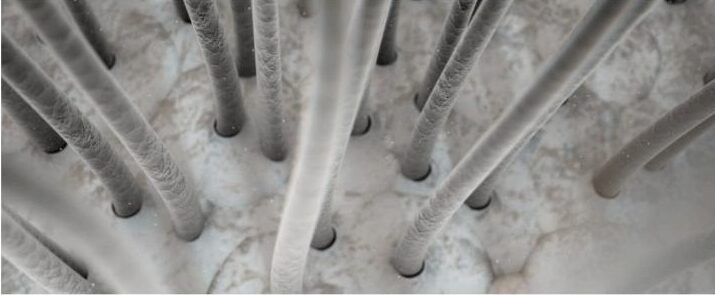
Eyebrow hairs grow nearly flat against the skin, unlike scalp hair, which exits at a much steeper angle. Grafts must be implanted at an extremely acute angle of 5 to 10 degrees, nearly parallel to the skin surface. Any steeper and the hair will protrude unnaturally, creating the telltale “transplanted” look.
This is technically demanding work. The surgeon must create recipient sites at this near-flat angle without damaging adjacent follicles or underlying structures.
DHI using a Choi Pen provides the most precise angle control and is considered the premium technique for eyebrow restoration. Sapphire blade FUE creates cleaner, more precise incisions than traditional steel blades, improving angle consistency and healing speed.
Variable 2: Hair Direction Zones
Eyebrow hair does not all grow in one direction. The brow is divided into anatomical zones, each with a distinct directional pattern.
At the medial (inner) brow head, hairs point upward. Across the body of the brow, hairs converge in a herringbone or fan-like pattern. At the tail, hairs angle outward and downward.
A surgeon who ignores these zones and places all grafts in the same direction will produce brows that look artificial regardless of how well the other variables are executed.
Mapping these directional zones before surgery and executing them graft by graft is one of the most time-intensive and skill-dependent aspects of the procedure. The collaborative design consultation, where the surgeon draws the proposed brow outline and the patient reviews it in a mirror before any incisions are made, is a trust-building step that quality clinics always include.
Variable 3: Follicle Unit Size
Scalp hair grows in natural groupings of 1 to 4 hairs per follicular unit. In scalp transplants, multi-hair units are used strategically for density. In eyebrow transplants, this approach fails completely.
Only single-hair follicular units should be used for eyebrow transplants. Double or multi-hair grafts create an unnatural, clumped appearance that immediately reads as transplanted.
This means the surgeon and technicians must carefully dissect grafts under magnification to isolate individual follicles. This labor-intensive step separates high-quality clinics from volume-focused operations.
Hair Transplant Specialists emphasizes this principle through their Microprecision Follicular Grafting® technique, which prioritizes naturalness as the benchmark by which all results are judged.
Variable 4: Density Calibration
More grafts does not mean better results. Exceeding the safe density threshold causes poor graft survival and can create an unnatural, over-stuffed appearance.
Research recommends no more than 30 to 35 follicular units per square centimeter. Exceeding this risks poor graft survival and overproduction of sebum from transplanted sebaceous glands.
Typical graft counts for female patients range from 200 to 300 grafts per eyebrow for full restoration, 100 to 200 for partial restoration, and up to 400 for complete reconstruction. The safe maximum is 400 to 500 grafts per eyebrow.
Density calibration also varies across the brow. The body of the brow is denser, while the head and tail are feathered with lower density to create a natural gradient.
Patients should understand that a single session may not achieve maximum desired density. A second session may be needed, and this is normal, not a failure.
Variable 5: Donor Hair Match
Hair from the back of the scalp (occipital region) is most commonly used because it is permanent and accessible. However, periauricular hair (from behind the ears) is gaining recognition as a superior donor source for women because it more closely matches the fine diameter of natural eyebrow hair.
An important reality stems from donor selection: because scalp hair retains its scalp growth cycle of 3 to 7 years, transplanted brow hairs will continue to grow indefinitely. This requires regular trimming, approximately monthly, unlike natural eyebrow hair, which has a short 4-month growth cycle and self-limits.
This is not a flaw but a known characteristic that patients must understand before surgery. Clinics that minimize this information contribute to post-procedure dissatisfaction.
AI-guided facial mapping represents a recent advancement that helps design brows proportional to each patient’s unique facial structure and ensures even, calibrated graft spacing.
Designing Brows That Look Like Yours: Female-Specific Anatomy Considerations
Eyebrow design for women is fundamentally different from men’s. Women’s brows are naturally more arched, and this gender-specific design principle must be built into every female restoration.
The facial mapping process calibrates arch height to the patient’s eye shape and brow bone. Brow length is matched to face width. Tail trajectory follows natural muscle flow. Thickness is tailored to the patient’s hair texture and facial proportions.
Ethnic hair considerations matter significantly. Hair curliness, diameter, and growth pattern vary across ethnicities and affect both donor selection and placement technique. A skilled surgeon accounts for these variables rather than applying a one-size-fits-all approach.
What to Expect: The Honest Recovery Timeline
Procedure day involves 3 to 5 hours under local anesthesia as an outpatient procedure. Patients are awake and relaxed throughout, often enjoying amenities like the 65-inch flat screen TVs and Sonos music system available at Hair Transplant Specialists’ state-of-the-art Eagan facility.
Days 1 to 3 bring mild swelling and redness around the brow area.
Days 4 to 7 involve scabbing around each graft site. Patients must not pick or rub the area.
Weeks 2 to 3 bring the shock loss phase. Transplanted hairs shed. This phase causes significant anxiety because it looks like the procedure failed. It has not. Shock loss is a normal physiological response as follicles enter a temporary resting phase before regenerating.
Months 3 to 4 see new hair beginning to emerge from transplanted follicles.
Months 9 to 12 reveal full density and final results. Over 90% of transplanted hairs survive and continue to grow naturally when the procedure is performed correctly.
Ongoing maintenance requires monthly trimming because scalp hair retains its long growth cycle. This is a permanent lifestyle adjustment.
Who Is (and Is Not) a Good Candidate
Good candidates include women with permanent follicle damage from over-plucking, women with stable medical conditions (thyroid disease in remission, alopecia areata in extended remission), chemotherapy patients whose brows have not regrown 12 to 18 months post-treatment, women seeking to replace faded cosmetic tattoos with real hair, and women seeking corrective procedures after a botched transplant elsewhere.
Women who are not currently candidates include those with active autoimmune disorders, uncontrolled thyroid disease, active alopecia areata or frontal fibrosing alopecia, scarring conditions that may impair graft survival, or insufficient donor site density.
A good surgeon will tell a patient when she is not ready for surgery. This is a sign of integrity, not rejection.
What Makes an Eyebrow Transplant Look Natural: The Surgeon Selection Checklist
Key questions to ask any surgeon include: Do you use single-hair follicular units exclusively for eyebrow work? What angle do you implant grafts at? How do you map directional zones? What is your density protocol? Do you offer DHI or sapphire blade FUE for eyebrow cases?
Red flags include surgeons who cannot explain graft angle science, clinics that promise maximum density in a single session without caveats, before-and-after galleries with no technical explanation, no pre-surgical medical evaluation, and unusually low pricing that may indicate a volume-over-precision approach.
Hair Transplant Specialists’ credentials include board-certified surgeons, Dr. Sharon Keene’s former ISHRS presidency (2014 to 2015), combined 100-plus years of team experience, and surgical technicians with 15 to 18 or more years of experience.
Understanding the Investment: Cost, Financing, and Long-Term Value
Eyebrow transplants in the US range from $3,000 to $8,000 in 2026, with specialized clinics in major markets charging up to $15,000. Overseas options in Turkey range from $1,000 to $3,500.
Lower prices often reflect lower standards. Overharvesting, unqualified practitioners, unsanitary conditions, and lack of post-operative care are documented risks. The cost of corrective surgery after a botched procedure frequently exceeds the original savings.
Hair Transplant Specialists offers flexible financing starting at approximately $150 per month, making the procedure accessible without requiring full upfront payment.
Conclusion: Natural Results Are Built on Science, Not Just Skill
The difference between eyebrow transplant results that look genuinely natural and those that look obviously transplanted comes down to five precise, interrelated placement variables: graft angle, hair direction zones, follicle unit size, density calibration, and donor hair match.
Losing eyebrows affects how a woman sees herself. Seeking a permanent, natural solution is a reasonable and well-supported decision. For women who are good candidates, the outcome is brows that look like their own.
Ready to See If an Eyebrow Transplant Is Right for You? Schedule Your Consultation
A consultation with Hair Transplant Specialists is a conversation, not a commitment. It is the appropriate first step to receive a personalized medical evaluation, honest candidacy assessment, and accurate cost estimate.
Contact Hair Transplant Specialists at (651) 393-5399 or visit INeedMoreHair.com. The practice is located at 2121 Cliff Dr. Suite 210, Eagan, MN 55122. Office hours are Monday through Thursday 9:00 AM to 5:00 PM, Friday 9:00 AM to 3:00 PM, with weekend appointments available by arrangement.
The journey to brows that look like your own starts with a single honest conversation.