Transplant Beard Surgery: The Zone-by-Zone Density Blueprint
Introduction: Why Most Beard Transplant Content Gets It Wrong
Most online content about beard transplants follows the same pattern: a summary of FUE basics, a cost table, and a generic growth timeline. The underlying assumption is that a beard transplant is simply a miniaturized scalp procedure with smaller graft counts.
That assumption is wrong. Beard transplantation is a distinct surgical discipline, governed by three things: zone-specific density grading, a precise graft angle specification, and density math recalibrated for facial anatomy. The International Society of Hair Restoration Surgery (ISHRS) states the principle directly: hairline and beard design is 80% art and 20% surgery. That ratio is the organizing idea of this article.
Precision matters more as the procedure grows in popularity. According to the ISHRS 2025 Practice Census, beard transplantation is now the number one non-scalp hair restoration procedure for men. It accounted for 5% of all male hair restoration surgeries in 2024, up from 4% in 2021, and it is projected to grow at roughly 28% year over year in 2026, the fastest rate in the field. More demand brings more providers, and quality varies widely among them.
This article covers three things:
- The density blueprint, explaining how each facial zone is planned differently
- The donor-source tradeoff, a lifetime planning question most clinic pages never raise
- How to evaluate a provider’s technical rigor before committing to surgery
Beard Transplantation Is Not a Scaled-Down Scalp Procedure
Scalp technique does not transfer to the face simply by using smaller numbers. Facial skin has different characteristics, beard hair grows at sharper and more variable angles, and the face is seen up close in conversation. Together, these factors create a design problem that is entirely separate from the scalp.
The Density Math: Why Two-Thirds of Scalp Density Still Looks Full
A peer-reviewed study of 580 patients in the Journal of Cutaneous and Aesthetic Surgery found mean hair density of 141.5 hairs/cm² on the scalp and 65.6 hairs/cm² in the beard. Once adjusted for follicular units, beard density is roughly two-thirds that of the scalp.
That gap changes the planning math:
- Native beard density averages 30 to 50 follicular units (FU) per cm².
- Transplant targets of 25 to 35 FU/cm² are enough to create a “density illusion” of natural fullness.
A surgeon who applies scalp-density assumptions to the face will get it wrong in one of two ways. Too few grafts leave the beard looking thin and see-through. Too many grafts waste donor supply and can look crowded and artificial. Graft calculations have to be done zone by zone, using facial benchmarks.
The 20° Graft Angle Specification
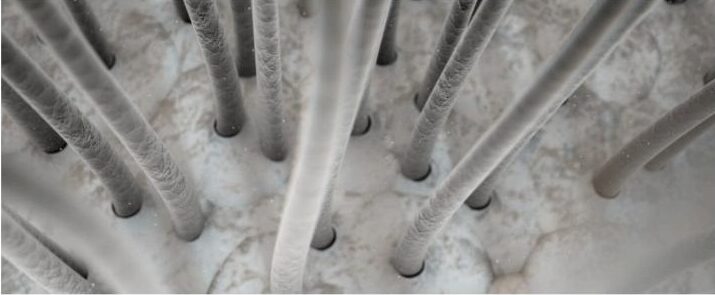
Beard hair grows at a shallow slope relative to the facial skin, approximately 20°. This is a clinical specification, not a matter of personal taste. A graft placed too steeply stands away from the face, and even with good density, the result looks unnatural.
For this reason, careful surgeons often keep donor hairs long during harvesting. Long hairs show clearly which way each follicle grows and at what angle, so the surgeon can confirm direction before implanting it.
Poor angle control is a major cause of the “pluggy” or synthetic look that patients fear most. Hair Transplant Specialists has built its scalp philosophy around avoiding that artificial appearance. The same discipline applies with even more force on the face, where every hair is visible at close range.
The ISHRS “80% Art, 20% Surgery” Standard
In practice, the ratio means accurate graft placement is the minimum requirement. The larger share of the outcome depends on artistic judgment:
- Facial symmetry
- Matching each patient’s native growth pattern
- Smooth transitions between zones
ISHRS framing describes zone mastery as “the dividing line between a hair restoration technician and a facial plastic surgeon.” The zone blueprint below puts this principle into practice.
The Zone-by-Zone Density Blueprint
The face is not one surface. It is made up of several distinct zones, and each has its own density target, angle behavior, and graft-type strategy. Treating the face as a single zone is the root cause of results that look manufactured.
Goatee and Cheek Beard: The Highest-Priority Zones
According to ISHRS data, the goatee and cheek beard are the highest-priority zones among patients, at 15.8% each. These are the areas people look at most during conversation, so they need the tightest control over density and angle.
Design considerations in these zones include:
- Blending into existing native hair so transplanted and natural follicles are indistinguishable
- Avoiding visible demarcation lines where transplanted density meets native density
- Following the curve of the jaw, where growth direction shifts gradually from chin to cheek
Mustache Zone: Density, Direction, and the Philtrum Boundary
The mustache needs tight graft spacing and careful directional planning, especially near the lip line and the philtrum (the vertical groove beneath the nose). Growth direction changes sharply near the midline: hairs on each side angle outward and downward, so the surgeon plans the angle graft by graft rather than placing every graft the same way. A mustache with uniform direction looks noticeably wrong, even to people who could not explain why.
Cheek and Sideburn Transition Zones: Where Design Reads as Natural or Artificial
Where the beard meets the sideburn and the upper cheek line, natural facial hair thins gradually. A good transplant reproduces that taper and lowers density step by step toward the edges.
Uniform density across all zones is the most common giveaway of a transplant. Natural beards are never equally dense everywhere, so a beard that is equally dense from sideburn to chin will look artificial.
Hair Transplant Specialists applies the same transitional-zone thinking to scalp hairline design, using a soft leading edge of single-hair grafts. The principle carries over to the face: soft edges and graduated density are what make the work look natural.
Applying Density Graduation Across the Full Facial Map
A well-planned beard design layers zones together:
- Highest density in the goatee, mustache, and central cheek beard
- Moderate density along the jawline and lower cheeks
- Tapered density at the sideburn junction and upper cheek borders
This graduated approach is what separates surgical artistry from a templated, one-size-fits-all procedure.
The Donor-Source Decision: Scalp Hair Now or Preserved for Later?
Few clinic pages address this question, yet a beard transplant is not only a procedural choice. It is a decision about a patient’s donor supply over a lifetime.
Why the Scalp Is the Default Donor Source
The ISHRS 2025 Practice Census reports that the scalp is the donor site in 91.7% of facial hair restoration cases. Beard-to-beard harvesting comes a distant second at 6.1%.
FUE (follicular unit extraction) is the dominant harvesting method. When beard hair is the donor source, FUE is the only viable option. When scalp hair is used, FUE gives the surgeon control over each individual graft, which matters greatly for precise facial placement.
Survival outcomes are favorable. Beard transplantation can achieve graft survival of 80 to 95% with experienced surgeons. One study found that beard grafts had the highest early survival rate (95%), compared with scalp (89%) and chest hair.
The Lifetime Donor-Supply Tradeoff
According to the ISHRS 2025 Census, 95% of first-time hair restoration patients are between 20 and 35 years old. Most beard patients therefore still face decades of possible male pattern baldness.
That creates a planning conflict:
- A full beard transplant can require 1,500 to 3,000 grafts, and up to 5,000 for full coverage.
- Those grafts come from a finite donor supply that the patient may need later for scalp restoration.
- The reverse also applies. In advanced scalp hair loss (Norwood 5 to 7), beard hair can itself serve as a donor source for the scalp.
Because the question runs both ways, the tradeoff should be mapped during a thorough consultation, not treated as an afterthought. Patients benefit from a surgeon who plans across a lifetime rather than one procedure at a time.
Candidacy: Who Is (and Isn’t) a Good Fit for Beard Transplantation
Candidacy depends more on donor supply and the cause of the hair loss than on how patchy the beard looks.
Correcting the Patchy Beard Myth
A patchy beard is usually inherited and is not a sign of low testosterone. Facial hair follicles respond to androgens differently from one region to another, which is why a man’s chin may grow thick while his cheeks stay thin. Knowing this helps patients come to a consultation with accurate expectations and without unnecessary worry.
Ruling Out Alopecia Barbae and Other Medical Causes
Alopecia areata barbae (AAB) is an autoimmune condition that causes beard hair loss. It accounts for roughly 28% of alopecia areata cases and often appears as smooth, round patches. Active autoimmune disease must be ruled out before surgery, because transplanting into an area where the disease is active risks graft failure.
Other causes worth screening for include:
- Tinea barbae, a fungal infection of the beard area
- Pseudofolliculitis barbae, chronic inflammation from ingrown hairs
Core Candidacy Criteria
Strong candidates generally have:
- Enough donor density in the scalp or body
- Stable overall health
- Realistic expectations about density and timeline
- An age of about 25 to 28 or older, so the natural beard pattern has settled before design decisions are made
Inside the Procedure: How Zone-Based Design Is Executed
On the day of surgery, the blueprint and the donor plan are put into practice.
Consultation and Facial Zone Mapping
A thorough consultation maps each zone separately (goatee, cheek beard, mustache, and sideburn transitions) and sets a density target for each. Donor planning is decided at this stage as well: whether to harvest from the scalp or the beard, and how today’s goals weigh against possible future scalp needs.
Graft Harvesting and Angle Verification
During FUE harvesting, individual follicular units are removed one at a time. Keeping donor hairs long lets the surgeon confirm direction and check the 20° angle before each graft is placed. Graft counts usually fall between 1,500 and 3,000, and can reach 5,000 for full coverage, depending on the zones being treated.
Placement by Zone, Not by Face
Experienced surgeons change three things from zone to zone:
- Graft type: single-hair grafts for borders and soft edges, multi-hair units where more density is needed
- Density: highest in the central zones, tapering toward the edges
- Angle and direction: adjusted to match how each area grows naturally
This zone-specific placement is the technical form of the “80% art” principle.
Recovery, Growth Timeline, and What to Expect
Recovery information supports the decision but is not the main factor in it. Patients still need clear expectations.
Shock Loss Is Normal, Not a Failure
Cleveland Clinic lists shock loss among the recognized risks of hair transplantation. It is a temporary shedding of transplanted hair and sometimes nearby native hair. It is an expected stage of recovery and does not mean the procedure has failed. The follicles stay in place and start producing new hair in the following months.
The Nine-Month Benchmark and Full Results Timeline
- Months 3 to 4: visible new growth begins
- Month 9: density reaches roughly 70 to 80% of the final result
- Months 9 to 12: full results become apparent
A 36-patient multicenter study reported 95.7% follicular unit survival and 100% patient satisfaction with cosmetic appearance at nine months, supporting this point as a reliable checkpoint for evaluating outcomes.
Risks, Credentialing, and Why Surgical Artistry Requires an Expert
If results depend on zone design, angle control, and density math, then the choice of provider matters as much as the procedure itself.
The Rising Risk of Unlicensed and Black-Market Providers
ISHRS data shows that 59.4% of member surgeons reported black-market clinics operating in their cities in 2024, up from 51% in 2021. Repair procedures now account for 6.9% of all hair transplants, up from 5.4% in 2021, and these are largely needed because of poor initial technique.
In beard work, template-driven procedures most often go wrong in the same places: a single density across the whole face, inconsistent angles, and hard edges. These are the details that make a transplant obvious.
What Credentialed Expertise Looks Like
Patients should look for board-certified surgeons with specific experience in facial hair restoration, not just a high volume of general FUE cases. Hair Transplant Specialists is one example of that standard:
- Dr. Sharon Keene, former President of the ISHRS and recipient of the society’s Platinum Follicle Award for research
- Over 100 years of combined experience across the team, supported by surgical technicians with 15 to 18+ years of experience
- Ongoing participation in international hair restoration research, workshops, and education
The practice’s proprietary, naturalness-focused technique was developed to avoid “pluggy” results on the scalp. Zone-specific beard design asks even more of that same philosophy.
Questions Worth Asking Before You Choose a Surgeon
- “How do you plan density for each zone of the face?” A strong answer describes different targets for each zone, not one number for the whole face.
- “How do you verify graft angle during harvesting and placement?”
- “How do you weigh my beard goals against future scalp donor needs?” This question is especially important for patients in their twenties and early thirties.
Conclusion: Precision Artistry, Not a Scaled-Down Scalp Procedure
A successful beard transplant depends on zone-specific density grading, strict angle control, and density math recalibrated for the face, not on a generic FUE template. The ISHRS “80% art, 20% surgery” standard is a useful way to judge any provider. Donor-source planning is a lifetime decision and deserves the same care as the facial design. Patients who understand these zones are better able to tell real surgical artistry apart from template-driven work.
Schedule a Zone-Specific Beard Transplant Consultation
Hair Transplant Specialists offers consultations that produce an individualized, zone-by-zone facial hair design plan. Patients can discuss donor-source strategy (scalp or beard, present or future needs) directly with surgeons experienced in both scalp and facial restoration. Consultations take place at the practice’s modern facility in Eagan, Minnesota, as part of its patient-centered approach to care.
Contact Hair Transplant Specialists:
- Phone: (651) 393-5399 or (651) 395-5366
- Address: 2121 Cliff Dr., Suite 210, Eagan, MN 55122
- Website: INeedMoreHair.com