Beard Hair Transplant: The Five-Zone Surgical Blueprint — Angulation, Density Mapping, and Why Facial Skin Changes Everything
Introduction: Why Most Beard Transplants Fall Short, and What the Best Ones Have in Common
Beard hair transplants have become one of the fastest-growing segments in non-scalp restoration. Yet a troubling statistic follows that growth: corrective and repair procedures now account for roughly 6.9% of all transplant cases. That figure is not an accident. It is the direct consequence of generalist providers applying scalp-derived protocols to a procedure that demands specialist thinking.
The central premise of this article is simple but consequential. A beard hair transplant is not a scaled-down scalp procedure. It is a fundamentally different surgical discipline, governed by unique anatomy, distinct follicle biology, and zone-specific placement logic that has no equivalent on the scalp.
To make sense of that discipline, this article uses two organizing frameworks. The first is the Five-Zone Surgical Blueprint: sideburns, cheek beard, mustache, goatee, and sub-jawline, each with its own angulation targets, density requirements, and graft composition rules. The second is the Four-Variable Placement Matrix: Angle, Direction, Depth, and Density Distribution, the clinical architecture that separates natural results from cosmetically obvious ones.
Beard and mustache transplants represent the single largest non-scalp restoration category for men, and demand is accelerating. That makes provider selection more consequential than ever. This article is written for men who have already decided they want the procedure and are now evaluating providers on clinical depth, not for those still asking what a beard transplant is.
The Biological Case for a Different Surgical Approach: Facial Skin Is Not Scalp Skin
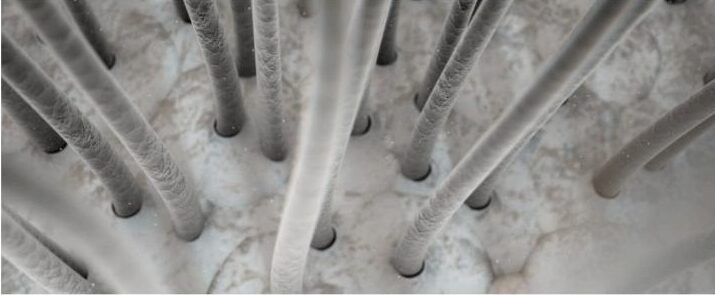
The foundational difference is angulation. Beard hair follicles emerge at roughly 10 to 30 degrees relative to the skin surface, dramatically shallower than scalp follicles, which grow nearly perpendicular. This single variable reshapes every downstream decision in surgical planning.
Facial skin mobility compounds the challenge. Unlike the relatively fixed scalp, facial skin shifts and stretches during extraction and implantation. Surgeons must continuously stabilize tissue by hand and re-map exit angles as the skin moves. This is also why robotic FUE systems, effective on the scalp, cannot currently perform reliable extraction or placement on facial donor sites.
Then there is the androgen paradox. The same hormonal environment that triggers scalp hair miniaturization actively supports beard density growth through the mid-30s. Androgens are the enemy of the scalp follicle and the ally of the beard follicle. This biological divergence is precisely why beard follicles behave so differently after transplantation.
Depth calibration is equally unforgiving. Incision depth in beard work must sit precisely at 3 to 4mm. Shallower incisions cause cobblestoning; deeper incisions risk scarring and poor graft survival. Few patients ever consider this variable, but the surgeon must master it.
Composition matters too. Scalp hair averages two or more hairs per follicular unit, while beard and mustache hair consists predominantly of single-hair units. Density planning must compensate for this structural reality to achieve visual fullness. Caliber differs as well: beard hair averages about 125 microns in diameter versus roughly 69 microns for scalp hair, nearly twice as thick, with nearly twice as many cuticle layers. That coarseness delivers visual density but demands careful caliber-matching in fine-texture zones.
Finally, there is the adaptation timeline patients are rarely told about. Scalp donor hair placed into the face initially grows straighter and finer than native beard hair. Over 12 to 24 months, the follicles adapt to the facial skin microenvironment and gradually develop characteristics more consistent with native beard growth.
Graft Survival in Beard Transplants: What the Clinical Data Actually Shows
The outcome data is encouraging. Peer-reviewed comparative research shows beard hair achieves a 95% one-year graft survival rate, surpassing scalp hair at 89% and chest hair at 76%, attributed partly to the shallower follicle depth of facial skin.
But 95% is not 100%, and the gap matters. At a typical volume of 1,500 to 2,500 grafts, a 5% variance translates into 75 to 125 grafts, more than enough to create visible patchiness in high-visibility zones like the mustache.
Patients must also understand shock loss. Anagen effluvium affects 60 to 80% of beard transplant patients, typically beginning 2 to 8 weeks post-procedure. The hair shafts shed, but the follicle roots remain intact. Visible regrowth begins at 3 to 4 months, with roughly 50 to 60% density at 6 months and final results between 9 and 18 months.
Crucially, survival rate and aesthetic outcome are not the same thing. High survival is necessary but not sufficient. Placement precision, meaning angle, direction, depth, and density distribution, determines whether surviving grafts produce a natural beard or a surgically obvious one.
To support healing and retention, PRP (platelet-rich plasma) therapy is now incorporated in roughly 42 to 51% of beard transplant procedures. Beyond aesthetics, the procedure also carries clinically significant value for scar concealment, including acne scars, burn scars, cleft lip repair scars, and trauma injuries.
The Four-Variable Placement Matrix: The Clinical Architecture of Natural Results
Every graft placement decision is governed by four variables: Angle, Direction, Depth, and Density Distribution.
The defining principle is that all four must be calibrated simultaneously, not sequentially. A graft placed at the correct angle but the wrong depth, or at the correct depth but the wrong direction, produces an unnatural result regardless of how well it survives.
This is why DHI (Direct Hair Implantation) using the Choi Implanter Pen has emerged as the 2026 gold standard for facial work. It combines angle, depth, and direction control into a single implantation step, collapsing the window for error. Conventional FUE, by contrast, creates recipient sites first and then places grafts, introducing a time gap and an extra handling step that increases desiccation risk and reduces directional precision in mobile facial skin.
The Matrix is never applied uniformly across the face. It is recalibrated zone by zone, which is the entire reason the Five-Zone Blueprint exists. Uniform angulation across all zones remains the most common aesthetic failure and the leading driver of corrective surgery.
The Five-Zone Surgical Blueprint: Zone-by-Zone Placement Protocols
This is the clinical core of the procedure, the breakdown that answers the question every serious patient should ask: how does a surgeon demonstrate genuine understanding of beard anatomy?
Zone 1: Sideburns — Transitional Density and the Scalp-to-Face Interface
The sideburn is the anatomical transition point between scalp and facial hair patterns. It requires a deliberate density gradient, not a hard boundary. Superior portions follow scalp-adjacent directional patterns while inferior portions transition toward cheek beard angulation, all within a small area. Because sideburn hair is typically finer than cheek hair, single-hair follicular units are preferred throughout, with careful caliber-matching to prevent visible texture discontinuity. Errors here produce a patchy appearance that styling cannot conceal.
Zone 2: Cheek Beard — Density Mapping Across the Largest Surface Area
The cheek beard covers the largest surface area of the five zones and therefore receives the highest graft-volume allocation in most full beard procedures. Natural cheek density is not uniform: it is denser near the jawline and sparser toward the cheekbone, and surgical density mapping must replicate that gradient. The cheek is also among the most mobile facial regions, forcing continuous manual stabilization and re-verification of exit angles. Procedures target 25 to 35 follicular units per cm², enough to create fullness through layering while staying within donor capacity. Because left-right asymmetry is most visible here, AI-assisted facial mapping is increasingly used by leading clinics in 2026 to design symmetrical, age-appropriate patterns based on individual bone structure.
Zone 3: Mustache — The Most Technically Demanding Zone
The mustache is the highest-precision zone. It occupies the most visually prominent position on the face, is examined at close range daily, and offers the least margin for error. The sagittal slit technique is used here, with incisions parallel to the lip vermillion border and grafts placed at extremely shallow angles of 10 to 15 degrees to achieve the characteristic downward drape. Clinical protocols reference density targets of 35 to 40 follicular units per cm², higher than the cheek, to compensate for single-hair composition. This zone demands the finest-caliber single-hair grafts available; coarser grafts create a wiry, unnatural texture. Placement relative to the philtrum columns must be precisely symmetric, as even minor deviations are visible in facial symmetry assessment.
Zone 4: Goatee — Angulation Convergence and the Chin Point
The goatee’s defining challenge is convergence. Hair from the left and right sides of the chin converges toward the chin point, requiring a precise angulation map that transitions from lateral to medial directions without creating a visible seam. The chin point is arguably the single most complex location in beard transplantation; grafts placed even slightly off-angle create a swirl or cowlick that styling cannot correct. The sub-labial area, just below the lower lip, requires upward-angled placement, a directional reversal from the downward chin beard that must occur within centimeters. Density is calibrated with higher concentration at the chin point and graduated reduction toward the outer borders for a natural fade.
Zone 5: Sub-Jawline — Depth Calibration and the Neck Transition
The sub-jawline sits at the transition between facial and neck skin, where follicle depth, skin thickness, and hair direction all change within a short distance. Neck skin is thinner and more lax, requiring adjusted incision depth to maintain the 3 to 4mm target; errors here are especially prone to cobblestoning. Hair naturally grows downward and slightly posteriorly, and that direction must be replicated to avoid a bristle appearance. This zone defines the lower boundary of the beard silhouette and the jaw-definition effect many patients cite as their primary motivation, yet it is frequently under-addressed, leaving beards that appear to float above the jawline.
Donor Supply Strategy: Preserving Options for the Long Term
Scalp donor hair is a finite, non-renewable resource. Every graft used for beard restoration is unavailable for future scalp restoration, a tradeoff the ISHRS explicitly warns must be discussed in pre-operative planning.
For smaller cases, generally fewer than 300 to 400 grafts, beard-to-beard harvesting from the sub-jawline or neck preserves scalp reserves entirely. This nuance is almost universally absent from generalist content. Regardless of source, a thorough assessment of existing scalp density, miniaturization patterns, and projected future loss is non-negotiable before allocating donor grafts.
Age and trajectory matter significantly. A 28-year-old with early-stage androgenetic alopecia and a 45-year-old with stable loss require fundamentally different allocation strategies, even with identical beard goals. For younger patients especially, planning around future hair loss is a non-negotiable part of responsible donor allocation. Ethnic variation matters too: Indian and Middle Eastern patients often have denser native beards and may need fewer grafts, while East Asian patients typically have lower native density and require higher counts and more precise density compensation. A minimum 8-month waiting period between procedures allows accurate assessment of integration before any additional session.
Why Generalist Providers and Medical Tourism Cannot Replicate This Approach
Providers whose primary expertise is scalp restoration tend to apply scalp-derived protocols to facial work: uniform angulation, standard FUE, and density targets calibrated for scalp skin. The biology documented above explains why this produces inferior outcomes.
Medical tourism introduces a structural follow-up problem. Beard outcomes unfold over 9 to 18 months, with shock loss, regrowth, and density evaluation requiring multiple post-operative touchpoints. Cross-border procedures eliminate the surgeon oversight that timeline demands. Patients considering out-of-state or international travel for hair restoration should weigh this follow-up gap carefully before committing.
Provider scarcity intensifies the risk. Roughly 44% of clinics globally face a shortage of experienced beard transplant professionals, meaning selection cannot rest on brand recognition or price. The surgeon’s specific experience with zone-by-zone protocols is the operative variable, and the consequence of ignoring this is visible in that 6.9% corrective surgery figure. AI-assisted facial mapping offers an advantage at leading specialist clinics, but the technology is only as good as the clinical expertise interpreting its outputs.
What to Evaluate When Selecting a Beard Transplant Surgeon
- Zone-specific protocol literacy: Can the surgeon articulate distinct angulation, density, and composition protocols for each of the five zones? Generic promises of “natural results” are insufficient.
- DHI vs. FUE decision rationale: Can they explain why they would choose one technique over the other for a specific zone? This tests genuine depth versus marketing language.
- Donor supply assessment: Does the consultation include scalp reserve evaluation, miniaturization mapping, and a frank discussion of beard-versus-scalp tradeoffs?
- Shock loss and timeline education: Do they proactively explain the 60 to 80% shock loss rate, 3 to 4 month regrowth onset, and 9 to 18 month full result timeline, or do they minimize them?
- Surgical team experience: The technicians preparing and placing grafts are as critical as the surgeon. Asking specifically about their facial hair experience is essential.
- Post-operative follow-up structure: What does follow-up look like at 1, 3, 6, and 12 months? A vague answer is a red flag.
- Board certification and ISHRS membership: These are baseline requirements, not differentiators, but their absence is disqualifying.
The Hair Transplant Specialists Approach to Beard Restoration
Hair Transplant Specialists operationalizes these principles through both experience and clinical discipline. The team brings a combined 100-plus years of practice, and its surgical technicians carry over 18 years of experience each, directly relevant to the technical demands described throughout this article.
Dr. Sharon Keene, former President of the ISHRS and recipient of the Platinum Follicle Award for outstanding achievement in basic scientific or clinically related research, anchors the practice to ISHRS-level standards, the same standards reflected in the zone-specific protocols above. Naturalness is a core value at the practice, which aligns precisely with the placement precision and density mapping that define the Five-Zone Blueprint.
The practice also emphasizes a comprehensive patient journey. Because beard outcomes require sustained follow-up over 9 to 18 months, that commitment to post-operative oversight matches the clinical timeline this procedure genuinely demands. Zone-specific work is executed through the proprietary Microprecision Follicular Grafting® framework, and PRP therapy is available as a graft survival support option, consistent with the 42 to 51% industry adoption rate.
Conclusion: The Difference Between a Beard and a Blueprint
A beard hair transplant is not a single procedure. It is five simultaneous, zone-specific surgical challenges, each governed by distinct angulation, density, depth, and directional requirements that emerge from the biological uniqueness of facial skin.
The Four-Variable Placement Matrix is the architecture that separates outcomes. Angle, direction, depth, and density distribution must be calibrated simultaneously, zone by zone, for a result to read as natural rather than surgical. The 95% one-year survival rate represents the biological potential of the procedure, but realizing that potential depends entirely on this precision.
The final result is not visible at 6 months, or even 9. The true endpoint is the 12 to 24 month adaptation period, during which scalp-derived grafts develop beard-like characteristics. That timeline requires a provider relationship built for the long term. For men who have decided this procedure is right for them, the remaining question is not what a beard transplant is. It is whether their chosen surgeon understands the five zones well enough to treat each one differently.
Ready to Evaluate Beard Restoration Options with a Specialist?
For those for whom the framework above resonates, the logical next step is a consultation built around it. Hair Transplant Specialists offers a zone-specific assessment of beard restoration goals, donor supply, and candidacy, the appropriate venue for the evaluation criteria outlined here, including protocol discussion, donor assessment, and follow-up structure.
The practice is located at 2121 Cliff Dr., Suite 210, in Eagan, Minnesota, with weekend appointments available by arrangement. To begin, call (651) 393-5399 or visit INeedMoreHair.com. It is the first step in a patient journey the practice is committed to leading, from consultation through the full adaptation timeline the result deserves.