Stem Cell Exosome Hair Loss Treatment 2026: What We Know — The Science, the FDA Reality, and Honest Expectations From a Clinic That Actually Offers It
Introduction: Why Most Exosome Content Fails Patients — and What This Article Does Differently
Search for “exosome hair loss treatment” online and two extremes dominate the results. On one side, clinic marketing pages promise miraculous regrowth with language borrowed from science fiction. On the other, skeptics dismiss the entire category as unproven snake oil. Neither position serves a real person trying to make a real decision about their own hair.
This article takes a different approach. It offers a clinician-level, evidence-based breakdown of what exosome therapy for hair loss actually is, what the science genuinely supports as of 2026, and what honest expectations look like. That means covering the molecular mechanisms, the FDA regulatory reality, a fair comparison with PRP, ideal candidate profiles, and how exosome therapy fits into a broader multi-modal protocol.
The stakes are high. Androgenetic alopecia affects an estimated 50 million men and 30 million women in the United States alone, creating an enormous population of people searching for options beyond minoxidil and finasteride. They deserve accuracy, not hype.
Hair Transplant Specialists (INeedMoreHair.com) writes from the position of a practice that actually offers this treatment. Led by board-certified surgeons including former International Society of Hair Restoration Surgery (ISHRS) President Dr. Sharon Keene, the clinic has a genuine clinical stake in getting the facts right. Throughout, this article cites peer-reviewed research, including 2025 and 2026 systematic reviews, so readers can verify every claim independently.
First, a Critical Distinction: Exosome Therapy Is Not Stem Cell Transplantation
The phrase “stem cell exosome therapy” gets used constantly, but it is technically imprecise, and the imprecision matters for both safety and expectations.
True stem cell transplantation involves introducing living mesenchymal stem cells (MSCs) into the body. That approach carries meaningful risks: immune rejection, unintended cell differentiation, and complex regulatory requirements.
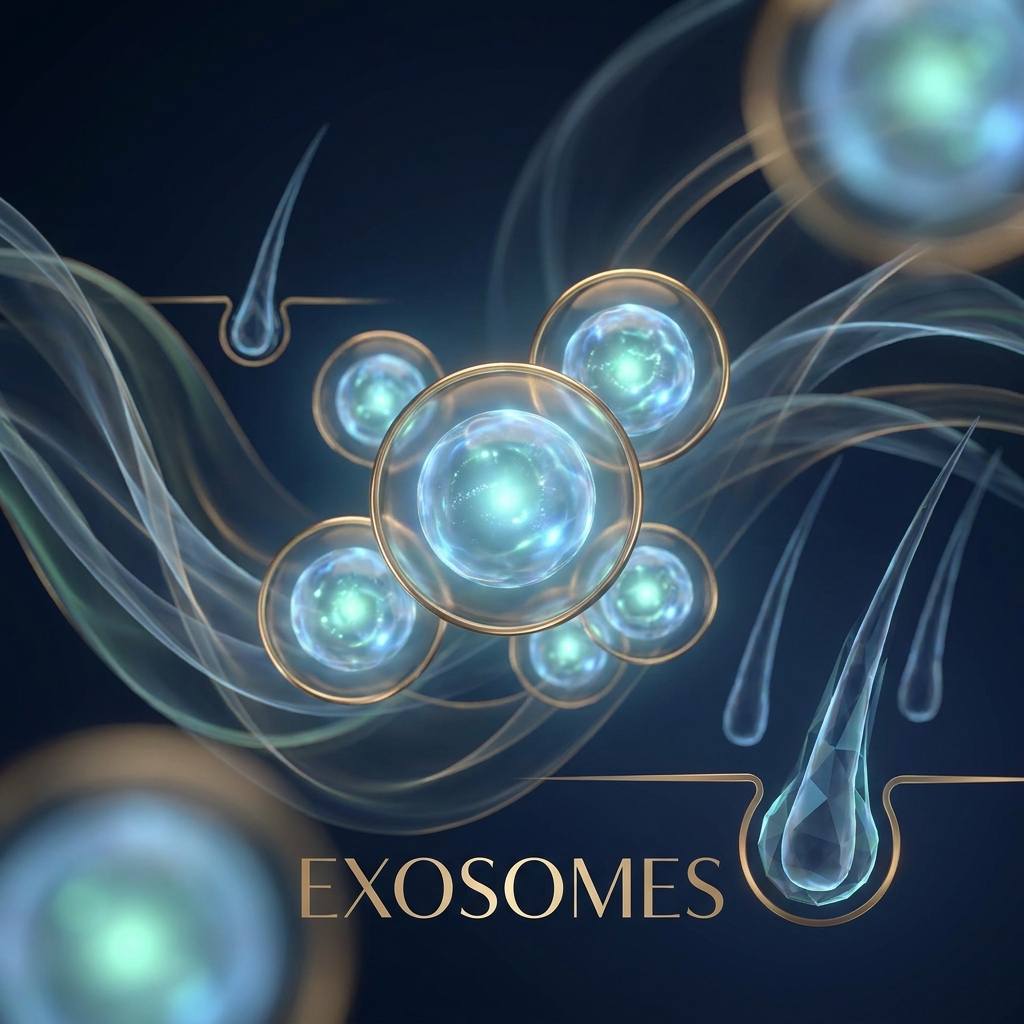
Exosome therapy is fundamentally different. It is a cell-free approach. Rather than transplanting living cells, it harnesses the paracrine signaling power of MSCs by delivering the extracellular vesicles those cells naturally secrete, without introducing any live cells at all.
Structurally, exosomes are tiny vesicles measuring roughly 30 to 200 nanometers. They carry bioactive cargo including proteins, lipids, mRNA, microRNA, and growth factors, functioning as biological messengers that deliver regenerative signals directly to hair follicle cells.
The cell-free nature is clinically significant. It reduces immune reaction risk, simplifies administration, and produces a more straightforward safety profile than live cell transplantation. This distinction is almost universally missed in competitor content, and the resulting confusion leads patients to either inflated or deflated expectations. For context, Japan’s Shiseido S-DSC therapy, launched commercially in July 2024, represents a true stem cell approach and remains unavailable outside Japan. That contrast illustrates exactly why the terminology deserves precision.
The Science: How Stem Cell-Derived Exosomes Promote Hair Regrowth
Most content skips the “why it works.” Below is an accessible but clinically grounded breakdown. A key point to hold onto: exosomes contain over 1,000 growth factors, delivering a far more complex regenerative signal than any single growth factor serum or PRP alone.
Mechanism 1: Activating the Wnt/β-Catenin Signaling Pathway
The Wnt/β-catenin pathway is one of the master regulators of hair follicle cycling. It governs the transition from telogen (the resting phase) to anagen (the active growth phase). In androgenetic alopecia, DHT suppresses this pathway, progressively miniaturizing follicles until they produce only fine, wispy hairs.
A 2025 study in Stem Cell Research & Therapy (Springer Nature) found that human umbilical cord MSC-derived exosomes significantly promoted hair follicle enlargement and facilitated the transition of follicles into the anagen phase by activating Wnt/β-catenin signaling. A separate 2025 Theranostics study on rapamycin-primed MSC exosomes showed enhanced follicle development and density through upregulation of Wnt/β-catenin signaling and autophagy pathways.
The research even identifies specific microRNAs, notably miR-21-5p and let-7b-5p, that regulate critical hair follicle genes. Adipose-derived MSC exosomes have also been shown to counteract DHT effects through this same pathway, as confirmed in a 2025 peer-reviewed review.
Mechanism 2: Stimulating Dermal Papilla Cell Proliferation
Dermal papilla (DP) cells act as the command center of the hair follicle, signaling follicle stem cells to enter the growth phase. Exosomes directly stimulate DP cell proliferation and survival, essentially reactivating the follicle’s own growth machinery.
A 2025 Dove Medical Press systematic review confirmed exosomes’ ability to control dermal papilla cell growth as a core mechanism across multiple alopecia types. This connects directly to a crucial clinical observation: exosome therapy works best when follicles are miniaturized but not permanently destroyed, a fact that directly shapes ideal candidate selection.
Mechanism 3: Promoting Angiogenesis — Building the Blood Supply Hair Follicles Need
Hair follicles are metabolically demanding structures that require robust blood supply to sustain active growth. Exosomes promote angiogenesis, the formation of new blood vessels in the scalp, improving delivery of nutrients and oxygen to follicle stem cells.
This mechanism is especially relevant for patients whose scalp vascularity has declined with age or years of chronic hair loss. The Dove Medical Press systematic review confirmed neovascularization as a key exosome-mediated pathway.
Mechanism 4: Reducing Scalp Inflammation and Oxidative Stress
Chronic low-grade scalp inflammation is a significant but underappreciated driver of follicle miniaturization in AGA. Exosomes carry anti-inflammatory signaling molecules that modulate inflammatory pathways, reducing the hostile microenvironment that accelerates hair loss. They also protect hair follicle stem cells from oxidative stress, extending their functional lifespan.
The Dove Medical Press review confirmed inflammatory pathway regulation as a third core mechanism alongside DP cell control and neovascularization. This anti-inflammatory effect may also explain why some patients with inflammatory alopecias beyond AGA show responses to exosome therapy.
What the Clinical Evidence Actually Shows in 2026
Intellectual honesty requires saying this plainly: the science is genuinely promising, but the clinical evidence base is still maturing. Patients deserve to know both.
A 2025 PMC systematic review examined 27 studies (3 in vitro, 3 preclinical, 18 combined in vitro and preclinical, and 3 clinical). It concluded that exosome-based therapies hold “immense promise” for hair regeneration while noting methodological heterogeneity and a limited number of clinical studies.
One notable clinical study by Gentile and colleagues evaluated autologous hair follicle MSC-derived exosomes in 60 patients and found significant improvement in hair density in both male and female pattern hair loss, with only mild side effects such as itching and numbness.
A separate 2025 systematic review of 11 clinical studies found a reassuring safety profile while concluding that larger, well-designed trials are needed before broad clinical adoption. Meanwhile, five ongoing ClinicalTrials.gov studies are currently evaluating exosome-based interventions for hair loss, with results expected through 2026 and 2027. One specific example is NCT06932393, a randomized, double-blind, self-controlled study verified in May 2026.
A 2026 Dermatological Reviews (Wiley) paper honestly confirmed persistent translational gaps, including limited longitudinal follow-up and variability in manufacturing. That candor builds trust rather than eroding it.
The accurate framing: exosome therapy is not experimental in the sense of being untested, but it has not yet accumulated the decades of randomized controlled trial data that established androgenetic alopecia treatment options like minoxidil and finasteride have.
PRP vs. Exosomes: An Honest, Evidence-Based Comparison
Any comparison that ignores the following fact is not serving patients honestly: PRP (Platelet-Rich Plasma) has a significantly stronger clinical evidence base than exosome therapy. PRP carries more than 15 years of clinical evidence, including a landmark 2025 meta-analysis of 43 randomized controlled trials involving 1,877 participants that confirmed PRP significantly increases hair density.
The biological difference is fundamental. PRP is autologous, derived from the patient’s own blood, and contains growth factors from platelets. Exosomes are typically allogeneic, sourced from donor MSCs, and contain a broader, more concentrated payload of over 1,000 growth factors plus regulatory microRNAs.
PRP’s practical advantages are its established safety record and well-understood protocols. The key advantage of exosomes is consistent potency regardless of patient age or health. This distinction matters because PRP quality degrades with age, illness, and certain medications, while exosome potency does not depend on the patient’s own biology.
Exosomes offer a meaningful edge over PRP alone for specific profiles: older patients whose platelet quality has declined, patients who have completed a full PRP protocol of four to six sessions without adequate response, and patients seeking a more comprehensive regenerative signal. Notably, combining PRP and exosome therapy targets hair loss through complementary pathways and may produce superior results compared to either treatment alone.
The honest summary: PRP remains the evidence-backed first-line regenerative option for most patients. Exosomes represent a meaningful next step or complement, particularly for specific patient profiles, not a wholesale replacement.
The FDA Reality: What “Not FDA-Approved” Actually Means — and What It Doesn’t
The FDA regulatory status of exosome therapy is the single most misrepresented aspect of this topic, both by clinics that ignore it and by content that weaponizes it as a scare tactic.
Here is the clear fact: as of 2026, no exosome product has received FDA approval for hair loss, aesthetic, or regenerative use in the United States. The FDA classifies exosomes as biological products requiring an approved Biologics License Application (BLA) under Section 351 of the Public Health Service Act.
What “not FDA-approved” does not mean is that the treatment is illegal when administered by a licensed physician using GMP-certified products in an appropriate clinical context. Off-label use by licensed physicians is a well-established and legal practice in medicine. Many uses of common medications operated in regulatory gray zones before or alongside formal approval.
That said, boundaries exist. In the first quarter of 2026, the FDA issued warning letters to exosome clinics in Florida, California, and Texas for fraudulent marketing of unapproved biologics. What those clinics did wrong included false claims of FDA approval, unverified products, and non-physician administration. The actionable takeaway is simple: any clinic claiming to offer “FDA-approved exosome therapy” is making a false claim, and patients should treat that as a red flag.
The 2026 Dermatological Reviews (Wiley) paper confirmed that no exosome-based products have received FDA approval for dermatologic use. The American Hair Loss Association (AHLA) does not endorse stem cell or exosome treatments outside of legitimate clinical trials and has issued explicit consumer warnings about fraudulent marketing in unregulated medispas.
This is precisely the standard patients should demand: board-certified physicians, GMP-certified products, and transparent communication about regulatory status. Japan’s environment differs, with Shiseido’s S-DSC therapy launched in July 2024, but that therapy remains unavailable to non-Japanese citizens and unapproved elsewhere.
How to Evaluate Exosome Product Quality: Questions Every Patient Should Ask
Not all exosome products are equivalent. The market ranges from rigorously manufactured, GMP-certified products to poorly characterized preparations. Patients should ask about the following quality markers:
- GMP (Good Manufacturing Practice) certification of the manufacturing facility
- Third-party testing and a certificate of analysis (CoA)
- Documented exosome particle count and concentration
- Sterility testing results
- Source cell documentation (adipose tissue, umbilical cord, bone marrow, placenta, or hair follicle)
Source matters because different MSC origins produce exosomes with different cargo profiles, and the clinical evidence is not uniform across all of them. Variability in manufacturing and product quality is one of the primary concerns flagged in the 2026 Wiley paper.
A straightforward test of any provider: ask directly, “What product are you using, where is it manufactured, and can you show me the certificate of analysis?” A reputable clinic answers without hesitation. Looking ahead, secretome therapy, a blend of proteins, peptides, and exosomes naturally released by stem cells, is emerging as the next frontier, containing hundreds more regenerative molecules than PRP alone.
Who Is — and Is Not — a Good Candidate for Exosome Hair Loss Treatment
Appropriate patient selection is the single biggest determinant of treatment satisfaction.
Patients Who May Benefit Most
- People with early-to-moderate hair thinning (Norwood Scale I to III for men, Ludwig Scale I to II for women) where follicles are miniaturized but not permanently destroyed.
- Patients who have not responded adequately to a full PRP protocol of four to six sessions, since exosomes offer a different mechanism of action.
- Older patients or those with health conditions that compromise platelet quality, given the consistent potency of exosomes.
- Patients seeking to maximize hair transplant results by using exosome therapy to support graft survival and stimulate surrounding native follicles.
- Women with female pattern hair loss, an underserved population for whom exosome therapy shows early clinical promise.
- Patients who want a non-surgical, minimally invasive option and are not yet ready for surgery.
- Patients committed to a multi-modal protocol, combining exosomes with finasteride, minoxidil, LLLT, or PRP, who understand this is one component of a plan, not a standalone cure.
Patients Who Are Not Good Candidates
- Those with advanced baldness (Norwood V to VII) where follicles are permanently gone. Exosome therapy cannot regenerate follicles that no longer exist; hair transplant surgery is the appropriate intervention.
- Patients with active cancer or those undergoing chemotherapy or radiation, since regenerative signals could theoretically interact with cancer biology.
- Patients with autoimmune diseases in active flare, where immune-modulating effects are not fully characterized.
- Patients with active scalp infections or significant non-AGA scalp inflammation.
- Patients with unrealistic expectations, particularly those expecting a full head of hair from a non-surgical treatment or unwilling to commit to maintenance.
- Patients who are pregnant or breastfeeding, given insufficient safety data.
These are general guidelines, not a substitute for individualized clinical assessment. A thorough consultation with a board-certified hair restoration specialist is essential to determine candidacy.
Realistic Expectations: Timeline, Results, and What Exosome Therapy Can and Cannot Do
Stated directly: exosome therapy is not a cure for hair loss, and any provider who frames it as one is not being honest.
The typical protocol involves two to three initial sessions spaced four to eight weeks apart, followed by maintenance sessions every six to twelve months. Each session usually takes 30 minutes or less and is minimally invasive, delivered by injection or microneedling-assisted infusion. Side effects are generally mild and transient, such as temporary redness and tenderness.
The results timeline is clear. Initial changes, including reduced shedding and early density improvements, typically begin between weeks 8 and 16. Peak density results are generally observed around the six-to-nine-month mark. Northwestern Medicine dermatologist Dr. Benjamin Marks describes exosome therapy as a treatment that activates dormant follicles, with results typically visible six to twelve months post-treatment.
Realistically, exosome therapy can slow or halt progressive hair loss, improve density in areas of thinning, prolong the anagen phase, and improve scalp health. It cannot regrow hair in areas of complete baldness. Because hair loss is progressive and the underlying genetic and hormonal drivers do not disappear, ongoing maintenance is part of any realistic long-term plan. Combining exosome therapy with proven treatments like finasteride and oral vs. topical minoxidil, plus modalities such as LLLT, Alma TED, or PRP, typically produces better outcomes than any single treatment alone. Individual results vary based on degree of hair loss, age, overall health, and adherence to the protocol.
Exosome Therapy as Part of a Multi-Modal Hair Restoration Protocol
The most clinically sophisticated perspective, and one almost universally missing from competitor content, is that exosome therapy is most powerful as one component of a comprehensive, individualized plan.
A well-structured multi-modal protocol layers complementary approaches:
- Medical foundation: finasteride and/or minoxidil to address the hormonal driver
- Regenerative layer: PRP and/or exosomes to stimulate follicle activity
- Energy-based support: LLLT or Alma TED ultrasound therapy to enhance follicle response
- Surgical restoration: FUE or FUT hair transplant for areas of advanced loss where non-surgical options are insufficient
The clinical logic is straightforward: each modality targets hair loss through a different mechanism, and combining them addresses the condition more comprehensively than any single treatment. Hair Transplant Specialists offers this full spectrum, from Alma TED and PRP to exosome therapy, LLLT, finasteride, and surgical FUE and FUT. That range allows the clinical team to build a genuinely individualized protocol rather than defaulting to a one-size-fits-all approach. The right plan depends entirely on the patient’s degree of hair loss, age, health status, goals, and prior treatment history, which is why a thorough consultation matters. This reflects the practice’s core philosophy: “It’s not just about the procedure; it’s about YOU and your journey.”
What’s Next: The Emerging Science Pipeline for Exosome-Based Hair Therapy
The science is moving quickly, and understanding what is coming benefits patients and clinicians alike.
Rapamycin-primed exosomes are one promising development. The 2025 Theranostics study demonstrated that priming MSCs with rapamycin before harvesting their exosomes significantly enhanced regenerative potency, upregulating Wnt/β-catenin signaling, autophagy, and growth factor pathways.
The secretome concept goes further still. Rather than isolating exosomes alone, secretome therapy captures the full range of bioactive molecules MSCs secrete: proteins, peptides, exosomes, and other extracellular vesicles, potentially delivering an even more comprehensive regenerative signal.
Meanwhile, the five ongoing ClinicalTrials.gov studies with results expected through 2026 and 2027 mean the next 12 to 18 months will likely produce the most important clinical data yet. The regulatory landscape is evolving as well: as evidence matures and manufacturing standards improve, the path toward formal FDA review becomes more plausible, though no timeline can be predicted. Patients treated today benefit from the most advanced exosome science available while contributing to the broader clinical knowledge base, a reasonable position for motivated, well-informed patients.
Conclusion: The Honest Bottom Line on Stem Cell Exosome Hair Loss Treatment in 2026
Here is the summary without hedging or hype. Exosome therapy is a scientifically grounded, biologically plausible, and clinically promising treatment for hair loss. It is also not a miracle cure, not FDA-approved, and not appropriate for every patient.
In plain language, exosomes work by delivering regenerative signals that activate the Wnt/β-catenin pathway, stimulate dermal papilla cell proliferation, promote angiogenesis, and reduce scalp inflammation, addressing hair loss at a biological level that medications alone do not reach.
The evidence status, stated honestly: the 2025 systematic reviews are encouraging, the safety profile is reassuring, and the clinical evidence is growing, but patients should enter treatment with calibrated expectations rather than promises of transformation. On the FDA question, “not FDA-approved” simply describes the current regulatory status of a treatment that is legally administered by licensed physicians using GMP-certified products. It is not a reason to dismiss the therapy, but it is a reason to choose a provider carefully.
The patients who achieve the best outcomes approach hair restoration as a long-term, comprehensive commitment, not a single-session fix. For that reason, Hair Transplant Specialists represents an appropriate next step: board-certified surgeons, a combined 100-plus years of practice, former ISHRS President Dr. Sharon Keene on staff, and a full spectrum of surgical and non-surgical options. For the right patient, at the right stage of hair loss, as part of the right protocol, exosome therapy is a meaningful and scientifically grounded addition to the hair restoration toolkit in 2026.
Ready to Find Out If Exosome Therapy Is Right for You? Schedule a Consultation With Hair Transplant Specialists
This article has provided the science, the regulatory facts, and honest expectations. The next step is an individualized assessment with a board-certified specialist.
A consultation with Hair Transplant Specialists is a clinical evaluation designed to determine whether exosome therapy, another non-surgical treatment, a surgical option, or a combination protocol is the right fit for a patient’s specific situation. The team brings the level of expertise complex hair loss decisions deserve: board-certified surgeons, former ISHRS President Dr. Sharon Keene, a combined 100-plus years of practice, and surgical technicians with 15 to 18-plus years of experience.
Because the practice offers a comprehensive treatment menu, from exosome therapy and PRP to Alma TED, LLLT, finasteride, minoxidil, FUE, FUT, and scalp micropigmentation, recommendations are based on what is best for the patient, not on what a limited-menu clinic happens to offer.
To take the next step, call (651) 393-5399, visit INeedMoreHair.com, or schedule a consultation at the Eagan, MN location (2121 Cliff Dr. Suite 210) or through Dr. Stoller’s Long Island practice.
Every patient’s hair restoration journey is unique, and so is the plan the team will build for them.