Non Surgery Hair Restoration: Will It Actually Work for You?
Introduction: The Question Behind the Search
It usually starts in the mirror. A part looks a little wider than it used to, the temples seem higher, or the crown shows through under bright bathroom light. The next step is almost always a search for “non surgery hair restoration,” and within seconds the searcher faces a wall of names: finasteride, minoxidil, PRP, exosomes, LLLT, microneedling, topical serums.
Most of that content jumps straight into product comparisons. It ranks treatments, cites efficacy scores, and debates which option is “best,” all while assuming the reader already knows their hair loss stage. For someone who has only just noticed thinning, that approach creates more confusion than clarity.
This guide takes a different route. Before any treatment comparison matters, there is one biological fact that determines whether non-surgical restoration can work for a given person at all. Understanding that fact, and learning to recognize its early signs, is the real starting point.
This article does not end with a product recommendation. It ends with a clear next step: a professional staging consultation. Self-assessment is useful, but it has real limits, and the difference between an educated guess and an accurate diagnosis can save months of wasted effort.
What “Non-Surgical Hair Restoration” Actually Covers
In broad terms, non-surgical hair restoration refers to any approach that treats existing hair and follicles rather than surgically relocating follicles from one area of the scalp to another. Within that definition sits a spectrum of options that can be grouped into tiers:
- FDA-approved medical therapy: finasteride and minoxidil, the established foundation of treatment.
- Evidence-supported adjuncts: platelet-rich plasma (PRP) and low-level laser therapy (LLLT), often used alongside medication.
- Emerging or off-label options: exosomes, topical finasteride, and low-dose oral minoxidil.
- Appearance simulation: scalp micropigmentation (SMP).
That last category deserves special attention because beginners often misunderstand it. Scalp micropigmentation does not grow hair. It is a specialized cosmetic tattooing process that deposits pigment into the scalp to create the appearance of greater density or a closely shaved head. It can be an excellent solution for the right person, but it is fundamentally different from treatments that act on living follicles.
This article will not rank these treatments against one another. Its purpose is narrower and, arguably, more important: to help readers determine whether they belong in the non-surgical conversation in the first place.
The One Concept That Determines Everything: Miniaturized vs. Dead Follicles
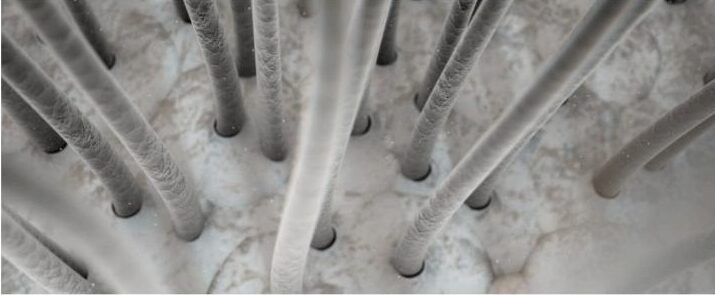
The most common form of hair loss, androgenetic alopecia (pattern baldness), does not happen overnight. Under genetic and hormonal pressure, primarily from the hormone DHT, hair follicles gradually shrink in a process called miniaturization. Over successive growth cycles, a miniaturized follicle produces hairs that are thinner, shorter, and lighter in color. Eventually, if nothing intervenes, the follicle stops producing visible hair, becomes dormant, and effectively dies.
Here is the critical distinction:
- A miniaturized follicle is still alive. It can potentially be stabilized or revived by medical therapy, PRP, or LLLT.
- A dead follicle cannot be “woken up” by any non-surgical product, regardless of how it is marketed.
A helpful way to picture this is a dimming lightbulb versus one that has burned out. A dimming bulb still has a working filament; with the right support, it can glow brighter again. A burned-out bulb will not light no matter how much electricity flows to it. Miniaturized follicles are dimming bulbs. Dead follicles are burned out.
This is why every non-surgical treatment on the market, from inexpensive drugstore solutions to premium clinical procedures, works by supporting living but shrinking follicles. None of them regenerate follicles that are gone. As a result, the first real decision point is not which product to choose, but staging: determining how many living follicles remain to work with.
How to Self-Assess Your Hair Loss (Without Knowing Your Norwood or Ludwig Stage)
Clinicians use the Norwood scale for men and the Ludwig scale for women to classify pattern hair loss. Readers do not need that vocabulary to begin, however; a few practical, at-home observations can offer meaningful early clues.
Signs Your Follicles May Still Be Alive (Good Candidacy Signals)
- Gradual or diffuse thinning. Hair that looks less dense overall, rather than smooth, fully bald patches, often indicates miniaturization rather than follicle death.
- Fine, short, or “peach fuzz” hairs in thinning areas. These wispy hairs are a hallmark of miniaturization. Their presence means follicles are still producing, just weakly.
- A relatively recent history of loss. Thinning that began within the past several years, or a widening part or temple recession that has not progressed to complete baldness, generally suggests living follicles remain.
- A pattern consistent with early-to-moderate pattern loss. A family or personal pattern pointing to the early stages of androgenetic alopecia, rather than advanced baldness, is a positive sign.
During a professional evaluation, a specialist may also perform a hair pull test, gently tugging on a small cluster of hairs to gauge how many release from the scalp. This helps distinguish active shedding from other types of loss. It is a clinical tool interpreted with training and context, not a reliable DIY diagnostic.
Signs You May Be Past the Non-Surgical Window
- Smooth, shiny scalp in areas that have shown no hair growth for many years.
- Advanced crown or vertex balding with no fine hairs present at all.
- Long-standing bald areas, often a decade or more, with no regrowth history even after earlier treatment attempts.
In these zones, follicles have typically died. No non-surgical product, at any tier, can reverse that specific type of loss.
That reality is not meant to discourage. It is simply the reason surgical restoration exists, and why it works well precisely where non-surgical options cannot.
Why Non-Surgical Success Depends on Catching It Early
Candidacy guidelines suggest non-surgical approaches are generally most effective in early-to-moderate pattern loss, roughly equivalent to Norwood I to III in men or Ludwig I to II in women, with at least half of the original follicle density remaining. In advanced stages such as Norwood V to VII, efficacy drops sharply because the biological material needed for treatment (living, miniaturized follicles) is largely gone.
The track records of the two FDA-approved medications reinforce this “alive but shrinking” window:
- Finasteride, the only FDA-approved oral medication for male pattern hair loss, has been shown by the American Academy of Dermatology to slow further hair loss in about 80% to 90% of men who take it. Actual regrowth is more likely in those who begin treatment early.
- Minoxidil was the first FDA-approved drug for pattern hair loss. According to the American Academy of Dermatology, results typically take about 6 to 12 months to appear. Importantly, stopping minoxidil reverses its benefits: hairs become thinner again and shedding increases. Non-surgical medical therapy is an ongoing commitment, not a one-time fix.
When used together, finasteride and minoxidil represent the current evidence-backed ceiling of non-surgical results. A 2025 network meta-analysis identified the combination as the most efficacious FDA-approved option for male androgenetic alopecia, showing an increase of approximately 29.68 hairs/cm² at 24 weeks and a SUCRA efficacy value of 80.21%. In plain terms, SUCRA is a statistical ranking score; the higher the percentage, the more likely a treatment ranks near the top among those compared.
Not All Hair Loss Is Androgenetic: Why That Matters for Your Assessment
Many people searching for non-surgical restoration do not actually have pattern baldness. Hair loss has numerous triggers, including:
- Postpartum shedding
- Stress-induced telogen effluvium (a temporary shedding phase following physical or emotional stress)
- Thyroid disease
- Chemotherapy
- Medication side effects
- Shedding associated with GLP-1 weight-loss drugs, an increasingly common reason new patients are entering the hair loss conversation in 2026
This distinction matters because non-androgenetic hair loss often requires addressing an underlying medical cause. The finasteride, minoxidil, and PRP pathway was built for pattern baldness and may be the wrong tool for a thyroid imbalance or post-illness shedding. For anyone unsure of the cause, this is another strong reason the next step should be a professional evaluation rather than a product purchase.
A Quick Look at the Non-Surgical Toolkit (And Where the Evidence Stands)
The following overview is intentionally brief. Detailed head-to-head comparisons are covered in Hair Transplant Specialists’ dedicated treatment guides.
Tier 1: FDA-approved medical therapy. Finasteride and minoxidil remain the foundation. They are well studied, widely used, and most effective when started early.
Tier 2: Evidence-supported adjuncts.
- PRP uses concentrated growth factors from a patient’s own blood. A meta-analysis across clinical trials found a statistically significant increase in hair density from 141.9 to 177.5 hairs/cm² following treatment.
- LLLT devices have been FDA-cleared since 2007. An evidence-based review published in PubMed found FDA-cleared LLLT devices to be both safe and effective for patients with pattern hair loss who did not respond to, or could not tolerate, standard treatments.
Tier 3: Emerging and off-label options.
- Topical finasteride (0.25% solution) is a notable 2026 development. Phase III data shows hair-count improvement similar to oral finasteride (about 20 new hairs/cm² at 24 weeks) with plasma concentrations more than 100-fold lower and fewer trial withdrawals (2.8% versus 7.1%).
- Low-dose oral minoxidil is increasingly prescribed but is not FDA-approved for androgenetic alopecia. Both options are promising, with evidence still evolving.
A caution on exosomes. Exosome therapy is heavily marketed in 2026 as the “frontier” of hair restoration. However, the FDA has approved zero exosome products for hair loss, and the American Hair Loss Association notes that peer-reviewed research supporting their effectiveness remains very limited. Clinical trials are underway, but aggressive exosome marketing deserves healthy skepticism until stronger evidence emerges.
A separate category: Scalp Micropigmentation. SMP creates the visual impression of density or a shaved look through pigment, not regrowth. It can also camouflage scars. It is worth knowing about even though it is not biological restoration.
Above all, none of these tiers can help if the underlying follicles are already dead. That point returns every treatment discussion to the self-assessment above.
What If You’re Likely Past the Non-Surgical Window?
This outcome is far more common than many expect. A large share of people who begin researching non-surgical options eventually learn that surgery is the more realistic path for fully bald areas.
Surgical restoration works on an entirely different principle. Techniques such as FUE (Follicular Unit Extraction) and FUT (Follicular Unit Transplantation) relocate living, DHT-resistant follicles, typically from the back and sides of the scalp, into areas where follicles have died. Rather than trying to revive what is gone, surgery places living follicles where they are needed.
Many patients are hybrid cases. One region of the scalp may still contain living, miniaturized follicles well suited to medical therapy, while another region is better addressed surgically. Medication may also be recommended after a transplant to protect existing native hair. This is exactly why individualized staging matters so much.
Hair Transplant Specialists offers the full range of options, including FUE, FUT, scalp micropigmentation, and non-surgical treatments such as finasteride, minoxidil, LLLT, PRP, and Alma TED. That breadth allows the team to evaluate the whole picture rather than steer every patient toward a single approach. Evaluating the full scalp, not guessing from a mirror, is the responsible next step.
Why a Professional Staging Consultation Is the Real Next Step
A professional evaluation typically includes:
- Close visual and sometimes magnified or microscopic examination of the scalp to assess follicle density and the degree of miniaturization.
- A hair pull test to evaluate active shedding.
- A medical history review to identify or rule out non-androgenetic causes such as thyroid issues, medications, recent illness, or postpartum changes.
This is how Norwood and Ludwig staging is properly determined. Readers are not expected to self-diagnose with certainty.
An accurate stage assessment helps prevent two costly mistakes:
- Spending months, or years, on treatments that cannot work on dead follicles.
- Assuming surgery is necessary when medical therapy could still preserve and strengthen existing hair.
A consultation is best viewed as a low-commitment, information-gathering step. At Hair Transplant Specialists, the board-certified team brings more than 100 years of combined experience evaluating exactly these cases. The team includes Dr. Sharon Keene, former President of the International Society of Hair Restoration Surgery and a published researcher on topics ranging from photobiomodulation to vitamin D and hair loss, and Dr. Roy Stoller, an author and examiner for board certification exams. The practice’s philosophy, “it’s not just about the procedure; it’s about ‘YOU’ and your journey,” reflects an education-first approach to helping patients understand their options.
Conclusion
The central lesson is simple: non-surgical hair restoration can only help follicles that are miniaturized but still alive. It cannot bring back follicles that have already died.
Self-assessment, which includes looking at the pattern of thinning, the presence of fine hairs, and the duration and location of loss, is a useful starting point. It is not a diagnosis. The earlier pattern hair loss is addressed, the more non-surgical options remain realistically available.
Whether the right path turns out to be medication, regenerative therapy, surgery, or a combination, the decision should rest on clarity rather than guesswork.
Ready to Know Where You Actually Stand?
Hair Transplant Specialists invites anyone experiencing thinning or hair loss to schedule a professional hair and scalp evaluation. This consultation provides an accurate, individualized stage assessment and determines realistic candidacy for non-surgical treatment, surgical restoration, or a combination of both, removing the guesswork from self-assessment.
Hair Transplant Specialists
- Eagan, MN: 2121 Cliff Dr. Suite 210, Eagan, MN 55122 (near the intersection of Nicols Road and Cliff Drive)
- Long Island, NY: Consultations with Dr. Roy Stoller
- Phone: (651) 393-5399
- Website: INeedMoreHair.com
Office Hours: Monday through Thursday, 9:00 AM to 5:00 PM; Friday, 9:00 AM to 3:00 PM; Saturday and Sunday by appointment.
There is no pressure and no obligation, just honest answers from experienced specialists. Every journey begins with understanding, and the team at Hair Transplant Specialists is ready to guide each patient through every step.