Natural Hair Density Follicles Per cm²: The Vascular Biology Behind Why Transplants Can’t Replicate Nature
Introduction: The Gap Between Nature’s Blueprint and What Surgery Can Build
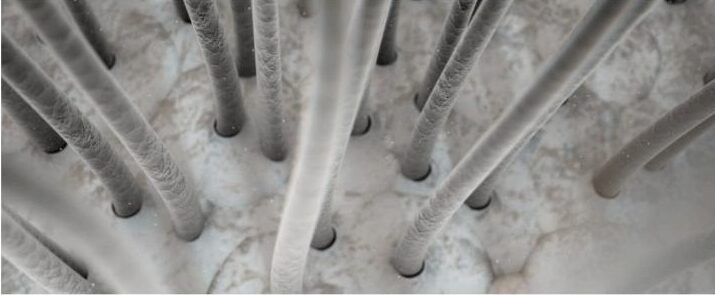
The human scalp presents a remarkable biological architecture: native hair density ranges from 80 to 120 follicular units per square centimeter in non-balding areas. Modern hair transplant surgery, even at its most advanced, achieves 40 to 60 follicular units per cm²—roughly half of nature’s original design. This gap raises a fundamental question that every prospective patient deserves to understand: why can’t modern surgical techniques simply replicate natural density, and does it even need to?
The answer lies at the intersection of vascular biology, optical perception, and mathematical reality. Three core insights transform how patients approach hair restoration: the vascular biology ceiling that creates hard limits on transplant density, the 50% density illusion that makes those limits clinically acceptable, and the donor math reality that determines what is actually achievable for each individual case.
Whether someone is researching hair loss solutions for the first time or preparing for a surgical consultation, understanding these biological constraints leads to better decisions and realistic expectations. Ethnic variation adds another layer of complexity rarely discussed in mainstream content, yet it significantly impacts surgical planning and outcomes. The science presented here is not marketing—it is the biological foundation upon which all successful hair restoration is built.
What Is Natural Hair Density? Understanding Follicles Per cm²
Before examining why transplants cannot match nature, one must first understand what nature actually provides. A follicular unit (FU) is a naturally occurring cluster of one to four hairs, with the average containing approximately 2 to 2.5 hairs per unit. This distinction matters: follicular unit count and individual hair strand count are not the same measurement.
The foundational benchmark, established by Bernstein and Rassman in 1999, demonstrates that native scalp density ranges from 80 to 120 follicular units per cm², translating to approximately 124 to 200 individual hairs per cm² in non-balding areas. The total human scalp contains roughly 100,000 hairs distributed across 600 to 700 cm² of scalp surface—equating to approximately 50,000 follicular units.
A critical distinction exists between hair density (strands per cm²) and hair thickness (shaft diameter). Both affect visual outcome differently and are frequently confused. A patient can have high density with fine hair or low density with thick hair—each scenario produces a distinctly different appearance.
Modern clinical practice relies on trichoscopy—dermoscopy of the scalp—as the non-invasive gold standard for measuring follicular density. This technology enables precise pre-surgical planning and accurate diagnosis, replacing the guesswork that characterized earlier eras of hair restoration.
Density Is Not Uniform: A Regional Map of the Scalp
Hair density varies significantly by scalp region—a fact critical to surgical planning and post-transplant appearance. A 2023 study published in JEADV Clinical Practice used digital microscopy to comprehensively map these variations. In men with normal scalps, the parietal and vertex regions demonstrated the highest density at approximately 138.6 hairs per cm², while the temporal region showed the lowest at roughly 73.7 hairs per cm².
The occipital donor zone—the gold-standard harvest site due to its DHT-resistance—contains 65 to 85 follicular units per cm² and 124 to 200 hairs per cm². A clinico-trichoscopic analysis found 89% higher hair density in the occipital area compared to the frontal area, reinforcing why donor site selection fundamentally matters.
This regional variation has direct implications for patients. Transplanted hair placed in a low-density temporal zone will look different than hair placed in the vertex, even at identical graft counts. The 2023 digital microscopy study confirmed significant site-specific and sex-based differences in density, adding another variable to surgical planning.
Ethnic Variation in Follicular Density: A Dimension Most Sources Ignore
Ethnic background represents one of the most significant—and most underreported—variables in natural hair density. The data reveals meaningful differences that should inform every transplant plan.
Caucasians average the highest total hair density at approximately 200 hairs per cm². Asians and Africans average approximately 165 hairs per cm², though with important distinctions. Asian hair demonstrates a thicker shaft diameter and faster growth rate, while African hair shows the lowest density and slowest growth rate but possesses unique curl characteristics that affect coverage.
Research on Chinese scalps found an average of 71.78 follicular units per cm² and 137.08 hairs per cm²—notably lower FU density than typical Caucasian benchmarks of approximately 100 FU per cm². A 2025 study on Indian ethnicity highlighted that quantitative reference data for many ethnic groups is still being established, underscoring how much variation exists globally.
Hair color also affects total counts: blondes average up to approximately 145,000 total scalp hairs (the highest follicular count), while redheads average roughly 86,000 (the lowest). The practical implication is clear: ethnic-specific density norms should inform transplant planning. A Caucasian patient and an Asian patient with the same Norwood grade may require entirely different graft strategies.
The Vascular Biology Ceiling: Why Transplants Cannot Match Nature
The core biological constraint limiting transplant density is straightforward yet absolute: transplanted grafts depend entirely on the recipient scalp’s dermal blood supply for survival, and that supply has hard limits.
When grafts are packed too closely, they compete for the same oxygen and nutrient supply from surrounding tissue—a phenomenon called ischemic competition. Clinical data demonstrate this effect quantitatively: graft survival approaches near-complete rates (approximately 100%) at 30 grafts per cm², but drops to approximately 84% at 50 grafts per cm².
At densities above 50 to 60 grafts per cm², the scalp’s dermal blood supply becomes overwhelmed. Experimental microsurgical limits approach approximately 80 follicular units per cm² before irreversible tissue damage occurs. A comparison of FUE versus DHI transplants found mean achieved densities of 50 grafts per cm² for FUE and 75 grafts per cm² for DHI, though the higher DHI density comes with increased vascular risk.
The structural explanation is fundamental: native follicles developed their vascular networks over years of growth, establishing robust blood supply connections. Transplanted grafts must re-establish blood supply in a compressed timeframe, competing with neighboring grafts for limited resources. The practical implication is counterintuitive but critical: chasing “dense packing” beyond biological limits does not produce more hair—it produces more graft failure.
Dense Packing Claims: What the Science Says About Marketing vs. Reality
The marketing trend of clinics advertising “ultra-dense” or “mega-session” transplants without disclosing survival rate trade-offs deserves scrutiny. The approximately 80 FU per cm² physiological upper limit under extreme microsurgical conditions is rarely cited publicly, leaving patients unable to evaluate overclaiming.
A useful distinction exists between “social observation” density and “critical observation” density. At 40 to 50 follicular units per cm², hair achieves fullness under everyday social viewing conditions. Close-up scrutiny, however, reveals lower density. Understanding this distinction helps patients set realistic expectations.
Notably, a four-year follow-up study found that over 91% of subjects experienced some reduction in transplanted hair density over time—challenging the “permanent results” narrative that some clinics promote. Prospective patients should ask clinics for graft survival rate data at their proposed packing density, not just total graft counts.
The 50% Density Illusion: Why Full Native Density Is Not Required
Research confirms a principle that transforms how patients should think about transplant goals: only approximately 50% of original density is needed to create the visual appearance of fullness. Clinicians call this “cosmetic density.”
The 2024 update to StatPearls explicitly states that the clinical goal of hair transplantation is to “create the illusion of density,” not to restore pre-balding amounts. The perceptual science explains why: the human eye perceives coverage and contrast, not individual hair counts. This is why 50% density can look “full” under normal social viewing conditions.
Several factors amplify this illusion. Hair caliber plays a significant role—a 0.1mm increase in hair shaft diameter can add up to 30% to cosmetic density perception. This means thick-haired patients achieve visual fullness at lower graft counts. Hair length creates a layering effect that amplifies perceived coverage beyond what follicle count alone would suggest.
Color contrast between hair and scalp is a major but rarely discussed factor. Black hair on light skin creates high contrast, making lower densities appear more sparse. Blonde hair on light skin creates low contrast, making lower densities appear fuller. The practical takeaway is significant: transplant goals should be calibrated to visual outcome, not numerical replication of native density.
The Donor Math Reality: How Many Follicles Are Actually Available?
Understanding donor supply mathematics is essential for realistic expectations. The total scalp contains approximately 50,000 follicular units across 600 to 700 cm². However, only about 25% of total follicular units—roughly 12,500—reside in the DHT-resistant occipital donor zone, the only safe harvest area for transplantation.
Applying the 50% density threshold reveals a sobering calculation: since approximately 50% density is needed to maintain donor area appearance, only approximately 6,250 follicular units are safely available for transplantation without visibly depleting the donor zone.
In advanced Norwood VII cases, where the balding area is largest and donor supply most limited, only approximately 12.5% of original follicles may realistically be available—a critical expectation-management insight almost entirely absent from mainstream content.
This math matters for surgical planning. A patient needing coverage across a large bald area with limited donor supply requires a strategic allocation plan, not a single mega-session promise. The current clinical philosophy emphasizes “preservation over replacement”—protecting existing native hair while strategically adding transplant density, with long-term planning accounting for future hair loss progression.
Calculating Realistic Coverage: Matching Donor Supply to Recipient Demand
Consider a simplified example: a Norwood V patient with approximately 8,000 available follicular units in the donor zone and a recipient area of 150 cm². The math yields 8,000 FUs divided by 150 cm², equaling approximately 53 FU per cm²—near the upper safe limit and only achievable in a single session if vascular biology permits.
Staging procedures across multiple sessions is often the more biologically sound approach than attempting maximum density in one session. At Hair Transplant Specialists, an eight-month minimum waiting period between procedures allows accurate assessment of graft survival before placing additional grafts.
Patients with unrealistic expectations—wanting full native density restoration—are clinically contraindicated for the procedure, according to StatPearls 2024. Managing expectations is not pessimism; it is medical responsibility.
How Hair Characteristics Amplify or Limit Transplant Outcomes
Beyond follicle count, several variables determine visual outcome. Shaft diameter significantly impacts results: thicker hair, common in Asian patients, can compensate for lower FU density, while fine hair may require higher graft counts for equivalent visual coverage.
Curl pattern affects coverage efficiency. Curly or wavy hair covers more scalp surface per strand, creating greater perceived density at lower follicle counts. Color contrast, as noted, dramatically affects perceived density—high-contrast combinations make lower densities more visible, while low-contrast combinations are more forgiving.
A skilled surgeon factors all these variables into graft planning. Hair Transplant Specialists’ Microprecision Follicular Grafting® technique places natural follicular groupings of one to four hairs strategically to maximize the visual effect of available grafts—working with biology rather than against it.
What This Means for a Hair Transplant Consultation
Prospective patients should bring specific questions to any consultation. What graft survival rate does the clinic achieve at the proposed packing density? What is the estimated donor supply? How many sessions will be needed for the specific Norwood grade?
A reputable surgeon will use trichoscopy to measure both donor density and recipient area before proposing a plan. The goal is visually natural results under normal social conditions—not microscopic replication of native density.
Long-term planning must factor in future hair loss progression. Today’s graft allocation affects options for future sessions. Non-surgical adjuncts—finasteride, minoxidil, PRP, and technologies like Alma TED—protect native hair and can enhance transplant outcomes, supporting the preservation-over-replacement philosophy.
Conclusion: The Science of ‘Good Enough’—and Why It’s Actually Great
The density gap between nature and transplantation is not a limitation to overcome but a biological reality that skilled surgeons work with, not against. Three core insights define realistic expectations: vascular biology creates a hard ceiling at approximately 50 to 80 follicular units per cm²; the 50% density illusion means visual naturalness is achievable within that ceiling; and donor math requires strategic planning, especially in advanced cases.
Ethnic variation, hair characteristics, and regional scalp anatomy all influence what “natural” looks like for each individual patient. The best outcomes come from understanding the science, choosing an experienced surgical team, and entering the process with calibrated, realistic expectations.
The goal—a natural appearance that restores confidence—is fully achievable within these biological parameters when surgery is planned and executed with precision.
Ready to Understand What’s Possible? Schedule a Consultation
For those ready to take the next step, a personalized consultation with the board-certified surgeons at Hair Transplant Specialists provides clarity. A proper consultation includes trichoscopic density assessment, donor supply evaluation, and a realistic, individualized treatment plan—not a one-size-fits-all graft count.
The team’s credentials speak to their expertise: Dr. Sharon Keene served as President of the International Society of Hair Restoration Surgery, alongside Dr. Roy Stoller, Dr. Paul Rose, and surgical technicians with 15 to 18 years of experience. The Microprecision Follicular Grafting® technique represents the practice’s commitment to the most natural results achievable within biological limits.
Contact Hair Transplant Specialists at (651) 393-5399 or visit INeedMoreHair.com. Located in Eagan, Minnesota, the practice offers financing options starting at $150 per month and transparent, all-inclusive pricing.
The journey to restored confidence starts with understanding the science—and partnering with the right team to guide the way.