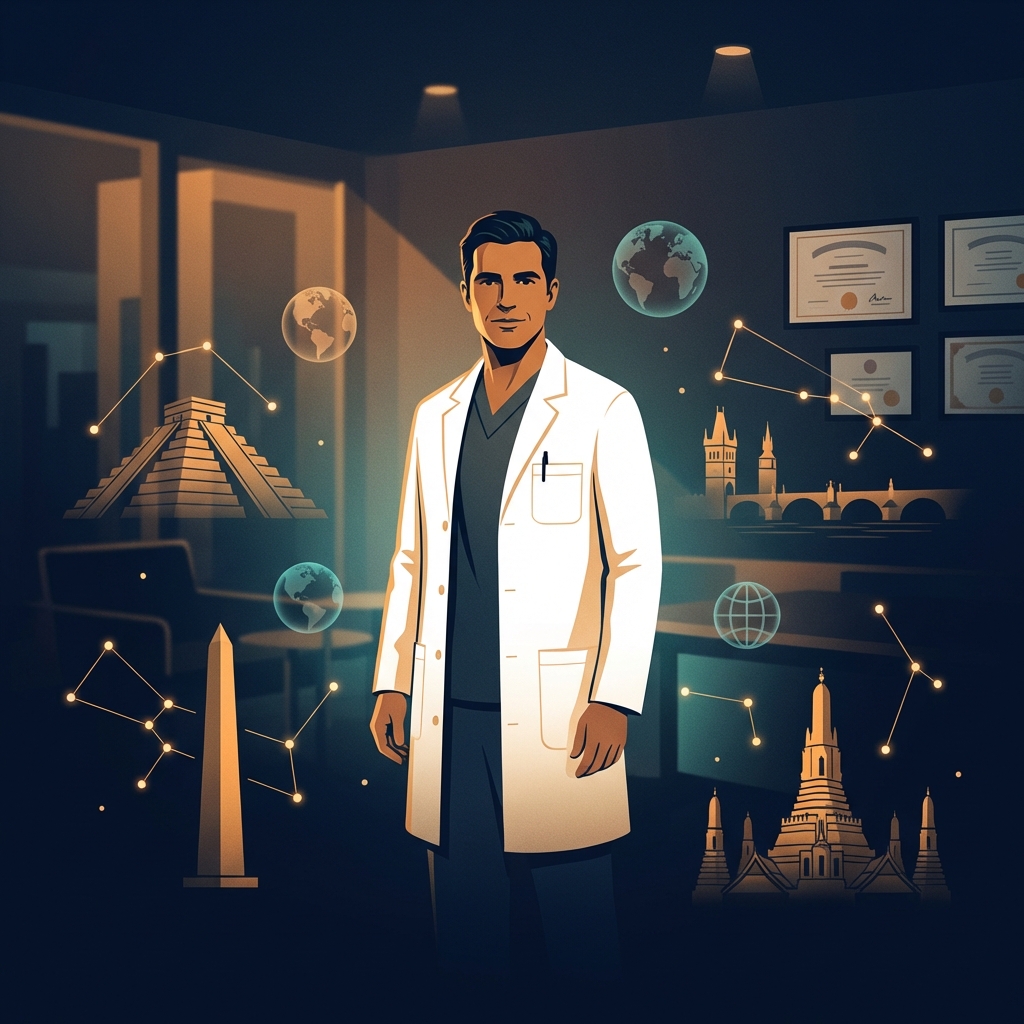
Hair Transplant Surgeon International Training: Why Cancún, Buenos Aires, Prague & Bangkok Matter to Your Results
Introduction: Why a Surgeon’s Passport Matters More Than Ever in 2026
The numbers tell a sobering story: 59% of International Society of Hair Restoration Surgery (ISHRS) members reported black-market hair transplant clinics operating in their cities in 2026, up from 51% in 2021. This is not a statistic about distant markets—it is a patient safety crisis unfolding in communities across the globe. In this environment, a surgeon’s international training history has become far more than a prestige signal; it is one of the most reliable indicators of clinical competence a patient can evaluate.
The stakes continue to rise. The global hair transplant market is valued at approximately $10.74 billion in 2026 and is projected to reach $59.89 billion by 2035, growing at a compound annual growth rate of 21.04%. This explosive growth creates enormous financial incentive for unqualified practitioners to enter the space—and enormous risk for patients who cannot distinguish legitimate credentials from marketing claims.
This article examines why a surgeon’s verifiable participation in ISHRS-sanctioned events in cities like Cancún, Buenos Aires, Prague, and Bangkok represents a meaningful indicator of clinical excellence. A critical distinction must be made clear from the outset, however: attending a conference is not the same as presenting original research, operating live before peers, or undergoing formal peer review. That difference directly affects patient outcomes.
The regulatory landscape makes this evaluation essential. Any licensed physician in the United States can legally perform hair transplant surgery without specialized training. This gap means internationally verified credentials represent one of the few reliable trust signals available to patients navigating an increasingly complex marketplace.
The ISHRS Framework: Understanding the Global Standard Behind the Cities
The International Society of Hair Restoration Surgery stands as the world’s leading authority on hair restoration, with over 1,200 members across more than 80 countries. Understanding what ISHRS membership and participation actually require provides patients with a framework for evaluating surgeon credentials.
ISHRS full members must attend ISHRS-approved international meetings every three years as part of their continuing medical education requirements. This makes international participation a mandatory standard rather than optional professional enrichment. The organization’s Fellowship Training Programs demand 9–12 months of intensive training with a minimum caseload of at least 70 cases per fellow, following established Core Curriculum and Core Competencies guidelines.
Three tiers of participation exist at ISHRS events, each representing fundamentally different levels of expertise and peer accountability:
- Attendee: Present at the event, exposed to educational content
- Presenter: Submitted work accepted through competitive review, delivered original research or case studies
- Live Surgery Faculty: Performed procedures before peers and faculty, with technique subject to real-time critique
The highest form of peer validation is the Clinical Observation Center designation—awarded to surgeons whose techniques are so advanced that peers travel internationally to observe them. This distinction signals that a surgeon’s work has been recognized not just locally, but by the global scientific community.
ISHRS events span the globe, with workshops and congresses held in the Czech Republic, Mexico, Thailand, Argentina, and beyond. Regional bodies including FUE Europe and FUE Asia contribute to this ecosystem, reinforcing that elite surgeons operate within a worldwide peer network of continuing education and technique refinement.
Cancún: The Latin American FUE Workshop and What Live Surgery Training Actually Means
The ISHRS 9th Annual Latin American FUE Workshop, scheduled for March 27–30, 2026, in Cancún, México, represents a concrete, verifiable training milestone. Organized by the Paraguayan Society of Hair Restoration Surgery, this workshop series has established itself as a recurring credential with documented history—including the 5th Annual event held in Buenos Aires, Argentina, in March 2019.
A “live surgery workshop” means precisely what the name suggests: surgeons operate on actual patients in front of peers and faculty. Every aspect of technique—graft handling, recipient site creation, hairline design, extraction patterns—is subject to real-time observation and critique. This exposure creates accountability that private practice cannot replicate.
The distinction between passive attendance and active participation matters significantly. A surgeon who presents or operates at the Latin American FUE Workshop has had their work evaluated by international peers. A surgeon who merely attended has not. Both may list the workshop on their credentials, but only one has been subjected to meaningful peer review.
This training carries direct clinical relevance. FUE led the market with 58.62% revenue share in 2025, making mastery of this technique essential for surgeons performing the procedure most patients will receive. Latin American workshops also expose surgeons to diverse hair textures, curl patterns, and alopecia presentations common in Hispanic and mixed-heritage patients—broadening clinical competence that benefits all patient populations.
Patient action item: When evaluating a prospective surgeon, ask not just whether they attended the Latin American FUE Workshop, but in what capacity—attendee, presenter, or live surgery faculty—and request documentation.
Buenos Aires: Peer-Review Culture and the Standard of Surgical Accountability
The 5th Annual Latin American FUE and Live Surgery Workshop in Buenos Aires, Argentina (March 2019) was hosted by the Plastic Surgery Society of Buenos Aires and organized by the Paraguayan Society of Hair Restoration Surgery—an ISHRS-affiliated event with documented history and institutional credibility.
When a workshop is co-hosted by a national plastic surgery society, the peer-review standards extend beyond the hair restoration community into the broader surgical discipline. This creates an additional layer of professional accountability that distinguishes these events from industry-sponsored gatherings.
Peer-review culture in a live surgery context means that every surgical decision—donor area selection, extraction density, graft placement angles, hairline design—is observed and critiqued by colleagues who perform the same procedures at the highest level. The “teach-to-master” principle applies: surgeons who train others or demonstrate techniques before peers must perform at a higher, more consistent standard than those who operate only in private settings.
This training directly addresses the repair crisis documented in recent ISHRS data. Repair cases attributable to black-market transplants rose to 10% in 2024, up from 6% in 2021. Surgeons trained in peer-review environments are equipped to identify and correct the errors that create these cases—overharvested donor areas, improperly placed grafts, and unnatural hairlines.
The clinical landscape continues to evolve. Combination FUT + FUE procedures are projected to grow at a 14.88% CAGR through 2031. Buenos Aires workshops that address both techniques prepare surgeons for this trajectory, ensuring they can offer patients the most appropriate approach for their specific situation. Patients considering their options can learn more about FUE vs. FUT and which is better for their individual circumstances.
Prague: The World Congress Standard and What Global Peer Recognition Looks Like
The ISHRS 25th World Congress in Prague, Czech Republic (October 4–8, 2017) represents the field’s equivalent of a major academic conference—the largest annual gathering of hair restoration surgeons globally. The World Congress format includes scientific paper presentations, live surgery demonstrations, hands-on workshops, and peer-reviewed research submissions.
Presenting at the World Congress differs fundamentally from attending it. Surgeons who present original research or demonstrate techniques have had their work accepted through a competitive submission process and evaluated by an international scientific committee. This acceptance represents validation by the global scientific community, not by local peers or marketing departments.
ISHRS faculty at these events are world-renowned experts who author textbooks and publish the field’s most important journal articles. Participation in the World Congress places a surgeon within that knowledge-creation ecosystem—contributing to and learning from the collective expertise that defines best practices.
The organization’s commitment to global accessibility is evident: ISHRS now provides AI-based live translation in more than 60 languages at its World Congress, reflecting the truly international scope of the peer community that gathers at these events.
Patient action item: Search for a surgeon’s name in ISHRS World Congress program archives, or ask directly what they presented or demonstrated. A specific answer indicates genuine participation; a vague response warrants follow-up questions. Knowing the right questions to ask during a hair transplant consultation can make a significant difference in evaluating a surgeon’s credentials.
Bangkok: Asia-Pacific Innovation and the Technology Integration Imperative
The ISHRS 27th World Congress and World Live Surgery Workshop in Bangkok, Thailand (November 13–17, 2019) confirmed this city’s role as a global hub for hair restoration innovation. Bangkok’s relevance continues: the Thai Society of Hair Restoration Surgeons (TSHRS) is hosting a 2026 workshop titled “The Modern Era of Hair Restoration Surgery: Man and Robots”—a theme that reflects the field’s technological trajectory.
The Asia-Pacific context matters for understanding global technique evolution. Turkey performed over 1.5 million procedures in 2024, accounting for more than 60% of global hair transplant medical tourism. Asia Pacific is projected as the fastest-growing regional market. Surgeons who train at Asia-Pacific events encounter the techniques, technologies, and patient populations that are shaping the field’s future.
In 2026, AI-guided robotic systems such as ARTAS iXi and FUEsion X 5.0 are increasingly integrated into advanced practices. The Bangkok 2026 workshop’s “Man and Robots” theme acknowledges that surgeons trained at these events are at the frontier of technology adoption. Robotic and AI-assisted FUE systems are adopted at different rates across global markets; surgeons who train internationally encounter these technologies earlier and develop more nuanced judgment about when to deploy them versus manual techniques.
FUE Asia hosts live surgical workshops at institutions like AIIMS Delhi with international faculty from over 40 countries. Bangkok events connect surgeons to this broader Asia-Pacific training network, ensuring exposure to the techniques and technologies that will define the next decade of hair restoration.
The Black-Market Crisis: Why Internationally Trained Surgeons Are a Patient Safety Issue
The 2026 data is unambiguous: 59% of ISHRS members report black-market hair transplant clinics operating in their cities—up from 51% in 2021. This represents an accelerating crisis, not a stable background risk.
“Black-market” in this context refers to clinics operating outside regulatory oversight, often staffed by unlicensed technicians performing surgical procedures with no physician involvement in the actual transplant. The consequences are measurable: repair cases from black-market transplants rose to 10% in 2024 (up from 6% in 2021), and repair procedures now account for 6.9% of all hair transplants.
The regulatory gap that enables this crisis is straightforward: any licensed physician in the United States can legally perform hair transplant surgery without specialized training. This means credentials—not licensure—are the primary patient protection.
Internationally verified training provides a verifiable track record that black-market operators cannot fabricate. A surgeon who has presented at ISHRS World Congresses, operated live at regional workshops, and undergone peer review by global colleagues has documentation that can be confirmed through official channels.
The demographic stakes are significant. First-time surgery patients in 2024 skewed younger, with 95% initiating surgery between ages 20–35, and female patients increased by 16.5% from 2021. Younger, more diverse patients may be more vulnerable to marketing-driven decision-making and less equipped to evaluate credentials without guidance. Understanding the best age for hair transplant surgery is an important part of making an informed decision.
How to Verify a Surgeon’s International Training History: A Patient’s Practical Guide
Verification is both possible and expected. Legitimate surgeons maintain documentation of their international participation—certificates, program listings, published abstracts, or ISHRS member profiles.
The ISHRS member directory serves as a starting point. Patients can search the organization’s website to confirm a surgeon’s membership status and, in some cases, their participation in approved meetings. Patients must understand, however, the difference between a certificate of attendance—which confirms presence—and a certificate of faculty participation, presentation, or live surgery contribution, which confirms active, peer-evaluated involvement.
Questions to ask during a consultation:
- In what capacity did you participate—attendee, presenter, or live surgery faculty?
- What did you present or demonstrate?
- How has that training changed your current technique?
- Can you provide documentation?
The American Board of Hair Restoration Surgery (ABHRS) certification provides another benchmark. ABHRS requires ongoing continuing medical education and periodic recertification, offering patients a reliable standard for evaluating surgeon qualifications.
A red flag to watch for: a surgeon who lists multiple international workshops but cannot describe in specific terms what they contributed, presented, or learned may be using conference attendance as a marketing credential rather than a genuine training milestone. Patients can also review what hair transplant surgeon credentials to look for when making their selection.
What Globally Trained Surgeons Bring Back to the Procedure
International training translates directly into patient benefit. Every technique refinement a surgeon learns at a Bangkok live surgery workshop or a Prague World Congress presentation becomes an input into the procedures they perform.
Surgeons who train internationally encounter hair textures, curl patterns, scalp characteristics, and alopecia presentations from patients of many ethnicities. This diverse case exposure broadens clinical judgment in ways that benefit all patients, regardless of background.
The outcome data supports this connection. Hair transplant success rates at reputable clinics range from 90–98%, with graft survival rates of 95–97%. Surgeons who train at international centers and teach internationally typically achieve outcomes at the higher end of these ranges because teaching demands consistent, high-level performance. Patients can explore realistic hair transplant graft survival rates to better understand what to expect.
Technology adoption provides another advantage. Surgeons who attend international workshops encounter AI-guided robotic systems, new graft-handling protocols, and emerging techniques before they become widely available—giving patients access to current best practices.
The most critical patient concern—avoiding the “pluggy” or artificial appearance associated with older techniques—is directly addressed by surgeons who have had their hairline design and graft placement evaluated by international peers. Natural results require both technical skill and aesthetic judgment; both are refined through global peer exposure.
Conclusion: International Training as the Standard, Not the Exception
In a market growing at a 21.04% CAGR, with 59% black-market prevalence and a regulatory gap that allows any physician to perform hair transplants, internationally verified training represents the most reliable patient safety signal available.
Each city discussed represents a distinct milestone: Cancún and Buenos Aires as live surgery and peer-review milestones in FUE mastery; Prague as the global scientific community’s standard for research and technique validation; Bangkok as the frontier of technology integration and Asia-Pacific innovation.
The distinction that matters most is the difference between a surgeon who attended these events and one who presented, operated, or was peer-reviewed at them—the difference between a credential and a milestone in clinical evolution.
Patients who ask specific questions about international training history, request documentation, and understand what ISHRS participation means are better equipped to make decisions that protect their health and investment. As the hair transplant market expands and the black-market crisis deepens, globally trained surgeons are not just the best option—they are increasingly the only option that can be verified, trusted, and held accountable to an international standard of care.
Ready to Consult with a Globally Trained Hair Restoration Surgeon?
Hair Transplant Specialists at INeedMoreHair.com exemplifies the international training standard described throughout this article. Dr. Sharon Keene’s credentials include service as President of ISHRS (2014–2015), a 2020 certificate for the 6th Latino Americano FUE Workshop in Cancún, 2019 certificates from Buenos Aires and Bangkok workshops, a 2017 recognition plaque from Prague for advancing the Art and Science of Hair Restoration, and the 2013 Platinum Follicle Award for outstanding research.
Dr. Roy Stoller brings credentials as an international presenter and board certification examiner, while Dr. Paul Rose trained with elite aesthetic surgeons worldwide. The surgical technician team brings over 18 years of experience each—among the most experienced in the world.
Consultations at Hair Transplant Specialists are designed to connect a surgeon’s international training history directly to each patient’s specific hair loss pattern, goals, and expected outcomes. The practice operates from two state-of-the-art surgical suites in Eagan, Minnesota, offering the expertise patients deserve at prices they can afford.
To schedule a consultation, contact the practice at (651) 393-5399 or visit the Eagan, MN location at 2121 Cliff Dr. Suite 210.