Hair Transplant Safe Donor Area Limits FUE: The Peer-Reviewed Math Behind How Much Can Be Safely Harvested
Introduction: Why the Math Behind Your Donor Area Matters More Than You Think
Follicular Unit Extraction (FUE) is the most popular hair restoration method in the world, accounting for over 75% of procedures according to the International Society of Hair Restoration Surgery (ISHRS). Yet behind that popularity lies a growing, largely preventable crisis: donor area overharvesting. Too many patients walk away from a single session with permanent damage that no future surgery can fully repair.
Here is the concept that almost no clinic blog explains clearly. Every patient has a finite lifetime graft budget, roughly 6,000 to 7,000 grafts that can be safely harvested over a lifetime. How that budget is managed in the very first session shapes every option a patient will ever have. Spend it aggressively early, and the door to future restoration may quietly close.
This article explains the peer-reviewed mathematical framework that defines safe FUE donor area limits, a framework developed by Dr. Sharon Keene, Dr. William Rassman, and Dr. James Harris and published in Hair Transplant Forum International in 2018. Most clinic content never mentions this research, let alone cites it.
Dr. Sharon Keene, MD, FISHRS, is the authoritative voice behind much of this work. A former President of the ISHRS and a recipient of the prestigious Platinum Follicle Award, she is a lead researcher on safe excision limits and a core member of the team at Hair Transplant Specialists. The sections ahead cover the anatomy of the safe donor zone, the residual density threshold, the formula for calculating safe limits, how hair characteristics modify those limits, what happens when limits are exceeded, and how to evaluate whether a surgical team is applying these principles.
The Anatomy of the Safe Donor Zone: Where DHT-Resistant Hair Lives
The safe donor area (SDA) is the mid-occipital region of the scalp, located between the upper and lower occipital protuberances. It forms a horseshoe-shaped band where follicles are genetically resistant to dihydrotestosterone (DHT), the hormone responsible for pattern hair loss.
The foundational science dates back decades. Orentreich’s donor dominance theory in the 1950s established that follicles transplanted from this zone retain their original resistance to balding. Unger’s 1994 anatomical research, based on 328 men over age 65, mapped the reliable boundaries of this permanent zone, confirming that follicles harvested there survive transplantation and resist miniaturization.
The numbers matter. The SDA spans roughly 190 to 200 cm² (approximately 27 cm wide by 7 to 8 cm tall). Baseline follicular unit (FU) density in this zone ranges from 65 to 85 FUs per cm² according to NIH StatPearls.
A frequent source of patient confusion deserves clarification here. FU density (follicular units per cm²) is not the same as hair density (individual hairs per cm²). Each follicular unit contains 1 to 4 hairs, so hair density is always higher than FU density.
There is also an often-ignored “intermediate zone,” the transitional band between the confirmed permanent safe zone and the actively balding region. Harvesting from this zone carries long-term risk because those follicles may eventually miniaturize as hair loss progresses. This nuance is rarely discussed in clinical content, yet it can make or break a surgical plan.
Trichoscopy (scalp dermoscopy) is the current standard preoperative tool for measuring donor FU density and detecting early miniaturization before surgery. Without it, accurate planning is guesswork.
The Peer-Reviewed Math: Keene, Rassman, and Harris’s Safe Excision Framework
In 2018, a landmark paper titled “Determining Safe Excision Limits in FUE: Factors That Affect, and a Simple Way to Maintain, Aesthetic Donor Density” was published in Hair Transplant Forum International (Vol. 28, No. 1) by Dr. Sharon Keene, Dr. William Rassman, and Dr. James Harris.
At its heart sits a deceptively simple equation:
Baseline FU Density − Excision Density = Residual Density
This formula is the foundation of responsible FUE planning. It represents the difference between a plan grounded in evidence and one built on hope.
The 40 to 50 FUs/cm² Residual Density Threshold: What It Means and Why It Exists
The critical finding from Keene et al. is this: a residual donor area density of 40 to 50 FUs/cm² is the minimum threshold required to maintain adequate cosmetic coverage, specifically for patients with medium-diameter, straight-to-mildly-wavy hair.
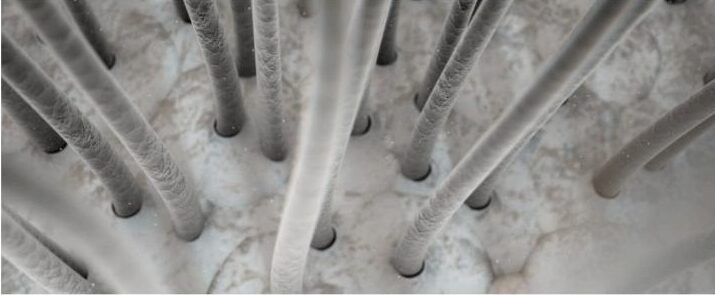
The visual logic is straightforward. Follicular unit spacing normally averages 1 to 1.4 mm. When a unit is excised, that distance doubles. Remove too many units, and the gaps between the remaining follicles become visible, producing a “mottled” or “moth-eaten” appearance that cannot be corrected without additional surgery.
NIH StatPearls confirms that donor areas below 40 FUs/cm² are considered less suitable for harvesting, aligning directly with the threshold Keene’s team established. Importantly, this is not a universal floor for every patient. Hair characteristics, covered in the following section, can raise or lower the safe minimum.
Calculating Safe Excision Density: A Step-by-Step Example
Consider a concrete example. A patient with a 189 cm² donor area and a baseline density of 65 FUs/cm² has approximately 12,285 total follicular units in the donor zone.
For patients with a baseline density of 65 to 75 FUs/cm², safe excision density in a single session is generally 10 to 15 grafts/cm², leaving a residual density of 50 to 55 FUs/cm², comfortably above the 40 to 50 FUs/cm² aesthetic threshold.
Applying that to a 189 cm² donor area yields approximately 1,890 to 2,835 grafts in a single safe session, a range consistent with the ISHRS 2025 Census average of roughly 2,347 grafts for a first-time procedure.
A useful rule of thumb supports this: most surgeons consider 50% of donor density the safe upper limit for a single FUE session. At that level, the remaining hair still covers extraction sites adequately.
The implication patients rarely encounter is significant. Even with conservative per-session limits, the total safely harvestable lifetime supply is approximately 6,000 to 7,000 grafts, not the 20,000 to 25,000 total follicular units present in the donor zone. The gap between total supply and safe supply is one of the most important concepts in hair restoration.
How Hair Characteristics Modify Safe Harvesting Limits
The 40 to 50 FUs/cm² threshold is calibrated for medium-diameter, straight-to-mildly-wavy hair. Individual hair characteristics can shift it significantly in either direction.
The highest-risk profile is fine, straight, dark hair on a light scalp. Fine hair provides less coverage per follicular unit, straight hair lies flat and reveals gaps readily, and high color contrast between hair and scalp makes any thinning immediately obvious. This combination demands more conservative harvesting and a higher residual density target.
The most favorable profile is coarse, wavy or curly hair with low contrast between hair color and scalp color. Coarse hair delivers greater coverage per unit, curl creates visual volume that masks gaps, and low contrast conceals thinning. These patients may tolerate slightly more aggressive harvesting.
Keene et al.’s research introduces the concepts of the Hair Diameter Index and Hair Coverage Value, metrics that quantify how much visual coverage a given follicular unit provides based on shaft diameter and curl pattern.
Planned hair length matters as well. Patients who intend to wear a buzz cut have less tolerance for donor thinning, because short hair provides less cover over extraction sites. There is no single safe excision density that applies to every patient; these variables must be assessed individually before surgery.
What Happens When Safe Limits Are Exceeded: From Cosmetic Thinning to Focal Necrosis
Overharvesting consequences fall along a spectrum from mild to severe.
- Mild overharvesting produces the “moth-eaten” or “mottled” appearance: visible gaps between residual follicular units. This is the most common cosmetic consequence.
- Moderate overharvesting causes diffuse donor alopecia, generalized thinning across the entire safe zone that cannot be hidden even with longer hair. It is permanent and often irreversible.
- Severe overharvesting can cause focal donor necrosis, a vascular complication in which overly aggressive FUE destroys tissue in the donor area. This serious outcome is rarely acknowledged in general clinical content, which typically mentions only cosmetic thinning.
The stakes connect directly to a worldwide problem. According to the ISHRS 2025 Practice Census, 59% of members reported black-market hair transplant clinics in their cities, up from 51% in 2021. Ten percent of repair cases in 2024 were due to prior black-market procedures, up from 6% in 2021, with overharvested donor areas cited as a primary complication.
The ISHRS “Fight the Fight” campaign documents real-world consequences of overharvesting by unqualified practitioners, including permanent damage requiring multiple costly repair surgeries. Patients who have experienced these outcomes often seek hair transplant gone wrong repair options to address the damage left behind. As FUE’s popularity has grown globally, the number of patients affected by donor overharvesting has measurably increased, making patient education on safe limits more important than ever.
Planning for Multiple Sessions: The Repeat FUE Challenge
Over 25% of hair transplant patients require a second procedure in their lifetime, per the ISHRS 2025 Census. That reality makes conservative donor planning in the first session essential to preserving future options.
Repeat FUE compounds the challenge. Each session removes follicular units and leaves small dot scars, typically under 1 mm with the most common punch size of 0.81 to 0.90 mm. Individually minor, these scars cumulatively reduce donor zone density. ISHRS journal methodology stresses that surgeons must account for previously excised grafts when calculating how many can be safely harvested in subsequent sessions, a calculation that requires accurate records from prior surgeries.
Younger patients face the greatest risk. A 25-year-old with early-stage hair loss who undergoes an aggressive first session may deplete their lifetime graft budget before their hair loss pattern is even fully established, leaving insufficient supply for future needs.
Responsible surgeons plan a multi-session strategy from the outset, allocating grafts across anticipated future procedures rather than maximizing yield in a single sitting. As androgenetic alopecia advances, the intermediate zone may itself become part of the balding area, further reducing the effective safe supply. This is yet another reason conservative early planning matters.
When Scalp Donor Supply Is Insufficient: Supplemental Sources
For advanced hair loss patients (Norwood V to VII), scalp donor supply alone is often insufficient for meaningful coverage.
Body hair transplantation (BHT) offers supplemental options. Beard hair is the most commonly used source, accounting for 73.5% of BHT cases per ISHRS 2025 data. Chest, abdomen, and other body hair can also contribute. However, body hair follicles have different growth cycles, shaft characteristics, and survival rates than scalp follicles, so they are best used as supplemental fill rather than primary grafts.
Dr. Keene’s FUE-LE hybrid technique, published in Hair Transplant Forum International in 2022 and validated in Facial Plastic Surgery in 2024, offers a strategic solution. By combining FUE with linear ellipse (strip) harvesting, surgeons can optimize lifetime graft yield while minimizing donor depletion. The technique accesses grafts from the central donor strip via linear excision while preserving peripheral density via selective FUE, reducing the cumulative impact on any single area.
How to Evaluate Whether a Surgical Team Is Applying These Principles
Patients can use the following questions as a practical checklist during consultations:
- Will the surgeon measure baseline FU density using trichoscopy before planning? Without it, safe excision limits cannot be accurately calculated.
- What is the target residual density after this session, and how was that number determined? The answer should reference the 40 to 50 FUs/cm² threshold, adjusted for individual hair characteristics.
- How many total grafts are available over a lifetime, and how does today’s session fit the long-term plan? A surgeon who cannot answer this has not planned for the patient’s future.
- Is the surgeon a board-certified physician with documented hair restoration training? Black-market clinics often use non-physician technicians for extractions, dramatically increasing overharvesting risk.
- Does the practice have published research or documented expertise in safe donor management? Peer-reviewed publications are the gold standard for verifying clinical expertise.
The difference between a surgeon who applies Keene et al.’s framework and one who does not can mean the difference between preserved future options and a permanently depleted donor zone.
Dr. Sharon Keene and the Research Behind Hair Transplant Specialists’ Approach
Dr. Sharon Keene, MD, FISHRS, is a core member of the Hair Transplant Specialists team and the researcher whose peer-reviewed work underpins the safe excision framework described throughout this article.
Her credentials are substantial: former President of the ISHRS (2014 to 2015), recipient of the ISHRS Platinum Follicle Award (2013) for outstanding achievement in clinically related research, and author of the landmark 2018 safe excision limits paper. Her 2022 FUE-LE paper and its 2024 peer-reviewed validation in Facial Plastic Surgery (Vol. 40, No. 2, pp. 205 to 213) establish her as an active contributor to the field’s evolving best practices.
This framework is not theoretical. It is actively applied in surgical planning at Hair Transplant Specialists, where the team’s combined experience spans over 100 years and surgical technicians bring 15 to 18-plus years of individual experience. Safe donor management requires not only surgeon expertise but a skilled, experienced team.
Non-surgical treatments play a complementary role. Options such as finasteride, minoxidil, PRP, Alma TED, and low-level light therapy can help preserve existing hair and potentially reduce the number of grafts needed, extending the effective value of a patient’s lifetime graft budget.
Conclusion: The Math Is the Medicine
Safe FUE donor area limits are not arbitrary guidelines. They are derived from peer-reviewed mathematics. The formula (baseline FU density minus excision density equals residual density) and the 40 to 50 FUs/cm² threshold established by Keene, Rassman, and Harris represent the clinical standard for responsible FUE planning.
The numbers worth remembering: 65 to 85 FUs/cm² baseline density in the safe donor zone; 40 to 50 FUs/cm² minimum residual density threshold; 6,000 to 7,000 lifetime graft budget; and 10 to 15 grafts/cm² safe excision density per session for typical candidates.
Overharvesting is permanent. Consequences range from cosmetic thinning to focal necrosis, and the growing black-market epidemic puts more patients at risk of irreversible damage than ever before. The best time to protect a lifetime graft budget is the first session. Conservative, mathematically grounded planning in session one preserves options for every session that follows.
Advances like the FUE-LE technique and individualized density assessment are expanding what is possible, but only when applied by surgeons with the training, experience, and research foundation to use them responsibly.
Ready to Understand Your Donor Area Potential? Schedule a Consultation
Patients ready to take the next step can schedule a personalized consultation at Hair Transplant Specialists, where donor area assessment is performed using the same evidence-based framework described in this article.
A consultation includes trichoscopy-based density measurement, individualized safe excision limit calculation, lifetime graft budget planning, and a multi-session strategy tailored to each patient’s hair characteristics and hair loss pattern. The team’s qualifications are notable: Dr. Sharon Keene’s peer-reviewed research on safe donor limits is not simply something the team references; it is research she helped write and continues to advance.
To schedule, contact Hair Transplant Specialists at (651) 393-5399 or visit INeedMoreHair.com. Office hours are Monday through Thursday, 9:00 AM to 5:00 PM; Friday, 9:00 AM to 3:00 PM; and Saturday and Sunday by appointment.
The goal of the consultation is not to sell a procedure. It is to give each patient the information they need to make the best decision for their long-term hair health.