Hair Transplant Recipient Site Angle and Direction: The Zone-by-Zone Incision Science Behind Results That Look Grown, Not Placed
Introduction: The Invisible Architecture Behind Every Natural-Looking Hair Transplant
When patients research hair transplants, they typically focus on graft count, donor quality, and surgeon reputation. Yet the single variable that most determines whether results look “grown” or “placed” happens during a step most people have never heard of: recipient site creation.
This is where angle and direction decisions are made. These are not one variable but two entirely separate surgical decisions, and every zone of the scalp demands a completely different incision logic.
The stakes are significant. According to ISHRS data, 6.9% of all hair transplants performed were repair procedures, with hairline revisions making up approximately 20% of all repair cases. A substantial proportion of these corrections stem from incorrect angle and direction errors during the initial procedure.
Understanding the “shingling effect” provides the biomechanical key to grasping why acute angles create the illusion of density. This physics principle is rarely explained to patients, yet it fundamentally determines how natural their results will appear.
Recipient site creation represents an irreversible artistic and surgical decision. Once grafts become embedded in scar tissue at the wrong angle, correction is extraordinarily difficult, and results may never achieve full naturalness.
Angle vs. Direction: Two Separate Variables That Most People Confuse
Angle refers to the anterior-posterior tilt of the hair shaft relative to the scalp surface. It is measured in degrees from the skin plane, not perpendicular to it. A 15-degree angle means the hair lies nearly flat against the scalp.
Direction refers to the lateral rotational compass heading of the hair. This determines which way it points across the scalp surface: forward, backward, toward the temple, or toward the midline.
Conflating these two variables is a critical error. A surgeon can achieve the correct tilt angle but point the hair in the wrong compass direction, and the result will still look unnatural.
Consider this analogy: angle is how steeply a weather vane is mounted to a rooftop, while direction is which compass point it faces. Both must be correct simultaneously.
A peer-reviewed study published in PubMed concluded that surgeons should nearly always mimic the scalp hair directions and angles seen in nature, with direction determined by multiple partings of the hair during recipient site creation.
The ISHRS Core Competencies for Hair Restoration Surgery explicitly lists “proper attention to exit angle” as a required surgical competency, establishing this as an industry-recognized standard of care rather than an optional refinement.
The Shingling Effect: Why Acute Angles Create the Illusion of Density
The “shingling effect” is the biomechanical and optical phenomenon that explains why acute exit angles are critical at the hairline.
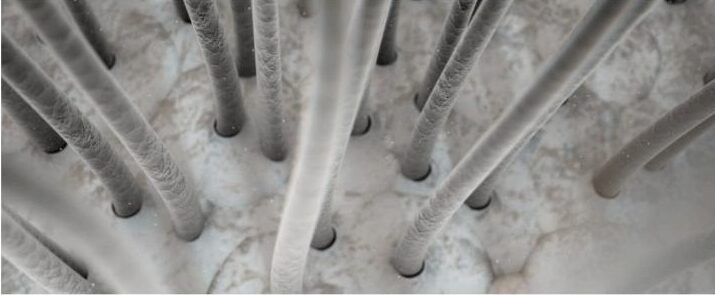
When hairs exit the scalp at very acute angles (10 to 20 degrees), they lie nearly flat against the scalp surface and overlap like roof tiles or fish scales. Each hair shaft blocks the light that would otherwise reveal the scalp beneath it.
In contrast, when hairs stand upright at 45 degrees or more, they create gaps between shafts. Light reaches the scalp and reveals thinning, even when graft density is identical.
The same number of grafts placed at acute angles can appear significantly denser than grafts placed at steep angles. The coverage footprint of each hair shaft is dramatically larger when it lies flat.
Research published in the NIH database demonstrated that acute insertion angles reduce depth of penetration and vascular damage. Coronal slits produce less vascular damage than sagittal slits, connecting optical benefits to biological ones.
The lateral slit (coronal) technique allows more acute angulation than sagittal (vertical) slits. It enables grafts to fan out over the scalp surface for better coverage and gives surgeons the highest degree of control over both angle and direction.
Think of how hairs spread and overlap in a natural shingling pattern, maximizing coverage per graft, similar to how a peacock’s tail feathers layer over one another.
Zone-by-Zone Incision Science: Why the Scalp Is Not a Uniform Surface
The scalp is not a single uniform surface. It is a topographically and biologically varied landscape where each zone has evolved a distinct hair growth pattern that must be precisely replicated. Understanding this “surgical cartography” is essential before making a single incision.
The Frontal Hairline Zone (15 to 20 Degree Exit Angle)
The frontal hairline is the most scrutinized zone. It is the first thing observers see and the area where transplant errors are most immediately visible.
The correct exit angle ranges from 15 to 20 degrees from the scalp surface, creating a nearly flat, forward-pointing hair shaft. Single-hair grafts must be used at the very front edge in an irregular triangular pattern with a feathered edge. A straight line would immediately signal an artificial result.
The transitional zone concept requires a quarter-inch width of single-hair grafts at the front, transitioning to 2-hair then 3-hair grafts further back. This replicates the natural density gradient found in native hairlines.
Tumescence (fluid injected to lift the scalp) temporarily distorts natural hair angles during surgery. Skilled surgeons must mentally compensate, knowing that transplanted hairs will revert to the natural acute angle once tumescence is absorbed. The body also slightly elevates the implanted angle during healing, so surgeons must plan incision angles slightly more acute than the target.
The Frontotemporal Zone (10 to 15 Degree Exit Angle)
The frontotemporal zone transitions between the frontal hairline and the temporal hairline. Here, angles must progressively decrease as they approach the temples.
The correct exit angle range is 10 to 15 degrees, even more acute than the frontal hairline. Hair in this zone naturally lies extremely flat against the scalp.
The directional complexity increases here. Hairs not only point forward but begin to angle downward and laterally toward the temple. This requires simultaneous adjustment of both angle and direction variables.
Errors in this zone are particularly visible because the frontotemporal recession point is a highly gender-specific anatomical landmark. Incorrect angles here can make a male hairline look feminine or vice versa.
The Temporal Hairline Zone (5 to 10 Degree Exit Angle)
The temporal hairline is the most technically demanding hairline zone for angle precision. Exit angles as low as 5 to 10 degrees mean hairs lie almost completely parallel to the scalp surface.
Temporal hairs point predominantly downward toward the ear and jaw, not forward. This direction is completely different from frontal hairs and must be independently planned.
Errors here create an immediately obvious “pluggy” appearance that is extremely difficult to correct. Hairs pointing forward instead of downward, or exiting at 20 degrees instead of 5 degrees, signal an artificial transplant to any observer.
Existing miniaturized hairs in this zone should be observed with loupe magnification to determine individual growth patterns before any incisions are made.
The Mid-Scalp Zone (30 to 45 Degree Exit Angle)
The mid-scalp contrasts sharply with hairline zones. Exit angles increase significantly to 30 to 45 degrees, reflecting the natural tendency of mid-scalp hairs to grow at a more upright angle.
Hairs generally point forward but with less extreme lateral variation than the hairline zones. The mid-scalp typically receives 2-hair and 3-hair follicular unit grafts at higher density than the hairline.
This zone serves as a transition between the acute-angle hairline and the complex radial pattern of the crown. The angular shift across this zone must be gradual.
The ISHRS Practice Census found the average FUE case uses 2,262 grafts across multiple zones. This means a surgeon must maintain consistent angle and directional precision across thousands of individual micro-incisions over a 4 to 6 hour procedure.
The Crown and Vertex: Where Every Single Graft Points in a Different Direction
The crown (vertex) is the most technically demanding zone in the entire scalp. The challenge is not angle complexity alone but the radial whorl pattern that makes every single graft point in a unique direction.
Hair in the crown grows in a radial spiral pattern emanating from a central axis point. A graft placed at 12 o’clock on the whorl points in the exact opposite direction from a graft placed at 6 o’clock, yet both are in the same small anatomical zone.
Unlike the hairline, where a surgeon can establish a consistent angle and direction across a zone, the crown requires individualized directional planning for every single incision. There is no “default” direction.
Some patients have double or triple whorl centers, creating intersecting radial patterns that require even more complex directional mapping before surgery begins.
The cross-hatching technique used in the crown follows the patient’s specific whorl pattern. Three-hair and 4-hair grafts are placed at lower density (25 to 35 FU per square centimeter) to account for technical complexity and lower blood circulation in this zone.
Graft survival rates at the crown average 85 to 92% compared to 90 to 95% in frontal areas. This difference partly reflects lower blood circulation and the technical complexity of recreating the whorl pattern.
The Biology Behind the Incision: How Angle Affects More Than Appearance
The biological consequences of incision angle extend beyond aesthetics. Acute angles connect optical benefits to measurable improvements in graft survival and vascular preservation.
As insertion angle decreases (becomes more acute), the depth of the channel decreases for the same graft length. This reduces the risk of severing blood vessels that are critical for graft survival in the first 48 to 72 hours.
Coronal (lateral) slits produce measurably less vascular damage than sagittal slits, which is why leading surgeons prefer lateral slits for both biological and aesthetic reasons.
Sapphire FUE blades feature a V-shaped crystal geometry that creates micro-channels with more consistent depth walls than U-shaped steel blades. This improves graft anchorage and reduces depth variation, contributing to more reliable angle maintenance and better graft survival.
Reputable clinics using advanced recipient site techniques report graft survival rates averaging 90 to 95%. Every graft that fails to survive due to poor angle-related vascular damage represents a permanent loss of donor hair that cannot be replaced.
When Angle Goes Wrong: The Irreversibility Problem
The most consequential and underreported aspect of recipient site angle errors is their extreme difficulty, and sometimes impossibility, to fully correct.
Once a graft is placed at an incorrect angle and survives, it becomes anchored in scar tissue that forms around it during healing. The follicle is then biologically programmed to grow at the wrong angle.
To fix a wrong-angle graft, a surgeon must either remove it entirely (risking permanent follicle loss), attempt to redirect it (technically very difficult in scar tissue), or camouflage it with additional correctly-angled grafts.
Correction often requires multiple surgical sessions. Each session adds more scar tissue, reduces the available donor supply, and increases the complexity of subsequent procedures.
The official ISHRS page on revision surgery confirms that grafts placed at the wrong angle or direction, especially at the hairline, create a very unnatural appearance and are a leading cause of revision surgery.
In some cases, particularly when wrong-angle grafts are densely packed in heavily scarred tissue, results may never be fully natural regardless of how many corrective procedures are attempted.
Patients should ask specific questions during consultation: How does the surgeon plan and document angle and direction before making incisions? What is their approach to the crown whorl? How do they account for tumescence distortion?
What Separates Elite Recipient Site Creation from Average: The Artistic Dimension
Recipient site creation is simultaneously a precise surgical procedure and an irreversible artistic decision. The most technically correct angles can still produce unnatural results if artistic judgment is absent.
An elite surgeon mentally maps the entire scalp as a three-dimensional topographic surface. They plan how light will interact with hair at every angle and from every viewing direction, not just from the front.
A hairline that looks natural from the front must also look natural from the side, from above, and in motion. Angle and direction planning must account for all viewing angles simultaneously.
The density gradient artistry requires transitioning from the feathered single-hair edge of the hairline through progressively denser zones. This demands a calibrated sense of how density interacts with angle to create the illusion of natural growth.
The ISHRS describes recipient site work as “where the science and art of hair transplant are applied.” This framing validates the dual-dimension framework that separates adequate results from exceptional ones.
This artistic dimension explains why experience matters profoundly. The judgment required to make thousands of correct angle and direction decisions across a full scalp, while accounting for zone transitions, hair texture, tumescence distortion, and healing corrections, cannot be learned from a textbook. Patients evaluating surgeons should review before and after hairline results to assess the quality of angle and direction work across real cases.
Conclusion: The Incision Is the Result
Recipient site angle and direction are not a single technical step in the hair transplant process. They are the irreversible architectural decisions that determine everything the patient will see in the mirror for the rest of their life.
Angle (tilt) and direction (compass heading) are separate variables that must both be precisely controlled, zone by zone, graft by graft. The shingling effect serves as the unifying physics principle: acute angles create the illusion of density through light-blocking overlap.
From the 5 to 10 degree temporal hairline to the 30 to 45 degree mid-scalp to the radial whorl of the crown, where every single graft points in a different direction, the scalp demands a completely individualized incision strategy.
Patients who understand these principles are better equipped to evaluate surgeon skill, ask the right questions during consultation, and recognize the difference between a surgeon who treats recipient site creation as a routine technical step and one who treats it as the irreversible artistic decision it truly is.
Ready to See What Precision Recipient Site Creation Can Do for You?
Understanding the science is the first step. The second step is having a consultation with surgeons who apply this science at the highest level.
Hair Transplant Specialists brings board-certified surgeons to every procedure, including former ISHRS President Dr. Sharon Keene. Their proprietary Microprecision Follicular Grafting® technique and surgical technicians with 15 to 18 years of experience represent the standard that produces results that look grown, not placed.
A thorough pre-surgical assessment, including multi-parting scalp analysis, whorl mapping, and zone-by-zone directional planning, is the foundation of natural-looking results.
To discuss a specific hair loss pattern and restoration goals, prospective patients can schedule a consultation at Hair Transplant Specialists (INeedMoreHair.com) or call (651) 393-5399. Financing options are available starting at $150 per month.
At Hair Transplant Specialists, the philosophy is clear: “It’s not just about the procedure; it’s about YOU and your journey.” Patients who choose this practice are choosing surgeons who understand that every incision is an irreversible decision and who treat it with the precision, artistry, and respect that decision deserves.