Hair Transplant Overhead Lighting Photography: The Physics Behind Why Your Scalp Looks Worse in Clinic Photos
Introduction: Why Hair Looks Worse in Clinic Photos Than in Real Life
The scenario is all too familiar: a patient sits in a clinic examination room, reviews their “before” photographs, and feels a wave of shock. Their hair appears dramatically thinner in those images than it ever does in their bathroom mirror or during daily life. The immediate assumption is that the camera has captured some hidden truth—but the reality is far more nuanced.
Overhead lighting is not a neutral observer. It functions as a physics-driven distortion engine that systematically exaggerates scalp visibility and hair thinning. This phenomenon affects both “before” and “after” photographs, meaning that inconsistent lighting between documentation sessions can make results appear dramatically better or worse than reality warrants.
Understanding the optical physics at play empowers patients to independently evaluate any clinic’s photo library with a science-backed framework. Hair transplant overhead lighting photography represents a specific, underexplored topic with real consequences for patient decision-making. From specular reflection and sebum amplification to fluorescent light characteristics and ISHRS-endorsed standards, the following analysis provides the technical foundation patients need to interpret clinical photographs accurately.
The Physics of Light and Hair: What Actually Happens When Overhead Light Hits the Scalp
Two fundamental types of light reflection determine how hair appears in photographs: specular reflection (mirror-like, directional) and diffuse reflection (scattered, filling). The distinction between these two phenomena explains nearly everything about why overhead lighting creates such unflattering results.
When overhead lighting strikes the scalp, it produces the brightest illumination on the very top of the head—precisely the area most affected by hair thinning in pattern baldness. This positioning creates maximum contrast between scalp skin and hair shafts.
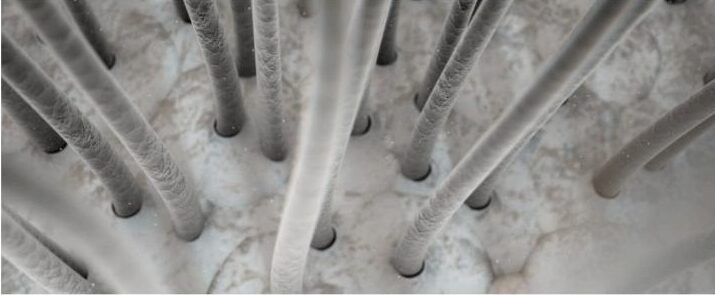
Specular reflection on individual hair shafts compounds the problem. Direct overhead light causes each hair to appear as an isolated, thin filament with a bright highlight along its length. This visual separation makes strands that would otherwise appear as a unified mass look sparse and disconnected.
Diffuse lighting produces the opposite effect. When light arrives from multiple angles or is scattered by soft surfaces, it fills the gaps between hair strands. The hair mass appears fuller, denser, and more continuous—much closer to how it looks in person under normal social conditions.
The concept of “local contrast amplification” further explains the distortion. Overhead light increases the contrast between pale scalp skin and darker hair shafts, making the scalp appear to “show through” even in areas of moderate density. Additionally, hair color interacts significantly with these physics: lighter hair allows more light to pass through, appearing thinner under bright overhead illumination, while darker hair absorbs more light and appears denser under identical conditions.
The Sebum Factor: How the Scalp’s Natural Oil Amplifies Overhead Glare
The scalp naturally produces sebum—an oily secretion that creates a semi-reflective surface layer across the skin. This biological reality has significant implications for photography.
Direct overhead lighting strikes the sebum layer at a near-perpendicular angle, generating strong specular highlights that visually “wash out” the scalp surface. These glare spots make the scalp appear more exposed than it actually is, amplifying the appearance of thinning.
At oblique angles, sebum reflections redirect away from the camera lens, dramatically reducing scalp glare and revealing true hair density above the skin. This explains why the same head of hair can look drastically different depending on the lighting angle.
The sebum-amplification effect proves most pronounced in patients with naturally oily scalps, in post-operative patients whose scalps may be more reactive, and in photos taken shortly after washing when temporary sebum stripping leaves the scalp shinier.
The “wet hair” variable introduces additional complexity. Wet hair clumps together and lies flat, reducing apparent volume. Combined with bright overhead or flash lighting, wet hair can make even a healthy scalp look nearly bald—a critical variable that must be controlled in before-and-after documentation.
This matters profoundly for patient self-assessment. The harsh overhead lighting found in many bathrooms and examination rooms creates a worst-case optical scenario that does not represent how hair looks under normal social lighting conditions.
Why Fluorescent Overhead Fixtures Are Particularly Problematic
Fluorescent overhead lighting is widely cited by dermatologists and hair restoration experts as one of the worst light types for making hair look thin—even in people with perfectly normal hair density.
The spectral characteristics of standard fluorescent tubes explain part of the problem. These fixtures emit light in discontinuous spikes across the visible spectrum rather than a smooth, full-spectrum curve, distorting the perceived color and texture of both hair and skin.
Color temperature, measured on the Kelvin scale, represents another critical variable. Standard indoor fluorescent bulbs typically range from 3000K–4000K with a cool, slightly green-tinged output. Standard incandescent bulbs (~2700K) produce warm yellow overtones. Both distort hair and skin color relative to clinical standards.
For medical and clinical photography, 5000K is considered the ideal color temperature because it replicates natural daylight with white light and captures subtleties and details with clarity.
The overhead placement of fluorescent fixtures compounds their spectral problems. Even a spectrally neutral light source becomes problematic when positioned directly above the subject because the geometry of illumination—not just light quality—determines how scalp and hair are rendered.
Clinical photography experts explicitly avoid overhead lights. According to ISHRS research, “even subtle variations in lighting, technique, and angulation can produce misleading outcome results—both intentional and unintentional.”
How Unethical Clinics Exploit Lighting to Manipulate Before-and-After Photos
The most common manipulation tactic involves using bright, harsh overhead lighting in “before” photos to maximize scalp visibility and apparent thinning, then switching to dim, soft, or offset lighting in “after” photos to minimize scalp show and make hair look fuller.
The “wet versus dry” manipulation represents another deceptive practice. “Before” photos taken with wet, flat hair under overhead light combined with “after” photos featuring dry, styled hair under flattering diffuse light can make even modest results appear dramatic.
Camera angle manipulation offers yet another tool for distortion. Slightly lowering the camera angle in “after” photos reduces the overhead perspective on the scalp, while raising it in “before” photos maximizes scalp exposure—a subtle but powerful technique.
Timeline manipulation poses additional risks. Hair transplant results evolve over 12–18 months, and lighting inconsistencies between early “before” photos and later “after” photos can dramatically exaggerate apparent improvement, misleading patients about realistic outcomes.
AI-driven image analysis tools now offer emerging protection. These systems can scan before-and-after photographs to detect pixel inconsistencies, lighting manipulation, and digital alterations used to exaggerate hair density.
Importantly, not all lighting inconsistencies reflect malicious intent. A 2022 peer-reviewed study found that only 32% of hair loss patients in an academic dermatology practice had optimal standardized photos taken—underscoring how widespread the problem is even without deliberate manipulation.
The ISHRS Clinical Gold Standard: What Ethical Hair Transplant Photography Actually Looks Like
The International Society of Hair Restoration Surgery (ISHRS) serves as the leading professional authority on hair restoration standards and has published specific photography guidelines for clinical documentation.
The 45° dual-point illumination standard requires fluorescent lamps placed at 45° angles from the patient on both sides. This positioning minimizes shadows and produces consistent, balanced illumination that accurately represents hair density.
The 5000K color temperature requirement ensures daylight-equivalent white light that captures hair and skin color with clinical accuracy, avoiding the warm distortion of incandescent bulbs or the spectral gaps of standard fluorescent tubes.
Advanced clinical photography employs a “twin-flash” (dual point light source) system that creates balanced illumination enhancing both depth and texture without the specular blowout caused by single-point overhead or built-in camera flash.
The full standardized protocol includes:
- Consistent lighting setup
- Fixed camera position and distance (tripod required)
- Identical head angles
- Same hair styling state (wet vs. dry)
- Same background
- Documented timestamps for each photo session
Cross-polarized light photography represents an advanced technique used in dermatology to eliminate specular reflections entirely, enhancing visualization of subsurface scalp structures.
Dedicated photography rooms with object markers for head positioning are recommended by ISHRS to ensure reproducibility across sessions—a standard that separates serious clinical practices from those using ad hoc documentation.
A Patient’s Framework for Evaluating Any Clinic’s Photo Library
Prospective patients can apply the following science-backed checklist when reviewing before-and-after photos on any clinic’s website or during consultation:
Lighting consistency: Are the “before” and “after” photos taken under the same lighting conditions? Matching shadow patterns, highlight placement, and overall brightness levels indicate standardization.
Overhead versus angled light: Does the “before” photo show a bright highlight on the top of the scalp with harsh shadows around hair shafts? This signature of overhead lighting artificially exaggerates thinning.
Wet versus dry hair: Is hair wet and flat in the “before” photo but dry and styled in the “after”? This combination can manufacture dramatic-looking results from modest actual improvement.
Camera angle: Is the camera positioned at the same height and angle in both photos? Higher angles in “before” photos maximize scalp exposure; lower angles in “after” photos minimize it.
Color temperature: Do the photos have the same color cast? A warm yellow “before” and cool white “after” (or vice versa) signals a lighting change that may distort the comparison.
Video evidence: Videos are considered superior to still photos for evaluating results because moving hair under natural light reveals density, texture, and naturalness that static photos can easily hide or exaggerate.
Timestamps and staging: Are photos clearly timestamped? Results documented at 6 months versus 18 months represent very different stages of the growth cycle.
Patients should feel empowered to ask clinics directly about their photography protocol. A reputable clinic should describe their lighting setup, color temperature, and standardization procedures without hesitation.
What Good Lighting Reveals: Setting Realistic Expectations
Hair density and transplant results that appear thin under harsh overhead or flash lighting may still look completely natural under normal, diffuse, or front-lit conditions. Only very high-density transplants can consistently escape appearing thin under all harsh lighting conditions.
The “bathroom mirror effect”—seeing hair look dramatically thinner under overhead bathroom lighting—represents a real optical phenomenon, not necessarily an accurate reflection of actual hair density or transplant success.
Many patients experience anxiety about their results specifically because of how their hair looks under overhead lighting at home or in examination rooms, when the same hair may appear entirely natural in social settings with diffuse or ambient light.
The 12–18 month growth timeline adds another dimension. Evaluating transplant success at 3–4 months under harsh overhead lighting creates unnecessary distress about results that have not yet fully developed.
According to the 2025 ISHRS Practice Census, 84.7% of surgical patients are men, with average FUE cases involving approximately 2,262 grafts. This context matters when evaluating photographic documentation of density.
Patients should request in-person consultations under varied lighting conditions—including both overhead and natural light—to gain a more complete picture of their actual hair density and transplant progress.
How Hair Transplant Specialists Approaches Clinical Photography and Patient Documentation
Hair Transplant Specialists (INeedMoreHair.com) maintains a commitment to ethical, accurate patient documentation as part of their broader philosophy of transparency and patient-centered care.
Dr. Sharon Keene’s credentials directly inform this commitment. As a former President of ISHRS (2014–2015) and recipient of the Platinum Follicle Award for outstanding research, Dr. Keene brings direct familiarity with ISHRS photography standards and their scientific basis.
The practice’s Microprecision Follicular Grafting® technique is designed to produce results that look natural under all lighting conditions—not just under favorable studio lighting. This makes accurate photographic documentation both possible and important.
The practice’s ethical foundation is well-established. Dr. Keene’s 2003 “Mouth of Truth” ethics award and extensive patient education about industry red flags—including misleading before-and-after photos from overseas providers—reflect a culture of transparency.
Accurate clinical photography serves practical purposes beyond ethics: honest documentation allows surgeons to accurately assess results, plan subsequent procedures with the required 8-month waiting period, and provide patients with realistic expectations.
Conclusion: The Camera Doesn’t Lie — But the Lighting Might
Overhead lighting creates specular reflections off the scalp’s sebum layer, forces individual hair shafts to appear as isolated thin filaments, and systematically exaggerates scalp visibility—making hair look thinner than it actually is.
The distinction between intentional manipulation and unintentional standardization failures matters. Both produce misleading photos, and patients deserve to understand the difference.
The ISHRS gold standard—45° dual-point illumination at 5000K color temperature, consistent camera position, identical hair styling state, and documented timestamps—represents the framework that produces honest, clinically defensible documentation.
With the patient checklist provided in this article, any prospective hair transplant patient can independently evaluate a clinic’s photo library using the same scientific framework that clinical experts apply.
As AI-driven image analysis tools become more accessible and clinical photography standards gain wider adoption, patients will have increasingly powerful tools to verify the authenticity of before-and-after documentation.
Understanding the physics of light does more than protect patients from misleading marketing. It relieves the anxiety of seeing one’s own hair look thinner than expected under harsh overhead lighting by explaining that this is a property of the light—not the hair.
Schedule a Consultation with Hair Transplant Specialists
Patients concerned about hair loss or evaluating hair transplant options are invited to schedule a consultation with Hair Transplant Specialists at INeedMoreHair.com. The practice’s commitment to transparent, accurate documentation and honest patient education reflects the same values demonstrated throughout this article.
The team’s credentials speak for themselves: board-certified surgeons with combined 100+ years of experience, including a former ISHRS President, and surgical technicians with 15–18+ years of experience.
The Eagan, Minnesota location offers convenient access, with contact available by phone at (651) 393-5399 or through the website. Office hours are Monday–Thursday 9 AM–5 PM and Friday 9 AM–3 PM, with weekend appointments available.
Prospective patients are encouraged to explore the practice’s before-and-after photo library with their new knowledge of lighting standards and to reach out with any questions about how the practice documents its clinical results.