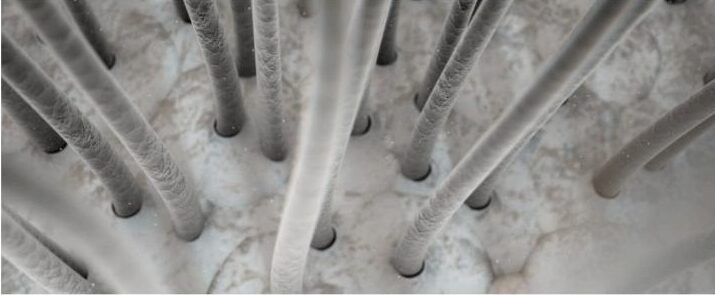
Hair Transplant Donor Hair Characteristics: The Molecular Biology Behind Permanent Results
Introduction: Why Some Hair Never Falls Out — And What That Means for Transplantation
On the same scalp, a remarkable paradox unfolds daily: some hair follicles are progressively destroyed by hormones while others—located just centimeters away—remain completely immune to the same biological assault. This phenomenon is not random. It is the result of precise molecular programming that determines which follicles thrive and which succumb to androgenetic alopecia (AGA), the condition affecting approximately 50% of men over age 40 and 30–40% of women aged 60–69.
The scientific foundation of modern hair transplantation rests on a discovery made by Dr. Norman Orentreich in the 1950s. His research established what is now called “donor dominance”—the principle that DHT-resistant follicles retain their resistance even when surgically relocated to DHT-sensitive areas of the scalp. This single insight transformed hair restoration from experimental curiosity into reliable medical practice.
Most explanations of hair transplant donor hair characteristics stop at a simple statement: hair from the back of the head resists DHT. This article goes deeper, unpacking the three-layer molecular biology that makes occipital follicles uniquely permanent, then grounding that science in the anatomical statistics surgeons use to plan successful restorations.
The Foundation: Donor Dominance and Why Location Is Not Destiny
Donor dominance operates on a fundamental principle: a follicle’s behavior is determined by its own genetic programming, not by the scalp environment it occupies. The “seed” overrides the “soil.”
When occipital follicles are transplanted to previously bald areas, they continue producing thick, healthy hair because they carry intrinsic resistance within their cellular machinery. The recipient scalp’s DHT-rich environment cannot reprogram these follicles—their genetic identity remains intact. According to ISHRS data, over 85% of transplanted follicles continue growing even five years after surgery, confirming the long-term permanence of DHT-resistant donor grafts.
The scalp divides into distinct zones based on androgen sensitivity. The frontal scalp and vertex (crown) are DHT-sensitive zones where miniaturization occurs. The occipital and temporal regions—the back and sides of the scalp—are DHT-resistant zones where follicles maintain their integrity throughout life.
Dihydrotestosterone (DHT) is a potent androgen derived from testosterone. In susceptible follicles, DHT binds to cellular receptors and triggers a cascade that progressively shrinks the hair shaft until the follicle stops producing visible hair entirely. Donor dominance is not merely a clinical observation—it has a precise molecular explanation built on three independent biological mechanisms.
The Three-Layer Biological Protection System of Occipital Follicles
Understanding why hair transplants work permanently requires examining the three-layer protection system that shields occipital follicles from androgen-driven destruction. Each layer independently reduces androgen sensitivity, and together they create robust, redundant resistance that persists for decades.
These three mechanisms are: (1) differential androgen receptor and 5-alpha reductase type 2 gene expression, (2) the aromatase advantage, and (3) the epigenetic lock via DNA methylation.
Layer 1: Differential Androgen Receptor and 5-Alpha Reductase Type 2 Expression
The dermal papilla (DP) cell functions as the command center of each hair follicle. It receives hormonal signals and determines whether a follicle grows, miniaturizes, or dies. Research published in Nature Scientific Reports (2023) demonstrated that frontal and vertex dermal papilla cells express significantly higher levels of androgen receptor (AR) and 5-alpha reductase type 2 (5αR2) than occipital DP cells.
This differential gene expression creates a two-step vulnerability in frontal follicles: 5αR2 converts testosterone into DHT (the more potent androgen), and AR then binds DHT to trigger miniaturization signaling. Occipital follicles have substantially less of both enzymes and receptors, dampening the entire cascade.
Research from the Journal of Endocrinology confirms that balding dermal papilla cells contain significantly greater levels of androgen receptors than non-balding scalp DP cells. This differential expression is measurable, consistent, and intrinsic to the follicles themselves—not a temporary hormonal state that changes over time.
Layer 2: The Aromatase Advantage — Converting Androgens Into Protection
Aromatase (CYP19A1) is an enzyme that converts androgens into estrogens, effectively neutralizing their hair-damaging potential at the follicle level. Research indicates that occipital follicles show higher levels of aromatase compared to frontal follicles, which show higher AR and 5αR2 expression. This biochemical balance tilts occipital follicles toward estrogen protection.
Estrogens generally exert a hair-preserving effect. The local conversion of androgens to estrogens within occipital follicles creates a microenvironment that actively counteracts DHT-driven miniaturization. This mechanism is particularly relevant for female patients, as women have higher baseline aromatase activity than men—helping explain why female pattern hair loss tends to be more diffuse and less severe than male AGA.
This is a local enzymatic advantage within the follicle itself, independent of systemic estrogen levels, and it persists post-transplant regardless of the patient’s hormonal profile. While reduced AR and 5αR2 expression limits DHT’s ability to signal, aromatase actively disarms androgens before they can bind.
Layer 3: The Epigenetic Lock — DNA Methylation Silences Androgen Sensitivity
Beyond the DNA sequence itself, chemical tags on the genome can switch genes on or off. In occipital follicles, the androgen receptor gene is actively silenced by DNA methylation—one of the most stable epigenetic mechanisms known.
Research from the Indian Journal of Dermatology demonstrates that DNA methylation of the AR gene promoter is increased in occipital hair follicles compared to vertex AGA scalp follicles. This methylation physically blocks the AR gene from being transcribed into androgen receptor proteins.
This is not passive low expression—it is an active, heritable silencing mechanism. Epigenetic methylation patterns are cell-intrinsic and maintained through cell division. Transplanted occipital follicles carry this epigenetic lock into their new location and pass it on to daughter cells.
Frontal and vertex follicles show lower AR promoter methylation, meaning the AR gene is more accessible and readily expressed—making them vulnerable to DHT-driven miniaturization. Even if androgen levels were artificially elevated in the recipient area, the epigenetic lock would continue suppressing AR expression in transplanted occipital follicles.
How the Three Layers Work Together: A Redundant Defense System
Occipital follicles benefit from a unified, multi-layered defense: they produce less of the enzyme that makes DHT (reduced 5αR2), have fewer receptors to receive DHT’s signal (reduced AR expression), actively convert remaining androgens into protective estrogens (aromatase), and have the AR gene itself epigenetically silenced (DNA methylation).
Each layer independently reduces androgen sensitivity. Together, they create a defense system that is extremely difficult for DHT to overcome—explaining why donor dominance is so reliable and long-lasting. This also explains why transplanted hair retains not just its resistance to DHT but also its physical characteristics—hair shaft caliber, texture, and growth cycle—because these traits are encoded in the same genetic and epigenetic program.
The Anatomy of the Safe Donor Zone: Mapping the Permanent Harvest Area
The safe donor zone is anatomically defined as the mid-occipital region between the upper and lower occipital protuberances. According to StatPearls (NCBI), this area typically contains 65–85 follicular units per cm² and spans approximately 200 cm².
Walter Unger’s landmark 1994 study of 328 men over age 65 established the anatomical limits surgeons still use today. The study found that 80% of patients under age 80 retained hair within specific boundaries—providing the evidence base for safe harvesting zones.
Donor areas with over 80 follicular units per cm² are excellent transplant candidates, while densities below 40 FU/cm² are considered less suitable. A study of 580 Indian men found a mean follicular unit density of 78.2 FU/cm² in the donor area, with an average hair density of 141.5 hairs/cm²—illustrating that each follicular unit contains multiple hairs (typically 1–4).
The Lifetime Graft Budget: Understanding Finite Restoration Capital
Donor hair represents a finite, non-renewable resource—a lifetime restoration capital that must be strategically managed across a patient’s entire restoration journey.
The average safe donor zone contains approximately 20,000–25,000 total follicular units. However, only an estimated 6,000–7,000 grafts are safely harvestable in a lifetime without creating visible donor depletion. Of the approximately 50,000 follicular units on the scalp, roughly 75% are in the frontal region and vertex (at risk of loss in AGA), while the permanent donor area contains approximately 25%.
Removing more than 35–40% from any single region of the donor area risks visible thinning, creating cosmetic defects ranging from a moth-eaten appearance to near-complete donor alopecia. This is why reputable surgeons assess not just current hair loss but projected future loss—transplanting too aggressively early in life can leave insufficient donor hair for future procedures as loss progresses. Understanding how many grafts a hair transplant requires is therefore a critical part of long-term planning.
Hair Transplant Specialists maintains a minimum eight-month waiting period between procedures, allowing accurate assessment before committing additional grafts—one practical application of this principle.
Hair Shaft Characteristics: Beyond Follicular Unit Count
Donor hair quality is not determined solely by follicular unit density. Hair shaft caliber significantly affects visual outcomes—thicker hair shafts provide more coverage per graft. Curly or wavy hair provides greater apparent coverage than straight hair of the same density. High color-to-skin contrast makes both hair loss and transplanted hair more visually apparent.
Transplanted follicles retain all these physical characteristics post-transplant. Hair shaft caliber, texture, curl pattern, and color are encoded in the same genetic program as DHT resistance and are not altered by the recipient environment.
When the Safe Zone Isn’t Safe: Contraindications and Donor Limitations
Diffuse unpatterned alopecia (DUPA) represents a critical contraindication for hair transplantation. In this condition, hair loss affects temporal, parietal, and occipital areas—meaning there is no reliable DHT-resistant donor zone available. Surgeons identify DUPA risk through miniaturization studies of the donor area using dermoscopy or trichoscopy.
Harvesting outside the anatomically defined safe zone carries risk: follicles from extended temporal or parietal regions may not carry the same three-layer protection and may be lost to future AGA progression. With FUE specifically, because individual follicles are removed without a linear strip, invisible over-depletion can occur that only becomes apparent when the donor area thins.
Practical Takeaways for Hair Transplant Candidates
The permanence of hair transplant results is not a marketing claim—it is a direct consequence of three independently verified biological mechanisms operating at the genetic and epigenetic level.
Patients should choose a surgeon who respects the safe donor zone boundaries established by Unger’s research and adheres to the 35–40% harvesting limit. During consultation, a reputable surgeon should measure follicular unit density, assess miniaturization ratios, and discuss projected future hair loss before recommending a graft count. Considering the best age for hair transplant surgery is also an important factor in this long-term planning process.
Adjunct therapies—including finasteride, minoxidil, PRP, and Alma TED—can help preserve native hair and reduce the rate of future loss, extending the effective donor budget. The best outcomes result from treating hair restoration as a long-term strategy rather than a single event.
Conclusion: Three Molecular Layers, One Lasting Result
The permanence of hair transplant results is the product of three distinct, redundant biological protection mechanisms that make occipital follicles intrinsically and durably resistant to DHT. Unger’s 1994 research and updated clinical data provide surgeons with a precise, evidence-based map of the safe donor zone—approximately 200 cm², 65–85 FU/cm², with 6,000–7,000 grafts safely harvestable in a lifetime.
Understanding these mechanisms helps patients make informed decisions, ask better questions during consultations, and appreciate why the quality of surgical planning—not just surgical technique—determines long-term outcomes.
For patients with adequate donor density in the safe zone, a well-planned hair transplant is not just cosmetically effective—it is biologically permanent.
Schedule a Consultation with Hair Transplant Specialists
A comprehensive donor area assessment is the essential first step for patients seeking to apply this science to their own situation. Hair Transplant Specialists’ team—including Dr. Sharon Keene, former ISHRS President and Platinum Follicle Award recipient—brings the scientific expertise described in this article directly to patient consultations.
The practice evaluates follicular unit density, miniaturization ratios, hair shaft characteristics, and projected loss progression to develop personalized lifetime restoration strategies. With a combined 100+ years of surgical experience and technicians with 15–18+ years of experience, the molecular biology discussed here is applied with precision and artistry in every procedure.
Hair Transplant Specialists is located at 2121 Cliff Dr., Suite 210, Eagan, MN 55122, and can be reached at (651) 393-5399 or online at INeedMoreHair.com. Financing options are available starting at $150 per month.