Hair Transplant Clinic Minnesota State of the Art Facility: Inside the Two-Suite Standard That Redefines What a Surgical Environment Should Feel Like
Introduction: Why the Room Where Your Surgery Happens Matters More Than You Think
Picture the reality of a hair transplant procedure. A patient sits awake, alert, and largely stationary for anywhere from three to nine hours. There is no general anesthesia to fast-forward through the experience. The person receiving the surgery is present for every minute of it. That single fact changes everything about how a hair restoration facility should be designed, because the environment surrounding that patient becomes a direct variable in both the experience and the outcome.
This is the central argument worth taking seriously: facility quality is not a luxury marketing add-on. It is a measurable clinical and experiential factor that shapes patient stress levels, procedural compliance, and overall satisfaction. Patients already sense this intuitively. Research from the PwC Health Research Institute found that 65% of patients are willing to pay more for a better patient experience, a figure that confirms the connection between environment and value is not lost on the people undergoing treatment.
Hair Transplant Specialists in Eagan, Minnesota, serves as the subject of this facility deep-dive. This is a clinic that engineered its two surgical suites around the specific demands of long-duration hair restoration procedures, treating comfort infrastructure as a clinical consideration rather than a decorative afterthought.
This article breaks down exactly what a hair transplant clinic Minnesota state of the art facility should look like, why each element matters both clinically and experientially, and what the absence of this information from a competitor’s website should signal to a discerning patient.
The Anatomy of a Long Procedure: Understanding What 3 to 9 Hours in a Surgical Suite Actually Demands
Hair transplant surgeries, whether FUE (Follicular Unit Extraction) or FUT (Follicular Unit Transplantation), require patients to remain awake and relatively still for extended stretches of time. The typical range runs from three to nine hours, scaling with the scope of restoration.
During that window, a great deal happens. Local anesthesia is administered to keep the patient comfortable. Follicular units are extracted and implanted in careful phases. Throughout the entire process, the patient must remain calm, cooperative, and steady. This is not a passive experience. The patient is a participant.
That participation is where the environment becomes clinically relevant. Elevated stress responses can affect blood pressure, increase involuntary movement, and disrupt the controlled conditions a surgical team depends on. Each of those factors has downstream effects on graft survival and the precision of placement. A patient who is anxious, physically uncomfortable, or restless introduces variables that a well-designed environment can help minimize.
The data supports this connection. A Global Wellness Institute survey found that 87% of patients reported improved satisfaction when their healthcare environment included elements of luxury and personalized service. Comfort, in other words, is not separate from care. It is part of it.
This is why a standard exam room or a minimally equipped procedure room is functionally inadequate for this type of surgery. A space designed for a fifteen-minute consultation cannot reasonably support a patient for the better part of a working day. The surgical suite must account for the full duration of the procedure. With that context in place, the specific amenities at the Eagan clinic stop looking like perks and start looking like engineering decisions.
Inside the Two-Suite Standard: What Hair Transplant Specialists Built in Eagan, Minnesota
The facility at 2121 Cliff Drive, Suite 210, in Eagan, Minnesota, offers a concrete example of what deliberate design looks like in practice.
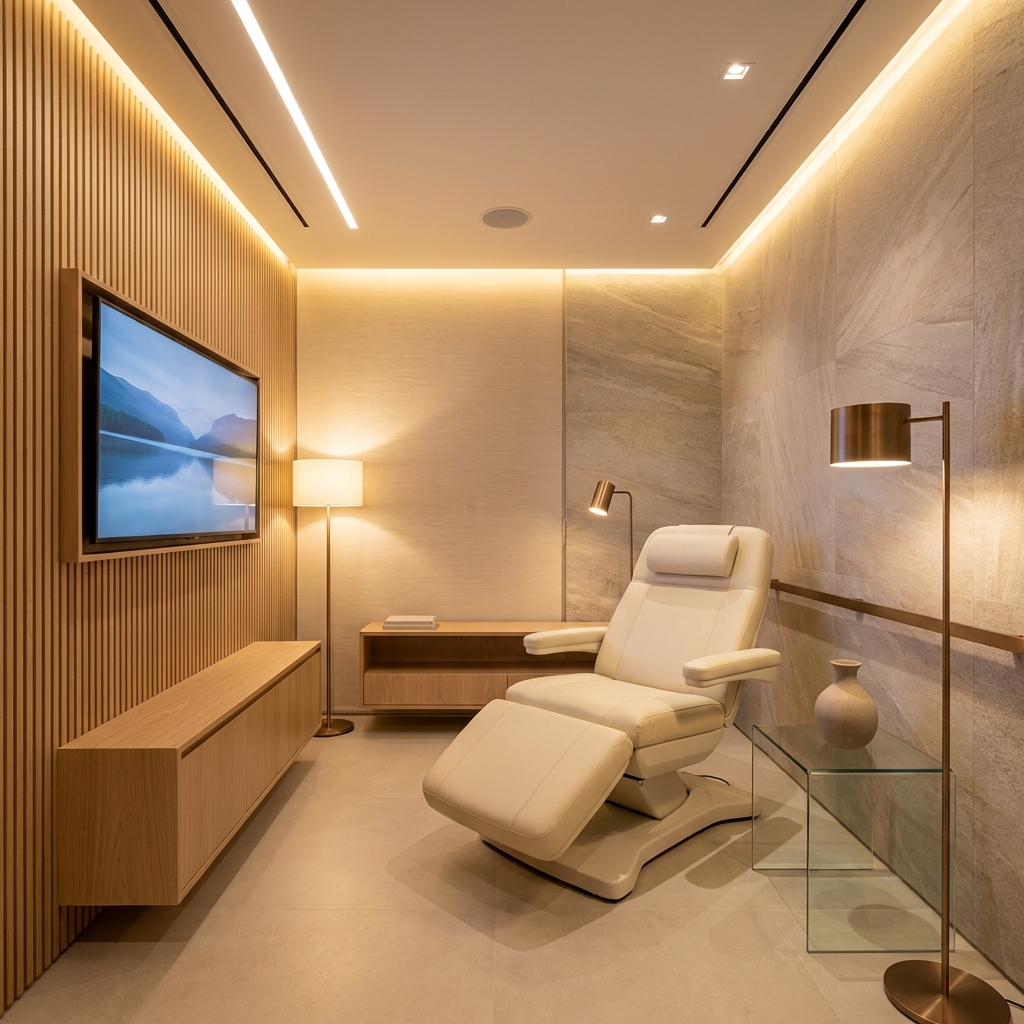
The foundational differentiator is straightforward: two dedicated state-of-the-art surgical suites. This is a specification most Minnesota competitors do not publicly disclose, which makes the disclosure itself a meaningful data point. When a clinic tells patients exactly how its surgical spaces are configured, it signals confidence in what it has built.
The operational significance of two suites goes beyond appearances. Dual suites allow the clinic to accommodate different procedure types, support combination FUT and FUE protocols (a hybrid approach projected to grow at a 14.88% CAGR), and maintain scheduling flexibility without ever compromising the sterility or setup integrity of either room. A single-suite operation cannot offer that kind of adaptability without tradeoffs.
The clinic also makes these suites visible through a virtual tour, allowing prospective patients to verify the environment before they ever set foot inside. That transparency stands in contrast to competitors who omit facility details entirely. Each amenity inside these suites is a deliberate design choice, not a decorative one, and the following breakdown explains why.
The 65-Inch TV, Netflix, and Sonos System: Entertainment Technology as Clinical Infrastructure
For a patient who will be awake and stationary for up to nine hours, the ability to watch a film, stream a favorite show, or settle into a curated music environment is far more than a convenience. It is a direct anxiety-management tool.
The clinical logic is well established. Reduced anxiety correlates with lower cortisol levels, steadier blood pressure, and reduced involuntary movement. Every one of those outcomes supports a more controlled surgical environment, which in turn supports the technical precision the procedure requires.
Each element in the Eagan suites serves that purpose:
- The 65-inch flat-screen TV provides an immersive visual anchor that redirects patient attention away from the procedure itself.
- Netflix streaming gives patients control over their own content selection, reinforcing a sense of autonomy during an experience where they might otherwise feel passive.
- The Sonos music system delivers high-quality audio tuned to patient preference, supporting genuine relaxation over a long session.
The competitive contrast is telling. No Minnesota competitor publicly specifies in-suite entertainment technology at this level of detail. Most say nothing on the topic at all. That silence is worth noticing. If a clinic’s surgical suite were genuinely equipped to this standard, it would have every reason to describe it.
Complimentary Meal and Beverage Service: Nutrition as a Procedural Requirement, Not a Courtesy
A patient undergoing a three-to-nine-hour procedure under local anesthesia has real physiological needs that do not pause for the surgery. Stable blood sugar, adequate hydration, and sustained energy levels all matter across a long session.
Neglecting these needs carries genuine consequences. Hypoglycemia, dehydration, and fatigue can increase patient discomfort, reduce cooperation, and in edge cases create medical complications that interrupt the procedure entirely. A hungry, dehydrated patient is a harder patient to keep still and calm.
The complimentary meal and beverage service at the Eagan clinic is best understood as a direct response to this reality. It is a procedural support system rather than a hospitality flourish. It also reduces the logistical burden on patients who may have traveled to the clinic and cannot easily step out mid-procedure to find food.
The broader payoff shows up in the patient experience. When patients feel physically cared for throughout a long procedure, their overall satisfaction and reported outcomes improve. That result is reflected in the clinic’s 4.6-star rating and in patient testimonials that specifically mention the facility’s amenities.
Facility Standards and Accreditation: The Regulatory Floor and What Exceeds It
Every Minnesota hair transplant clinic must comply with licensing from the Minnesota Board of Medical Practice and maintain state healthcare hygiene standards. That is the baseline, the regulatory floor beneath which no legitimate clinic can operate.
Above that floor sits a higher tier. The AAAHC (Accreditation Association for Ambulatory Health Care) and AAAASF are widely regarded as the gold-standard accreditation bodies for ambulatory surgical facilities. Clinics that reference or pursue these accreditations signal a meaningfully higher tier of facility standards.
What does that accreditation require? Board-certified surgeons, certified anesthesia providers, trained surgical staff, and documented internal quality review processes. Those standards align directly with the Eagan clinic’s credentialing profile. The ABHRS further requires that surgical extraction and incision creation are non-delegable acts, meaning they must be performed by the physician of record rather than handed off to unqualified staff. This is a core patient safety standard that the Eagan clinic’s board-certified surgical team satisfies.
The regulatory context makes all of this more important than it might first appear. In the United States, any licensed physician can legally perform hair transplants regardless of specialty background. There is no ABMS-recognized specialty board for hair restoration. That gap makes voluntary credentialing and facility standards the primary mechanism protecting patients. The Eagan clinic’s two dedicated surgical suites, board-certified team, and documented amenity standards all point to a facility that exceeds the regulatory floor. Patients evaluating any provider should ask competitors the same questions.
The Surgeon and Technician Standard: Why the People in the Suite Matter as Much as the Room
A state-of-the-art surgical suite is only as effective as the team operating within it. The physical facility and the human infrastructure are inseparable.
The Eagan clinic’s surgical team reflects that principle. Dr. Sharon Keene served as President of the ISHRS from 2014 to 2015 and received the Platinum Follicle Award for outstanding achievement in clinically related research. Dr. Paul Rose is board-certified and trained with elite aesthetic surgeons around the world. Dr. Roy Stoller is an international presenter, an author, and an examiner for board certification exams with more than twenty years of individual experience.
Taken together, the surgical team carries over 100 years of combined practice. That figure contextualizes the facility investment as part of a broader institutional commitment to clinical excellence rather than an isolated marketing decision.
The technician standard deserves equal attention. Surgical technicians at the Eagan clinic each bring more than eighteen years of individual experience. This matters enormously, because technician skill is a major variable in graft survival rates and procedural efficiency. Experienced hands at the technical level often make the difference between a good result and an exceptional one.
The scarcity of these credentials underscores their value. As of 2026, only 274 ABHRS-certified diplomates exist worldwide, with just 83 in the United States. Board-certified hair restoration surgeons represent a genuinely scarce credential. A highly experienced team also requires a facility engineered to support their precision: adequate lighting, a thoughtful suite layout, and a calm patient environment all contribute to the conditions in which expert technique can be executed.
What Minnesota Competitors Are Not Telling You: The Transparency Benchmark
This is a patient education exercise, not a competitive attack. When evaluating a hair transplant clinic, the information a clinic chooses not to publish can be as informative as what it does publish.
Consider the competitive landscape. Many Minnesota providers lead with surgeon credentials or brand recognition yet do not market facility comfort features or specify the number of surgical suites. Others leverage national brand recognition without any luxury facility positioning. The content gap is clear. No Minnesota competitor explicitly details the number of surgical suites, the specific in-suite technology (such as Sonos systems, Netflix, and 65-inch televisions), or the complimentary meal and beverage service as a differentiating facility feature.
Why does this gap matter? For a procedure lasting up to nine hours, a patient deserves to know precisely what environment they will occupy for that entire day. A clinic that has invested in genuine facility quality has every incentive to describe it in detail.
There is also a patient safety dimension. ISHRS data shows that 59% of members reported black market hair transplant clinics in their cities, up from 51% in 2021, and that 10% of cases are now repairs from prior black market procedures. In that context, facility transparency becomes a safety argument, not merely a comfort argument.
Patients can protect themselves by asking any clinic four direct questions:
- How many dedicated surgical suites do you have?
- What in-suite amenities are provided during the procedure?
- Are your surgeons board-certified by the ABHRS?
- What facility accreditation standards do you meet or exceed?
The Growing Patient Population: Why Facility Quality Is Increasingly a Decision Factor
The demand environment for hair restoration is robust and accelerating. The global hair transplant market was valued at approximately $9.10 billion in 2025 and is projected to grow substantially over the coming decade.
The demographics behind that growth are shifting in ways that make facility quality more relevant than ever. According to the ISHRS 2025 Practice Census, 95% of first-time hair restoration surgery patients in 2024 were aged 20 to 35. This is a digitally informed, experience-oriented demographic accustomed to researching facility quality before committing to any elective procedure.
The female patient segment is also expanding rapidly. Female surgical patients increased 16.5% from 2021, broadening the demographic profile of patients evaluating clinics. Research consistently suggests that this group places particularly high value on comfort, environment, and personalized care. Patients interested in understanding hair loss in women under 40 will find that the same facility standards that benefit male patients apply equally to this growing segment.
The post-COVID remote work trend has removed a longstanding barrier as well. Reduced concern about visible post-procedure signs, which can last up to ten days, has expanded the pool of patients ready to proceed. Those patients will increasingly differentiate providers on facility quality. All of this reinforces the PwC finding that 65% of patients are willing to pay more for a better experience, confirming that the Eagan clinic’s facility investment aligns with the direction of patient decision-making.
Patient Voices: What Real Experiences Reveal About the Facility’s Impact
The clinic’s verified review profile offers real-world confirmation of the facility’s impact. A 4.6-star rating, with facility amenities receiving specific positive mentions, demonstrates that the in-suite environment is a documented patient experience rather than a marketing claim.
Public endorsements reinforce that credibility. Darryl Sydor, a two-time Stanley Cup winner and former Minnesota Wild coach, is a public patient testimonial. That kind of high-visibility endorsement signals the clinic’s appeal to discerning, high-profile patients who have options and choose quality. Rob Olson, a Twin Cities television reporter, is another public endorser, strengthening the clinic’s credibility and visibility within the Minnesota community.
Across testimonials, the themes are consistent: life-changing results, restored confidence, natural-looking appearance, professional and kind staff, comfortable facilities, and the recurring sentiment that patients wish they had pursued treatment sooner. Those descriptions are not accidental. The comfort and professionalism patients report are the direct output of a facility engineered to support a positive experience from arrival through recovery.
Conclusion: Facility Quality Is a Clinical Variable, and Patients Deserve to Know the Difference
For a procedure lasting three to nine hours, the surgical environment is never a passive backdrop. It is an active variable in patient comfort, procedural success, and long-term satisfaction.
The Eagan clinic’s facility makes that principle concrete. Two dedicated surgical suites, 65-inch televisions with Netflix, a Sonos music system, and complimentary meal and beverage service are not luxury extras. They are functional design decisions made in direct response to the specific demands of long-duration hair restoration surgery.
The transparency argument runs through all of it. A clinic that has genuinely invested in its facility will describe that facility in detail. The absence of this information from a competitor’s website is a signal worth noticing. In a market where any physician can legally perform hair transplants and black market providers are on the rise, facility standards and surgeon credentials remain among the most reliable patient protection mechanisms available.
As the patient population continues to grow and diversify, with younger patients, more women, and more informed decision-makers entering the market, the clinics that have invested in both clinical excellence and facility quality will be best positioned to serve them. Patients who want to understand how to choose the right hair transplant surgeon will find that facility standards and surgeon credentials are inseparable parts of that evaluation. A true hair transplant clinic Minnesota state of the art facility earns that designation by treating the environment as part of the medicine.
Ready to See the Facility for Yourself? Schedule Your Consultation at Hair Transplant Specialists
For anyone weighing a hair restoration procedure, the most informative next step is to experience the facility firsthand. Scheduling a consultation at Hair Transplant Specialists in Eagan, Minnesota, offers the chance to see the two surgical suites in person and discuss individual goals directly with the surgical team.
For those who prefer to preview the space first, the virtual tour available on INeedMoreHair.com is an accessible starting point.
Location: 2121 Cliff Drive, Suite 210, Eagan, MN 55122
Phone: 651-393-5399
Office Hours: Monday through Thursday, 9 AM to 5 PM; Friday, 9 AM to 3 PM; weekends by appointment
The clinic also offers flexible financing options that make treatment accessible, with transparent pricing and no hidden fees. In keeping with the practice’s guiding philosophy, the consultation is about far more than the procedure itself. It is the beginning of a journey the clinic is committed to supporting at every step.