Beard Hair Transplant Near Me: The Surgical vs. Non-Surgical Decision Framework
FUE, DHI, and the 10–15° Angulation Factor That Separates Facial Hair Restoration From Scalp Work
Introduction: Why “Beard Hair Transplant Near Me” Is a More Complex Search Than It Looks
When someone types “beard hair transplant near me” into a search bar, they are usually asking two questions at once. The first is practical: who nearby can actually perform this procedure well? The second is technical: is surgery even the right choice, or should non-surgical options be explored first? Most people land somewhere in the middle, still comparing techniques and assessing candidacy while quietly scouting local providers.
That dual intent deserves a serious answer, because beard restoration has become a genuinely mainstream procedure. According to the ISHRS 2025 Practice Census, beard and mustache transplants are now the number one non-scalp hair restoration procedure for males, accounting for 5% of all male hair restoration surgeries in 2024, up from 4% in 2021. The global beard transplant market is projected to grow at an 18.48% CAGR through 2032, with year-over-year growth around 28% as of 2026.
Rapid growth, however, means provider quality varies dramatically. This article answers three questions before anyone books a consultation: (1) Is the patient a surgical or non-surgical candidate? (2) Which surgical technique fits beard work, and why does FUT almost never apply? (3) What is the 10–15° angulation factor, and why should it shape provider selection? By the end, readers will know exactly what to look for and why a practice like Hair Transplant Specialists in the Twin Cities meets that standard.
What Is a Beard Hair Transplant? Defining the Procedure Before Comparing Options
A beard hair transplant is the surgical relocation of hair follicles, typically harvested from the occipital (back) region of the scalp, into the face to create or restore beard density, coverage, or definition. It is a precise redistribution of a patient’s own living follicles.
One nuance most local clinic pages miss is directionality. Beard hair works in two directions. It can serve as a recipient site (scalp-to-face) in the classic beard transplant, or it can serve as a donor source (beard-to-scalp) for men with advanced scalp alopecia at Norwood stages 5 through 7. That distinction matters during consultation planning.
The reason transplanted follicles thrive is the principle of donor dominance, first described by Orentreich in 1959: relocated scalp follicles retain their genetic growth characteristics and continue producing hair for life once established in their new facial home.
Beard restoration can address a range of zones, including the full beard, goatee, mustache, sideburns, and scar coverage. Each requires different graft counts and angulation strategies. A full beard generally requires 1,500 to 3,500 grafts, while a goatee needs roughly 600 to 700. Notably, 95% of first-time beard transplant patients are between ages 20 and 35, making this a younger demographic with specific long-term planning considerations.
The Surgical vs. Non-Surgical Decision Framework: A Candidacy-Based Approach
Rather than the vague “it depends” that fills most clinic pages, the decision comes down to a structured, candidacy-based framework patients can use to self-assess before stepping into a consultation. This is a starting point for reflection, not a substitute for professional medical evaluation.
When Non-Surgical Treatments Are the Right Starting Point
Non-surgical treatment tends to fit patients with mild-to-moderate patchiness, early-stage thinning, a preference for a non-invasive approach, or a desire to optimize follicle health before considering surgery.
The evidence-based non-surgical options include:
- Topical minoxidil, which stimulates follicle activity.
- PRP (Platelet-Rich Plasma) therapy, which carries an 86% “Worth It” rating on RealSelf.
- Low-Level Light Therapy (LLLT) to stimulate follicles.
- Alma TED, an ultrasound-based system that delivers a growth serum without needles.
- Exosome and stem cell therapy for follicle support.
Scalp Micropigmentation (SMP) is also worth noting. This medical tattoo process can create the appearance of beard density and is especially useful for scar camouflage or for patients who are not surgical candidates.
The key limitation is fundamental: non-surgical treatments can stimulate existing follicles and slow loss, but they cannot create new follicles where none exist. That threshold is what separates non-surgical from surgical candidacy.
One critical disqualifier most competitor pages omit: active alopecia barbae, an autoimmune-driven form of beard loss, rules out surgical transplant because the inflammation prevents graft survival and can destroy newly placed follicles. These patients require medical management first.
When Surgical Beard Restoration Is the Appropriate Choice
Surgical restoration suits patients with severe patchiness, complete absence of growth in target zones, beard scarring from injury or prior procedures, or those for whom non-surgical options have been exhausted or are insufficient.
Beard transplantation is also a growing gender-affirming procedure for transgender and FTM patients. A 2025 systematic review confirmed that gender-affirming surgical interventions yield measurable improvements in mental health, reduction of gender dysphoria, and self-esteem.
A major gap in competitor content deserves attention here: donor allocation. Men under 35 with a family history of advanced male pattern baldness must recognize that scalp grafts are a finite, permanent resource. Allocating them to a beard now may limit scalp restoration options later. This conversation must happen at consultation, not after.
Reputable, accredited practices also include a pre-operative assessment to screen for Body Dysmorphic Disorder (BDD), a patient safety standard that separates quality providers from volume-focused clinics.
In short, if a patient has absent or severely scarred follicles in the target zone, is in stable health, does not have active autoimmune beard loss, and holds realistic expectations, surgical restoration is the appropriate path.
FUE, FUT, and DHI: The Technique Comparison Beard Transplant Patients Actually Need
The choice of surgical technique is not arbitrary; it is driven by the specific anatomical demands of the face. FUE accounts for 85.4% of all male hair restoration procedures globally (ISHRS 2025 Census), and DHI has emerged as the 2026 precision standard specifically for facial work.
FUE (Follicular Unit Extraction): The Foundation of Modern Beard Restoration
In FUE, individual follicular units are extracted one by one from the donor area using a micro-punch tool, leaving no linear scar. This suits beard work for two reasons: the absence of a linear scar matters for patients who wear their hair short, and individual extraction allows precise selection of single-hair follicular units, which are preferred for the natural look of facial hair.
FUE graft counts for beard work (1,500 to 3,500) are typically achievable in a single session without strip excision. Accredited clinics report 90–95% graft survival for beard transplants, and a 36-patient multicenter study documented 95.7% follicular unit survival at 9 months (Zhu et al., Dermatology and Therapy, 2020).
The limitation that leads to DHI: standard FUE is a two-step process. Recipient sites are created first, then grafts are placed. This introduces graft exposure time and makes precise angulation harder in the facial zone.
Why FUT (Strip Harvesting) Is Almost Never Used for Beard Transplants
In FUT, a strip of scalp tissue is surgically removed, dissected into follicular units, and implanted. It can yield high graft counts in a single session. There are three reasons it is rarely appropriate for beards.
- Reason 1, graft count math: Beard restoration typically requires 600 to 3,500 grafts, a range fully achievable with FUE. Strip excision is better justified for large scalp restorations requiring 4,000 or more grafts.
- Reason 2, linear scar placement: FUT leaves a linear donor scar at the back of the scalp. For the 20-to-35 demographic that dominates beard patients, and especially for those who wear their hair short, that scar is a serious concern.
- Reason 3, donor-site logic: The precision required for facial placement favors individual graft handling (FUE/DHI) over strip-dissected grafts, whose quality can vary by dissection technique.
There is a narrow exception. FUT may be considered when a patient simultaneously needs a very large scalp restoration and beard work in one session; that is a specialist decision, not a default. Peer-reviewed literature on scar alopecia restoration confirms that FUE avoids the linear donor scar that can trouble patients who prefer shorter hairstyles.
DHI and the Choi Implanter Pen: The 2026 Precision Standard for Facial Hair Work
DHI (Direct Hair Implantation) refines FUE. Extracted grafts are loaded directly into a Choi Implanter Pen and inserted in a single step, eliminating the separate site-creation phase. The core advantage: the Choi pen lets the surgeon control depth, direction, and angle of each graft simultaneously and precisely. That control is exactly what the next section demands.
The 10–15° Angulation Factor: Why Beard Restoration Is Technically Different From Scalp Work
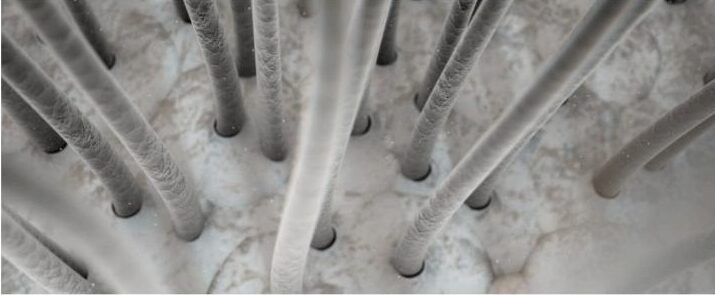
Here is the anatomical reality that separates facial hair from scalp work. Beard hair exits the skin at a very flat angle, roughly 10 to 15 degrees relative to the surface. Scalp hair exits at a much steeper angle.
The clinical consequence is unforgiving. If grafts are placed at the wrong angle, the resulting beard hair grows in the wrong direction, creating an unnatural, brushy, or visually inconsistent appearance that cannot be corrected without revision surgery.
This is precisely why DHI and the Choi pen are superior for beard work. The implanter pen sets the exact insertion angle at the moment of placement, a level of control that is mechanically difficult to replicate with the traditional two-step FUE approach of pre-made incisions and separate graft placement.
Angulation also connects to the broader artistry of beard design. Natural beard growth follows distinct directional patterns across zones (mustache, chin, cheeks, and neck), each with its own characteristic angle and direction. An experienced surgeon maps these zones individually. The 2026 standard of care combines DHI with the Choi Implanter Pen and AI-assisted facial mapping for symmetrical, age-appropriate design.
The stakes are not theoretical. Per the ISHRS, 6.9% of all hair transplants in 2024 were repair procedures, up from 5.4% in 2021, and angulation errors from less experienced providers are a documented contributor. Peer-reviewed literature in Facial Plastic Surgery Clinics of North America confirms that modern techniques produce natural-appearing results specifically because of refinements in angulation and direction control.
What to Expect: The Beard Transplant Timeline From Procedure to Full Results
For research-stage patients, one concern looms largest: what does recovery and growth actually look like, month by month?
- Procedure day: Performed under local anesthesia while the patient is awake and relaxed; duration typically 3 to 9 hours depending on graft count and zones.
- Days 4–5: Shock loss (telogen effluvium) begins in the recipient area. Transplanted hairs shed, but the follicles remain alive beneath the skin. This is expected, not a failure.
- Weeks 2–4: The donor area heals; most patients resume normal activities within a few days, with visible signs typically resolving within 10 days.
- Months 3–4: Visible regrowth begins as follicles enter the active anagen phase.
- Month 6: Roughly 50–60% of final density is visible; texture and caliber begin to normalize.
- Months 9–12: 90–100% of final results are visible.
Approximately 30% of patients elect a secondary session for additional density, with an average of about 1.5 procedures per patient. A minimum 8-month waiting period between procedures is standard. Beard hair demonstrates a 95% graft survival rate as donor hair, higher than scalp hair (89%) and chest hair (approximately 76%) at one year.
How to Evaluate a Local Beard Transplant Provider: The Quality Checklist
Understanding the technical landscape is only useful if it translates into smart local provider selection. The following criteria are actionable.
Credentials and Technique Specialization
- Verify board certification and membership in the ISHRS, the global standard-setting body with 1,200-plus members across 80 countries.
- Ask specifically whether the clinic performs DHI with the Choi Implanter Pen for beard work. A provider who defaults to standard FUE for all facial work may not be optimizing angulation.
- Inquire about the team’s experience with facial hair specifically, not just scalp restoration.
- Ask about AI-assisted facial mapping or equivalent symmetry-planning tools, a key 2026 differentiator.
- Confirm that a pre-operative candidacy assessment is included, covering autoimmune screening, donor allocation planning, and psychological readiness.
Red Flags and the Black-Market Clinic Warning
The ISHRS reported that 59.4% of its members identified black-market hair transplant clinics operating in their cities in 2024. This is a documented safety concern, not a hypothetical.
Watch for these red flags:
- Non-physician or unqualified practitioners performing procedures.
- Unusually low graft pricing without explanation.
- No pre-operative consultation or candidacy assessment.
- Inability to show before-and-after photos of beard-specific work.
- No post-operative care protocol.
International clinics may advertise aggressively, but the lack of follow-up care, variable regulatory standards, and distance from the provider if complications arise are significant concerns, especially for a procedure that hinges on precise angulation and may require revision. The 6.9% repair rate reflects the real-world cost of poor provider selection: revision surgery is more complex and yields less predictable results. Truly natural outcomes require both surgical skill and artistic judgment, not just access to equipment.
Beard Hair Transplants at Hair Transplant Specialists: Twin Cities Expertise at the 2026 Standard of Care
With that framework established, here is why Hair Transplant Specialists in Eagan, Minnesota meets it.
The credential depth is exceptional. The team includes Dr. Sharon Keene, former President of the ISHRS (2014–2015) and recipient of the Platinum Follicle Award for outstanding research, the highest level of peer recognition in the field. Dr. Roy Stoller serves as an author and examiner for board certification exams. Together, the surgical team brings more than 100 combined years of practice, supported by surgical technicians with 15 to 18-plus years of experience, described as among the most experienced in the world.
The practice’s proprietary Microprecision Follicular Grafting® technique and its commitment to naturalness speak directly to the 10–15° angulation requirement. That is not marketing language; it is a technical commitment to placing every graft at the correct direction and depth.
The facility features two state-of-the-art surgical suites designed for comfort during multi-hour procedures. The full decision framework is also supported under one roof: for patients not yet ready for surgery, non-surgical options including Alma TED, PRP, LLLT, finasteride, minoxidil, and SMP are all available.
Local trust signals reinforce the reputation. The practice has been publicly endorsed by Twin Cities television reporter Rob Olson and former NHL player and Minnesota Wild coach Darryl Sydor. Financing options are available for patients who need to plan their investment.
Location: 2121 Cliff Dr. Suite 210, Eagan, MN 55122. Office hours: Monday–Thursday 9 AM–5 PM, Friday 9 AM–3 PM, Saturday and Sunday by appointment.
Frequently Asked Questions About Beard Hair Transplants
Will the transplanted beard hair look and feel natural?
Yes. Because of donor dominance, scalp follicles keep their growth characteristics, and experienced surgeons select single-hair follicular units placed at the correct 10–15° angle to match natural beard texture and direction.
Can beard hair be used as a donor source for scalp restoration?
Yes. The submandibular region is the most commonly used body hair donor area for advanced scalp alopecia (Norwood 5–7). Beard hair shows a 95% graft survival rate as donor hair, higher than chest hair.
What disqualifies someone from a beard transplant?
Active alopecia barbae (autoimmune beard loss) is a primary disqualifier because the inflammation destroys newly transplanted follicles. Insufficient donor supply, unrealistic expectations, and active systemic health conditions may also disqualify a patient; all are assessed at consultation.
How many sessions will I need?
Most patients reach their goals in one session; about 30% elect a secondary session for additional density. A minimum 8-month waiting period between sessions is standard.
Is the procedure painful?
Procedures are performed under local anesthesia while the patient is awake and relaxed. Most patients describe it as comfortable, with mild soreness in the donor area during recovery.
What is the difference between FUE and DHI for beard work?
FUE extracts grafts and places them in pre-made recipient sites. DHI uses the Choi Implanter Pen to extract and place grafts in one step, giving superior control over the 10–15° insertion angle critical to natural beard results.
Are beard transplants covered by insurance?
No. They are elective cosmetic procedures. Financing options are available.
Conclusion: From Research to the Right Local Decision
This article delivered a three-part framework: a clear surgical vs. non-surgical candidacy assessment, an honest explanation of why FUT is rarely appropriate for beard work, and the 10–15° angulation requirement that makes DHI with the Choi pen the 2026 precision standard.
The core insight is straightforward. The technical demands of beard restoration are genuinely different from scalp work, and the chosen provider must understand those distinctions at a clinical level, not just a marketing one. With beard transplants showing roughly 28% year-over-year growth and provider quality varying widely, a research-oriented approach is essential.
Hair Transplant Specialists in Eagan brings ISHRS leadership-level credentials, more than 100 combined years of surgical experience, and a comprehensive approach covering both surgical and non-surgical pathways, making it the Twin Cities clinic equipped to have this conversation at the depth it deserves. The best outcome always begins with the right consultation: one where candidacy, donor allocation, technique selection, and long-term goals are all addressed before a single graft is placed.
Ready to Take the Next Step? Schedule Your Beard Restoration Consultation
Readers ready to move forward are invited to schedule a consultation with Hair Transplant Specialists at their Eagan, MN location. A consultation is an information-gathering appointment, not a commitment. Patients leave with a personalized candidacy assessment, a technique recommendation, and answers to their specific questions.
Contact: Phone (651) 393-5399, website INeedMoreHair.com, address 2121 Cliff Dr. Suite 210, Eagan, MN 55122.
Office hours: Monday–Thursday 9 AM–5 PM, Friday 9 AM–3 PM, Saturday and Sunday by appointment.
Not quite ready for surgery? Non-surgical options including Alma TED, PRP, LLLT, and SMP are available at Hair Transplant Specialists, making it a resource at every stage of the decision journey. With a former ISHRS President on staff and a team that has treated Grammy-winning artists, film actors, and professional athletes, patients can be confident they are consulting with practitioners who operate at the highest level of the field.