Beard Hair Transplant Donor Area: The 125-Micron Thickness Advantage & Sub-Zone Harvest Map
Introduction: Why the Donor Area Is the Foundation of Every Beard Transplant
The success of any beard hair transplant—whether adding density to a patchy beard or restoring a full beard from scratch—is determined before a single graft is placed, at the donor planning stage. Understanding the beard hair transplant donor area requires recognizing that donor hair flows in two directions: scalp-to-beard (the most common approach for beard restoration) and beard-to-scalp (increasingly important for patients with advanced hair loss who have exhausted scalp donor resources).
Two primary donor sources exist for beard procedures: the scalp and the beard itself. The biological differences between these sources directly impact surgical outcomes, healing times, and long-term appearance. At the foundation of these considerations lies the donor dominance principle—a scientific concept confirming that transplanted hair permanently retains the genetic characteristics of its origin site, regardless of where it is placed on the body.
This article provides specific metrics, anatomical maps, and clinical evidence that inform real surgical decisions. Patients seeking beard restoration or considering beard hair as a donor source for scalp procedures will gain the technical knowledge necessary to understand what distinguishes expert-level planning from surface-level approaches.
The Donor Dominance Principle: Why Transplanted Hair Keeps Its Identity
Donor dominance represents the foundational principle of hair transplantation: the genetic programming of a hair follicle is intrinsic to the follicle itself, not the recipient site. Transplanted hair will not adapt to its new location.
The practical implications are significant. Beard hair transplanted to the scalp will continue to grow with beard characteristics—its thickness, curl pattern, and growth cycle remain unchanged. Similarly, scalp hair transplanted to the beard retains scalp growth rates and characteristics. A clinical study of 35 patients confirmed that transplanted beard and body hair permanently retains its original color, curl, and caliber after transplantation.
This principle carries critical importance for patient expectations. Patients should not expect transplanted beard hair to eventually resemble scalp hair over time—it will maintain its original properties indefinitely. However, donor dominance also provides a significant advantage: beard follicles are resistant to dihydrotestosterone (DHT), meaning beard hair transplanted to the scalp will not be susceptible to male pattern baldness. This DHT resistance makes beard donor hair a valuable long-term asset for scalp restoration.
Scalp as the Primary Donor Area for Beard Restoration
The scalp’s occipital (back) and parietal (side) regions serve as the gold-standard donor source for beard transplants. According to the 2020 ISHRS Practice Survey, scalp donor hair was used in 92.5% of all hair transplant cases.
These scalp zones are preferred because the hair in these regions is DHT-resistant, genetically stable, and closely matches facial hair in terms of texture and behavior. The safe donor zone anatomy centers on the mid-occipital region, bounded by defined anatomical landmarks. A comprehensive study of 580 cases found an average follicular unit density of 78.2 FU/cm² in this zone.
Density thresholds guide surgical planning: donor areas exceeding 80 FU/cm² are considered excellent candidates, while those below 40 FU/cm² present limitations. For beard restoration specifically, surgeons selectively excise single or two-hair grafts from the scalp to match the finer, individual nature of facial hair—multi-hair grafts are avoided at the beard recipient site.
The scalp’s safe donor zone can yield approximately 6,000 follicular units total—a finite resource requiring careful planning across a patient’s lifetime. This limitation makes strategic donor management essential, particularly for patients who may need multiple procedures.
The 125-Micron Advantage: How Beard Hair Diameter Changes the Equation
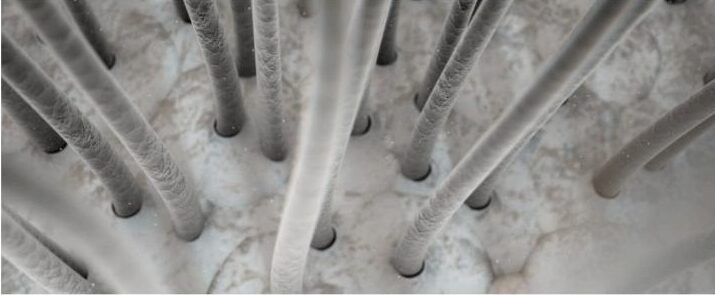
Beard hair averages 125 microns in diameter compared to 69 microns for scalp hair—making beard hair 70–100% thicker across Caucasian, Asian, and African racial groups. This substantial difference means each individual beard hair shaft covers significantly more surface area than a scalp hair, providing superior volume coverage per graft.
The structural differences extend beyond diameter. Beard hair follicles have nearly twice as many cuticle layers as scalp hair follicles, contributing to greater robustness, durability, and visual density post-transplant.
A trade-off exists: beard grafts typically contain only one hair follicle, unlike scalp grafts, which commonly have two to three hairs per follicular unit. More grafts are therefore needed per unit area—but the thickness advantage compensates for the lower hair count per graft. Racial and ethnic variation in beard hair diameter requires surgeons to account for these differences in donor planning and placement decisions.
The matching challenge is significant. Because beard hair is substantially thicker than scalp hair, it must be placed strategically—not at the hairline or temples where finer hair is needed for a natural appearance. The 125-micron thickness makes beard hair the preferred non-scalp donor source for scalp restoration when scalp donor supply is insufficient.
Growth Cycle Differences: Anagen Ratios, Growth Speed, and What They Mean for Results
Approximately 85% of scalp hairs are in the active growth (anagen) phase at any given time, while beard and body hairs spend proportionally more time in the resting (telogen) phase. This difference has practical consequences: because more beard hairs are in telogen at harvest time, the initial post-transplant shedding phase may appear more pronounced, and full results take longer to assess.
Beard hair grows at approximately 0.4 mm/day, outperforming chest hair (0.2–0.35 mm/day) and other body hair sites. This growth rate makes beard hair the superior non-scalp donor source in terms of growth speed. However, the shorter anagen phase of beard hair affects long-term hair length on the scalp—transplanted beard hair may not grow as long as native scalp hair, an important consideration for patients seeking longer hairstyles.
Pre-operative treatment with 5% minoxidil (six weeks to six months before surgery) can shift more beard follicles from telogen into anagen, increasing the number of harvestable grafts and improving yield.
The Beard Sub-Zone Harvest Map: Where Surgeons Actually Extract Grafts
Not all areas of the beard are equally suitable for donor harvesting. Surgeons use a strategic sub-zone map to maximize yield while minimizing visible impact. Most experienced surgeons can harvest 1,000–3,000 grafts from a regular beard and up to 3,000–5,000 grafts from a very dense beard across single or multiple sessions without causing visible patchiness.
Submandibular/Submental Zone: The Preferred Harvest Area
The submandibular and submental area—below the jawline and chin—serves as the preferred primary harvest zone within the beard. This zone is favored because it is the least cosmetically visible area of the beard, heals without noticeable impact on the patient’s groomed appearance, and offers good graft density.
Harvesting from under the chin minimizes the visibility of hypopigmentation—a known risk at extraction sites, particularly in darker-skinned patients. Beard donor-site punch holes in this zone typically heal within 24 hours to seven days, faster than scalp donor areas. This zone is particularly important for patients who wear shorter beards or are clean-shaven, as it allows harvesting without affecting the visible beard profile.
Cheek Zone: Secondary Harvest Area and Matching Considerations
The cheek zone serves as a secondary harvest area, typically used when submandibular supply is insufficient or when the hair characteristics of the cheek better match the recipient site. Cheek hair tends to be finer and lighter than submandibular hair, which can make it more suitable for certain recipient zones requiring finer caliber hair.
The visibility trade-off is significant: cheek harvesting is more cosmetically visible than submandibular harvesting, making it less ideal for patients who maintain a clean-shaven appearance. Variable exit angles in the cheek zone—where hair direction can change dramatically across a small area—increase the technical difficulty of extraction.
Neck Zone: Use Cases, Limitations, and Cautions
The neck zone, extending below the beard line toward the upper chest, serves as a tertiary harvest area used in cases requiring maximum graft yield. Neck hair characteristics often differ from beard hair—it may be finer, lighter, and have a shorter growth cycle—making it less ideal for scalp placement but potentially useful for specific recipient zones.
A key anatomical caution exists for neck harvesting: proximity to the marginal mandibular branch of the facial nerve carries a risk of temporary paresis if harvesting is performed without precise anatomical knowledge. The neck zone is generally reserved for experienced surgeons treating advanced alopecia cases where scalp and submandibular/cheek resources have been maximized.
Technical Challenges Unique to Beard Donor Harvesting
Beard donor harvesting is significantly more technically demanding than scalp harvesting—a fact patients should understand when evaluating surgeon qualifications. Four primary technical challenges exist:
Variable hair exit angles: Beard hair direction can change up to a dozen times per cm², requiring constant punch angle adjustment to avoid transection (cutting through the follicle).
Hypermobile facial skin: Unlike the relatively fixed scalp, facial skin moves significantly during extraction, requiring specialized techniques to stabilize the tissue.
Facial nerve anatomy: The marginal mandibular branch of the facial nerve runs through the beard harvesting zone, creating a risk of temporary nerve paresis if not respected.
Modified anesthesia requirements: Standard scalp anesthesia protocols must be adapted for the face, requiring familiarity with facial nerve block techniques.
Early beard harvesting techniques produced transection rates of 10–30%. A 2023 multicenter study using a skin-responsive FUE device across 82 patients achieved transection rates below 7% (beard approximately 4.8%, body approximately 5.6%)—a major clinical advancement. At six-month follow-up, 79.1% of patients rated their outcome as “very happy” and 20.9% as “satisfactory,” with zero “unhappy” responses.
Graft Survival Rates: Scalp vs. Beard Donor Hair
Survival rates differ because the longer telogen phase of beard hair means more grafts may be in a resting state at harvest, and the technical challenges of beard extraction can affect graft viability. Modern skin-responsive FUE devices have significantly improved these rates by reducing transection and improving graft integrity during extraction.
Survival rates are highly surgeon-dependent—experience with beard-specific extraction techniques is a critical variable in outcomes.
Strategic Placement: Where Beard and Scalp Donor Hair Should (and Should Not) Go
The 125-micron thickness of beard hair makes it ideal for coverage in certain zones but actively detrimental to natural appearance in others.
Recommended placement zones for beard donor hair on the scalp: Mid-scalp, crown (vertex), and scar repair zones—areas where density and coverage matter more than fine texture.
Zones to avoid: Beard hair should not be placed at the frontal hairline or temples. These zones require fine, single-hair grafts to create a natural, graduated appearance—thick beard hair in these areas creates an unnatural, pluggy look.
The optimal blending strategy shows that patient acceptability is highest when beard/body donor hair is mixed with scalp donor hair rather than used alone, even when there is a caliber or texture mismatch. FUT strip scar repair represents a specific use case where beard hair is well-documented for camouflaging linear scars from previous procedures.
Long-Term Donor Resource Planning: A Strategic Perspective
Because the scalp safe donor zone yields a finite maximum of approximately 6,000 follicular units, strategic planning across a patient’s lifetime is essential.
By supplementing scalp grafts with beard grafts in the mid-scalp and crown during initial procedures, surgeons can preserve more scalp donor hair for future hairline refinement or additional sessions. The 2020 ISHRS Practice Survey found that approximately 15% of procedures in men targeted non-scalp areas, with beard/moustache accounting for 5%—nearly double the 7.1% non-scalp rate recorded in 2012.
Assessment of beard and body hair resources should be a routine part of the initial evaluation of all male hair transplant candidates—not a last resort after scalp resources are exhausted. The first beard-to-scalp session should always be conservative and treated as a test to assess individual graft survival rates before committing to large-scale beard harvesting.
Special Considerations: Skin Tone, Ethnicity, and Hypopigmentation Risk
When a follicle is removed, the extraction site may heal with slightly lighter pigmentation than the surrounding skin. This hypopigmentation is particularly relevant for darker-skinned patients, where it is more visible and can create a spotted appearance in the beard area if not managed carefully.
The mitigation strategy involves harvesting from the submandibular/submental zone, placing extraction sites in the least visible area and minimizing the cosmetic impact of hypopigmentation. Racial and ethnic variation in beard hair diameter—while the 125-micron average applies broadly—affects matching decisions and requires population-specific calibration.
Conclusion: Precision Planning Is the Difference Between Good and Great Results
The beard hair transplant donor area is not a single location but a complex, anatomically mapped system of options—each with distinct biological characteristics, yield potential, and placement implications.
Three key quantitative insights distinguish expert-level planning: the 125-micron thickness advantage of beard hair, the sub-zone harvest map (submandibular preferred, cheek secondary, neck tertiary), and the donor dominance principle that makes results permanent.
Graft survival rates, transection rates, and long-term outcomes are all directly tied to surgeon expertise in beard-specific harvesting techniques—not just the technology used. Understanding these technical details helps patients ask better questions during consultations and recognize the difference between a surgeon who has a plan and one who does not.
Schedule a Consultation with Hair Transplant Specialists
Hair Transplant Specialists brings technical authority to graft matching and donor zone planning, with board-certified surgeons and a team with combined 100+ years of experience. Dr. Sharon Keene, former President of ISHRS and recipient of the Platinum Follicle Award for research excellence, brings the precise technical expertise described throughout this article.
Every male candidate receives a full assessment of scalp, beard, and body donor resources as part of the initial consultation. The practice’s proprietary Microprecision Follicular Grafting® technique ensures natural-looking results through precise graft selection and placement.
To receive a personalized donor area assessment and treatment plan, contact Hair Transplant Specialists at (651) 393-5399 or visit INeedMoreHair.com. The Eagan, MN location offers appointments Monday–Thursday 9 AM–5 PM and Friday 9 AM–3 PM, with weekend appointments available.