How Does a Hair Transplant Work? The Biology Behind Permanent Results
Introduction: The Biology Question Most Hair Transplant Content Skips
Most explanations of hair transplants describe a simple sequence: extract follicles, prepare them, implant them. Told this way, the procedure sounds like rearranging furniture, with hair moved from one room of the scalp to another. That description is accurate, but it leaves out what matters most.
People researching hair transplants usually want to know more than the steps. They want to know why transplanted hair keeps growing permanently in an area where hair was previously lost, and whether it will survive the move at all.
The answer rests on three biological pillars:
- Donor dominance, a genetic property that allows certain follicles to resist the hormone responsible for pattern baldness.
- A two-phase survival mechanism that keeps grafts alive in the first days after surgery, before they have a blood supply.
- Hair growth cycle biology, which explains why results take months rather than weeks.
Leading medical authorities such as Mayo Clinic, Cleveland Clinic, and the American Society of Plastic Surgeons accurately describe the surgical steps, but they rarely explain the underlying mechanism. This article fills that gap using independent, peer-reviewed findings rather than clinic marketing claims.
One clarification is needed first. A hair transplant is fundamentally a specialized skin and follicle graft procedure. It does not stimulate new hair growth. It relocates living tissue that is already genetically equipped to keep producing hair.
What a Hair Transplant Actually Moves (and Why That Matters)
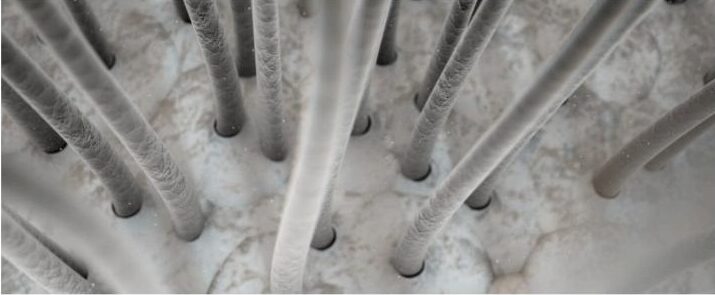
A hair transplant does not move “hair” in the casual sense. It relocates entire hair follicles along with a small amount of surrounding skin. As Cleveland Clinic describes it, a transplant is a form of skin graft that rearranges the hair a person already has. This places it in a different category from medications, lasers, or other regrowth therapies.
There are two primary ways to harvest these grafts:
- FUT (Follicular Unit Transplantation): A thin strip of scalp is removed from the donor area, usually the back of the head. Technicians then dissect it into follicular units, keeping hairs in their natural groupings of one to four.
- FUE (Follicular Unit Extraction): Individual follicular units are removed one at a time with a fine circular punch, either manually or with robotic assistance.
The extraction method matters, but none of it produces a lasting result unless the relocated follicles keep their original genetic programming after the move. That principle is called donor dominance.
Donor Dominance: The Genetic Foundation of Permanent Results
Modern hair restoration rests on an observation made by dermatologist Norman Orentreich in the 1950s. While performing early transplant procedures, Orentreich found that hair moved from the hair-bearing donor area kept the characteristics of its original location instead of taking on the traits of the balding recipient site. He called this principle donor dominance.
Patent filings that reference Orentreich’s 1959 research describe the mechanism this way: transplanted follicles keep their “programmed” terminal hair-producing features from their original location. Follicles taken from the back of the scalp continue to behave like back-of-scalp follicles even when placed at the hairline or crown. That finding is what first made permanent surgical hair restoration possible.
Researchers have since studied the reverse phenomenon, sometimes called recipient dominance, and some newer studies suggest the recipient site may have a modest influence on transplanted hair. Even so, donor dominance is still widely regarded as established fact in the medical community and remains the basis of every modern transplant technique.
The Molecular Mechanism: Why DHT Can’t Touch Donor Hair
Donor dominance has a molecular explanation, and it concerns gene expression.
Pattern hair loss, or androgenetic alopecia, is driven mainly by dihydrotestosterone (DHT), a hormone derived from testosterone. DHT acts on hair follicles by binding to androgen receptors.
In donor-zone follicles, the promoter region of the androgen receptor gene is methylated. Methylation is a chemical tag that reduces how strongly a gene is expressed. With less androgen receptor expression, these follicles have fewer docking points for DHT, so the hormone cannot set off the miniaturization process it causes elsewhere.
Genetically susceptible follicles on the top and front of the scalp behave differently. DHT binds more readily to their androgen receptors, and over successive growth cycles the follicles shrink. They produce thinner, shorter, lighter hairs until many stop producing visible hair.
The key point is that DHT resistance is a property of gene expression inside the follicle, not of its physical location. That distinction leads to an important nuance.
The Overlooked Nuance: Donor Dominance Is a Per-Graft Property, Not a Blanket Trait
A common simplification holds that “hair from the back and sides of the head is always permanent.” This is broadly true, but imprecise. Donor dominance belongs to individual follicles. It is not a guarantee attached to an entire region of the scalp.
Each graft carries its DHT-resistant programming only if the graft itself survives harvesting and implantation intact. A follicle that is transected (accidentally cut), crushed, dehydrated, or otherwise damaged during extraction or handling can fail no matter how favorable its genetics.
Stated precisely: donor dominance applies to every graft, but conditionally. It depends on that graft surviving the journey from donor site to recipient site. This is why surgical skill, graft handling, and team experience matter as much as a patient’s genetics.
The next question is what determines whether a genetically dominant graft lives or dies.
How a Graft Survives the First Days: The Two-Phase Survival Mechanism
When a graft is placed in a recipient site, it has no blood supply. It has been cut off from its original vessels and has not yet connected to new ones. It survives through a sequence of biological steps rather than immediate healing.
That sequence has two phases: plasmatic imbibition, a period of passive nourishment, followed by inosculation and revascularization, when an active blood supply is reconnected. Most content describes only the surgical steps and leaves this part out, but it is where a transplant either takes hold or fails.
Phase One: Plasmatic Imbibition
The period between grafting and revascularization is called plasmatic imbibition. As described in Medscape’s clinical literature on skin grafting, the graft passively absorbs wound exudate, the protein-rich fluid at the recipient site, through capillary action.
This process does two things:
- It prevents desiccation. Grafts that dry out die quickly.
- It provides minimal nourishment, enough to keep follicle cells alive until a true blood supply is established.
Because grafts depend on this passive process early on, the first 24 to 72 hours after the procedure are especially important. This is why surgeons give specific post-operative instructions about keeping grafts moist, avoiding pressure or friction on the recipient area, and handling the scalp gently while washing.
Phase Two: Inosculation and Revascularization
True revascularization begins about two to three days after grafting through inosculation, the formation of direct connections (anastomoses) between the graft’s small blood vessels and those of the recipient site.
Once inosculation occurs, the graft moves from passive nourishment to an active, self-sustaining blood supply. From this point, long-term survival becomes much more likely.
This two-step sequence connects surgical placement to a permanent, living graft, and it works the same way whether the graft was harvested by FUE or FUT. Technique affects how many healthy grafts reach this stage. It does not change the biology itself.
How Extraction Technique Affects Graft Survival Biology
If the survival biology is the same, extraction technique matters because of transection risk and graft integrity.
FUT removes a strip of tissue that technicians then dissect under microscopes. Because they can see each follicle’s full structure, including its angle and depth, microscope-assisted dissection can reduce transection compared with extraction methods that cannot see below the skin surface.
FUE removes each unit with a small punch. It is minimally invasive, avoids a linear scar, and has become the global preference: FUE comprises over 75% of hair transplants performed today, according to data from the International Society of Hair Restoration Surgery (ISHRS). Because the punch is guided by the visible angle of the hair at the surface, the follicle beneath can curve or splay unexpectedly. Transection risk therefore depends heavily on operator skill and tool precision.
Independent and industry-reported figures suggest these realistic survival ranges among experienced practitioners:
| Technique | Typical Reported Graft Survival |
|---|---|
| FUT | Roughly 90 to 95% (some sources cite 95 to 98% with microscope-assisted dissection) |
| FUE | Roughly 85 to 95% |
Complex cases can produce noticeably different results. A study published in PMC on treating postsurgical scalp scar deformities reported a mean FUE survival rate of 80.67%, with a range of 70 to 90%. Scar tissue has a weaker blood supply, which makes revascularization harder.
Regardless of extraction method, every graft goes through the same imbibition-to-inosculation process. Technique determines how many grafts enter that process intact. It does not alter how the biology works.
Hair Transplant Specialists in Eagan, Minnesota, offers both FUE and FUT, the latter using the practice’s proprietary Microprecision Follicular Grafting® technique. Its surgical technicians have 15 to over 18 years of experience. In both methods, careful handling directly affects how many grafts survive.
What the Independent Data Says About Long-Term Survival
Graft survival is not one fixed number. Several independent studies show how outcomes vary with tissue condition and supporting treatment:
- Survival can change over time in complex cases. A 2025 systematic review of transplants in primary cicatricial (scarring) alopecia found a weighted follicular unit graft survival rate of 82.7% at 7 to 12 months, declining to about 55% by year four. In scarring conditions, the underlying disease can continue to affect transplanted tissue.
- Tissue condition and surgical adjuncts make a measurable difference. A PMC-published study of stem cell therapy before transplantation into scarred tissue reported graft survival of 87% in the treated group versus 60% in the comparison group.
- Medication affects graft biology directly. A 2025 prospective study found 94% graft survival among patients using finasteride after transplant, compared with 90% without it. By suppressing DHT, finasteride protects native follicles and may also help newly transplanted follicles during the vulnerable early period.
This section relies on independent, peer-reviewed data on purpose. Clinic marketing often cites single, highly specific survival figures such as “95%+ survival.” Peer-reviewed findings give a more realistic picture and show that outcomes depend on the case, the tissue, and the overall treatment plan.
Why Results Take Months: Mapping the Hair Growth Cycle to the Results Timeline
Graft survival is only half the story. Visible results depend on the natural hair growth cycle, which transplanted follicles still go through. Every follicle cycles through three phases:
- Anagen: the active growth phase, lasting about 2 to 3 years.
- Catagen: a brief regressing phase of 2 to 3 weeks.
- Telogen: a resting phase of about 3 months.
The trauma of transplantation usually pushes grafted follicles into a resting state. The hair shafts often shed, but the follicles below the skin stay alive and later begin a new growth cycle.
According to Mayo Clinic, the typical timeline is:
- First month: Transplanted hair looks much the same as on the day of the procedure.
- Dormant period: Many hair shafts shed while follicles rest.
- Months 3 to 5: New growth begins.
- Months 8 to 12: Hair reaches stylable length, and the best results become visible.
This matches the timeline Hair Transplant Specialists gives patients: growth beginning around 3 to 4 months after the procedure, with full results at 9 to 12 months. The practice also requires a minimum of eight months between procedures so that surgeons can assess results accurately before placing additional grafts.
Shock Loss: The Biological Shedding Phase Most Content Leaves Out
Many patients become worried a few weeks after surgery when hair starts falling out. This is called shock loss. It is a normal part of the biological process and not a sign that the procedure failed.
It has two distinct causes:
- Anagen effluvium: early shedding, usually in weeks 2 to 4, driven by temporarily reduced blood flow (ischemia) to follicles during and after surgery.
- Telogen effluvium: later shedding that peaks around months 2 to 3, triggered by surgical stress that pushes follicles, sometimes including nearby native hairs, into the resting phase early.
Long-term outcomes are reassuring. Studies tracking 500 patients found no significant difference in final hair density at 18 months between those who experienced shock loss and those who did not. The shedding is temporary and does not affect the final result.
For anyone wondering whether hair falling out again is a bad sign, the biology answers the question: in nearly all cases, it is an expected stage on the way to new growth.
Why Candidacy Depends on Donor Hair Biology
Since the procedure relies entirely on relocating healthy, DHT-resistant follicles, candidacy depends on the patient’s donor hair biology. Good candidates generally have:
- Stable hair loss patterns, since rapidly progressing loss makes long-term planning difficult.
- Sufficient donor density to supply enough grafts without visibly thinning the donor area.
- Favorable donor characteristics, such as hair thickness, along with good general health and a clearly identified cause of hair loss.
An important point is often left out of marketing material: hereditary hair loss can keep progressing in non-transplanted areas after a successful procedure. Transplanted grafts keep their DHT resistance, but surrounding native hair may continue to thin over time. For this reason, many surgeons recommend medications such as finasteride or minoxidil, and plan hairlines and graft placement with future loss in mind.
The same biology also applies beyond male pattern baldness. Female surgical patients are now the fastest-growing segment in hair restoration, with the number treated by ISHRS members increasing 16.5% between 2021 and 2024. Donor dominance and graft survival principles also underlie treatment of scarring alopecia, beard restoration, and eyebrow restoration, all of which Hair Transplant Specialists provides.
Conclusion: Biology, Not Just Steps, Determines Permanent Results
A hair transplant is more than a surgical sequence. Three biological processes determine whether it succeeds:
- Permanence comes from donor dominance, the genetic DHT resistance created by androgen receptor gene methylation in donor follicles.
- Survival depends on the shift from plasmatic imbibition to inosculation in the first days after surgery.
- Visible results follow the natural hair growth cycle over 8 to 12 months.
Donor dominance is also conditional and specific to each graft. It is not an automatic guarantee for a region of the scalp. A follicle’s genetics matter only if that follicle survives harvesting and implantation, which is why surgical skill and careful graft handling matter as much as donor genetics.
Patients who understand the realistic timeline and expect temporary shedding tend to go through recovery with much less anxiety than those relying on compressed before-and-after timelines. This understanding is a useful basis for evaluating techniques, providers, and personal candidacy.
Ready to Understand Donor Hair Biology?
Each person’s donor density, hair loss stability, and follicle characteristics are different, and these factors determine what a transplant can realistically achieve. A personalized consultation is the most reliable way to assess candidacy using the principles described in this article.
Hair Transplant Specialists in Eagan, Minnesota, takes an educational, patient-first approach to hair restoration. The practice’s board-certified surgeons include Dr. Sharon Keene, former President of the International Society of Hair Restoration Surgery, and the team has more than 100 years of combined experience. Its focus is on natural, biologically sound results rather than one-size-fits-all promises.
Anyone who wants to discuss their hair loss pattern and candidacy can contact the team at (651) 393-5399 or visit INeedMoreHair.com. A consultation is an informational, low-pressure step toward understanding what their own biology makes possible.