Beard Transplant Density How Natural Does It Look: The 9-Zone Placement Science Behind Undetectable Results
Introduction: Why ‘Natural-Looking’ Is a Science, Not a Promise
Men researching beard transplants encounter the same assurance repeatedly: results will look “natural.” Yet surgeons rarely explain the precise mechanics behind this claim, leaving patients to trust marketing language rather than clinical evidence. This article closes that gap with specificity.
The stakes are significant. According to ISHRS data, 6.9% of all hair transplants performed in 2024 were repair procedures, an increase from 5.4% in 2021. Many of these corrections stem from preventable technical errors: poor angulation, overpacking grafts beyond safe limits, or implanting multi-hair follicular units where single-hair grafts belong. These are technique failures, not bad luck.
Naturalness in beard transplantation is determined by three interlocking variables: density calibration, single-follicle placement, and graft angulation. Each variable must be precisely executed across nine distinct facial zones. This article decodes each component with clinical specificity, zone by zone, so readers can evaluate any surgeon’s approach with informed confidence.
At Hair Transplant Specialists, the philosophy is clear: naturalness is the benchmark of surgical excellence, not an afterthought.
The Anatomy of a Natural Beard: What You’re Actually Trying to Replicate
Native beard density averages 30 to 50 follicular units per square centimeter, though this varies considerably by facial zone. This biological baseline represents the target surgeons must approximate to achieve visually convincing results.
Beard hair grows as single-follicle units, meaning one hair emerges from each follicle. This differs fundamentally from scalp hair, which can group one to four hairs per follicular unit. Understanding this distinction is foundational to achieving naturalness.
Hair direction across the face is not uniform. Upper lip hairs grow downward and slightly outward, following the natural lip contour. Chin hairs grow forward and downward, with a subtle convergence toward the midpoint. Cheek hairs fan outward from a central axis in a radial pattern. Sideburn hair follows a vertical-to-diagonal trajectory, transitioning between scalp and beard growth patterns.
Skin thickness also varies by zone. The upper lip features thinner skin, requiring precise incision depth to avoid complications. The cheeks present thicker skin with more robust blood supply, allowing for different technical approaches.
Replicating a natural beard is as much an artistic exercise as a surgical one. The surgeon must internalize these directional and density nuances before making a single incision.
The 9-Zone Placement Framework: Why One-Size-Fits-All Fails
Experienced surgeons divide the beard into up to nine distinct anatomical zones, each requiring unique density targets, hair direction specifications, and graft sizing decisions. Treating the beard as a single uniform area is the primary reason results appear artificial or patchy.
The nine-zone framework guides every clinical decision from consultation through implantation. Hair Transplant Specialists’ approach to facial hair restoration is grounded in this zone-specific architecture, reflecting the practice’s commitment to precision over volume.
Zone-by-Zone Breakdown: Density, Direction, and Design Decisions
Zone 1: Moustache (Upper Lip)
The moustache zone requires approximately 35 to 40 follicular units per square centimeter. A moustache alone typically requires 300 to 400 grafts per side.
Hair direction must follow a downward and slightly outward trajectory, conforming to the natural lip contour. The skin here is thin, meaning incision depth must be precisely calibrated to avoid cobblestoning, one of the two most common naturalness-compromising complications.
Single-hair grafts are non-negotiable at the border of the upper lip. This creates a soft, feathered edge rather than a hard line that signals artificial placement.
Zone 2: Philtrum Columns
The vertical columns between the nose and upper lip require very sparse, directionally precise placement. Hairs must align with the subtle downward flow of the philtrum; any deviation reads immediately as artificial.
Low graft density is intentional in this zone. The philtrum columns serve a framing function rather than a filling function.
Zone 3: Chin (Goatee Body)
The chin typically represents the highest-density zone, where maximum visual impact is desired. Hair direction follows a forward and downward trajectory, with slight convergence toward the chin’s midpoint.
Density can approach the upper range of 30 to 35 follicular units per square centimeter because the skin is thicker and blood supply more robust. Multi-hair grafts harvested from the scalp are separated into singles and implanted in the body of the goatee, while border grafts remain single-hair for proper feathering.
Zone 4: Chin Border and Soul Patch
The soul patch, located below the lower lip, requires careful directional alignment. Hairs grow downward and slightly forward in this area.
The chin border is where feathering technique becomes critical. Lower density with single-hair grafts creates a gradual fade rather than a sharp edge. Abrupt density transitions at borders are among the clearest visual signals of an inexperienced transplant.
Zone 5: Cheek Beard Border
The cheek border zone uses lower density with single-hair grafts exclusively to produce a soft, natural fade effect. This feathering approach mimics how natural beard growth tapers at the edges rather than stopping abruptly.
The border line itself is co-designed with the patient during consultation, a critical step where patient input directly shapes the final result.
Zone 6: Cheek Beard Body
The body of the cheek receives maximum density within the safe range of 25 to 35 follicular units per square centimeter, creating the visual fullness patients seek.
Hair direction fans outward from a central axis. Replicating this radial pattern requires the surgeon to adjust angle and direction with every single graft. Darker, thicker occipital scalp hair is preferred as donor material because it provides better coverage and more closely matches beard coarseness.
Zone 7: Jawline
The jawline is reconstructed with a conservative, minimal-graft approach. This deliberate prioritization strategy recognizes that cheek beard grafts, when placed correctly, provide overlapping coverage to the jawline.
This conservative approach preserves donor supply and reduces ischemia risk while still achieving visual fullness. Hair direction along the jaw follows a downward-to-forward trajectory that must match the cheek beard’s directional flow for seamless blending.
Zone 8: Sideburns
Sideburn hair follows a vertical-to-diagonal pattern, transitioning from scalp hair above to beard hair below. The transition zone between scalp and sideburn requires particularly careful density graduation to avoid a visible seam.
Single-hair grafts at the sideburn border blend the transplanted area into surrounding natural hair.
Zone 9: Neck Beard
The neck beard zone is often optional and patient-specific. When included, density is kept lower than the cheek body, and hair direction follows a downward-to-forward pattern.
The neck border must be precisely defined during consultation to avoid an unnaturally low or high hairline.
The Density Equation: Why 25 to 35 FU/cm² Achieves What 60 FU/cm² Cannot
The “illusion of density” principle explains why achieving 35 to 50 grafts per square centimeter, roughly 50% of natural scalp density, creates the visual appearance of fullness in everyday social situations.
This works because transplanted hair combines with any existing native growth, and light reflection from properly angled hairs amplifies the perception of volume. Clinical research establishes that planned recipient density set at 35 to 45 follicular units per square centimeter produces natural results.
The maximum safe density ranges from 50 to 60 grafts per square centimeter in a single session. Exceeding this threshold risks scalp ischemia, poor graft survival, and patchy growth due to competition for blood supply.
Overpacking represents a specific risk. Patients who demand maximum density may pressure surgeons to exceed safe limits, leading to tissue necrosis and the very patchiness they sought to avoid.
A surgeon who places 30 follicular units per square centimeter with perfect angulation and zone-appropriate direction will produce a more natural result than one who packs 55 follicular units per square centimeter with poor technique. Graft count measures quantity; placement architecture measures quality.
The Single-Follicle Rule: Why One Hair Per Graft Is Non-Negotiable
Beard hair grows naturally as single-follicle units. When scalp hair is harvested as donor material, multi-hair follicular units must be carefully dissected into individual single-hair grafts before implantation.
When this step is skipped or performed poorly, multiple hairs emerging from a single implantation point create a “pluggy” or “clumpy” appearance. This hallmark of outdated or inexperienced technique is immediately visible to observers.
This dissection step is labor-intensive and requires experienced surgical technicians. The technicians at Hair Transplant Specialists bring over 18 years of experience to this precise work.
Single-follicle grafting is especially critical at zone borders, where even one multi-hair graft can disrupt the feathering effect. The single-follicle rule is not a preference; it is the biological standard the transplant must replicate.
Graft Angulation: The Single Variable That Separates Natural from Artificial
Graft angulation is the most critical naturalness factor in beard transplantation, more impactful than graft count, density, or even donor hair quality.
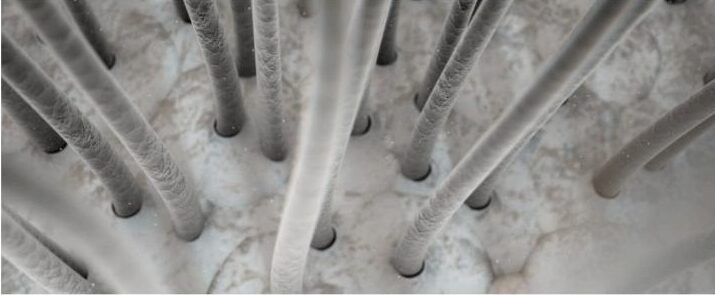
Facial hair follicles grow at 30 to 45 degree angles relative to the skin surface, unlike scalp hair, which grows closer to perpendicular at 70 to 90 degrees. Incorrect angulation causes hair to project outward from the skin rather than lying flat, creating an immediately visible artificial appearance often described as the “doll hair” effect.
Angulation must be adjusted for every single graft across all nine zones because the correct angle shifts as the surgeon moves from zone to zone. Ultra-acute angles require small-diameter incisions of 0.6 to 0.8 millimeters; larger incisions prevent the graft from sitting at the correct angle and increase cobblestoning risk.
Cobblestoning and improper graft direction are the two most common naturalness-compromising complications, both preventable with correct angulation and experienced technique. The surgeon must visualize the final hair-lying direction in three dimensions for every graft across hundreds or thousands of implantation sites.
Donor Hair Selection: How the Right Source Material Amplifies Naturalness
Donor hair characteristics significantly affect the final result. The occipital scalp (back of the head) is the preferred donor site because it provides darker, thicker hair that more closely matches beard texture and provides better coverage.
The sub-chin or existing beard hair can serve as an alternative when scalp hair texture is too fine or when beard-to-beard texture matching is a priority.
Hair color-to-skin contrast affects perceived density. Higher contrast (dark hair on light skin) increases perceived density, meaning fewer grafts may be needed. Lower contrast requires more strategic placement to achieve the same visual effect.
Transplanted scalp hairs initially grow straighter and finer than native beard hair but often adapt partially over 12 to 24 months as follicles respond to the facial skin environment. This adaptation period means early results at months three through six may not reflect the final outcome.
FUE micro-punches of 0.6 to 0.9 millimeters used for extraction leave virtually no visible scarring at the donor site.
The Timeline of Natural: What to Expect Month by Month
Months 1 to 2: Shock Shedding and the Waiting Phase
Transplanted hairs enter a shock shedding phase, with most grafts falling out within the first two to four weeks. This is normal and expected. The follicles themselves remain intact beneath the skin; shedding is not graft loss.
Visible signs of the procedure, including redness and small scabs, typically resolve within 10 days. Most patients resume normal activities within a few days post-procedure.
Months 3 to 6: Early Growth and Initial Texture
New growth begins around months three to four, initially appearing fine and straight. This is not representative of the final result.
Transplanted scalp hairs grow straighter than native beard hair during this phase, though this is temporary. Density appears lower than the final outcome because not all grafts have entered the active growth phase simultaneously.
Months 7 to 12: Maturation and the Final Result
Full, mature results are typically visible at 9 to 12 months post-procedure. Hair texture begins adapting to the facial skin environment, with hairs gradually becoming coarser and more beard-like.
At this stage, the zone-by-zone placement architecture, angulation, and single-follicle precision become fully visible in the final result. A minimum eight-month waiting period is recommended before any additional procedures to allow accurate assessment of placement.
Technology in 2026: How AI and AR Are Elevating Precision
3D result simulations enable patients to visualize projected outcomes based on their specific facial structure, hair characteristics, and chosen beard design. This reduces misaligned expectations significantly.
AR-guided implantation assists surgeons in maintaining precise angulation and density targets across all nine zones during the procedure itself. DHI pen implanter upgrades allow simultaneous incision and graft placement, reducing the time grafts spend outside the body and improving survival rates.
These tools do not replace surgical artistry; they amplify it by giving experienced surgeons more precise data to execute their vision. Hair Transplant Specialists’ commitment to leading-edge technique reflects this integration of technology and artistry.
What Separates a Natural Result from a Repair Case
The most common causes of unnatural results requiring repair include incorrect graft angulation, multi-hair grafts not separated into singles, overpacking beyond safe density limits, and poor zone-border feathering.
Cobblestoning presents as raised bumps at implantation sites caused by incisions that are too large or grafts placed at incorrect angles. This visible, permanent sign of poor technique is entirely preventable.
Hair Transplant Specialists provides extensive patient education on overseas surgery risks, including red flags such as unqualified practitioners, overharvesting, unsanitary conditions, and lack of post-operative care.
The consultation serves as the first naturalness safeguard. A surgeon who co-designs the beard shape with the patient, explains zone-specific decisions, and sets realistic timeline expectations demonstrates the artistic and ethical standards that prevent repair cases.
Choosing the Right Surgeon: Questions That Reveal Placement Architecture Expertise
Informed questions during consultation reveal whether a surgeon understands placement architecture or simply counts grafts.
Patients should ask how the surgeon adjusts graft angulation across different facial zones. A knowledgeable response should describe zone-specific angle ranges of 30 to 45 degrees and directional variation.
Patients should ask whether multi-hair follicular units are separated into single-hair grafts for beard implantation. The answer should always be yes.
Patients should ask about density targets per square centimeter and maximum safe limits. Answers in the 25 to 35 follicular unit range, with awareness of the 50 to 60 follicular unit ceiling, indicate appropriate expertise.
Patients should ask how transitions at zone borders are created. The answer should describe feathering with single-hair grafts at lower density.
Patients should ask to see before-and-after photos at 12 or more months post-procedure. Full results take 9 to 12 months; earlier photos do not represent the final outcome.
Hair Transplant Specialists’ board-certified surgeons bring over 100 combined years of experience, with surgical technicians contributing over 18 years of precision graft work. Dr. Sharon Keene’s former ISHRS presidency and Platinum Follicle Award indicate the research-level expertise that informs the practice’s approach.
Conclusion: Naturalness Is Architecture, Not Accident
A natural-looking beard transplant is the product of three precisely executed variables: calibrated density of 25 to 35 follicular units per square centimeter, single-follicle placement, and zone-specific graft angulation at 30 to 45 degrees. These variables must be applied across nine distinct anatomical zones.
Visual fullness does not require maximum graft counts. It requires strategic placement architecture that works with light, hair direction, and zone-specific biology.
No other single variable has a greater impact on whether a beard transplant looks natural or artificial than graft angulation.
Full results emerge at 9 to 12 months, with texture adaptation continuing through 24 months. Patience is part of the investment.
ISHRS data shows 90% of patients seek hair transplants to “feel more attractive,” and over 62% of beard transplant patients report improved appearance and confidence. These outcomes only follow when the science and artistry are executed correctly.
Hair Transplant Specialists treats naturalness not as a marketing promise but as a clinical standard built into every zone, every angle, and every graft.
Ready to See What a Precision Beard Transplant Can Do?
Schedule a consultation with Hair Transplant Specialists at INeedMoreHair.com or by calling (651) 393-5399. The consultation is where the zone-by-zone design process begins, with patients co-creating their beard design alongside a board-certified surgeon who explains every placement decision.
The Eagan, Minnesota location at 2121 Cliff Dr. Suite 210 offers appointments Monday through Friday, with weekend appointments available by arrangement.
Experience you can trust, prices you can afford, with financing available from as little as $150 per month.
The first step toward an undetectable result is a conversation with surgeons who understand that naturalness is a science, not a promise.